

Lebanese militant released after 40 years in French jail

1 / 3
A convoy, believed to be carrying Lebanese leftist militant Georges Ibrahim Abdallah, leaves Lannemezan prison for his extradition to Beirut, near Tarbes, southwestern France on July 25, 2025. (AFP)
2 / 3
Georges Ibrahim Abdallah, a Pro-Palestinian Lebanese militant, is welcomed by well-wishers upon his arrival outside the Beirut International Airport on July 25, 2025, after serving more than 40 years in jail in France for the killings of two diplomats. (AFP)
3 / 3
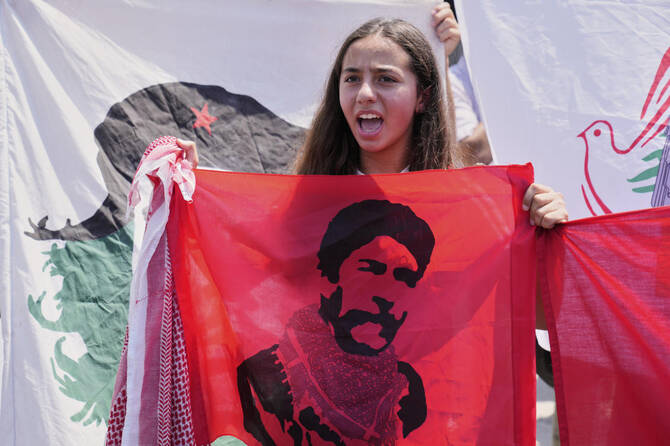
A supporter of Lebanese pro-Palestinian militant George Abdallah, pictured on the flag, shouts slogans as she waits for his arrival at Rafic Hariri International Airport in Beirut, July 25, 2025. (AP)
Short Url
Updated 25 July 2025
Follow

Lebanese militant released after 40 years in French jail

  • Dozens of supporters, some waving Palestinian or Lebanese Communist Party flags gathered near the arrivals hall to give him a hero’s reception
  • Abdallah’s family had said previously they would take him to their hometown of Kobayat

LANNEMEZAN, France: One of France’s longest-held inmates, the pro-Palestinian Lebanese militant Georges Ibrahim Abdallah, 74, was released from prison and deported on Friday, after more than 40 years behind bars for the killings of two diplomats.

At around 3:40 am (01:40 GMT), a convoy of six vehicles left the Lannemezan penitentiary with lights flashing, AFP journalists saw.

Hours later, he was placed on a plane bound for Lebanon.

As he disembarked in Beirut, he was welcomed by family members at the airport’s VIP lounge.

Dozens of supporters, some waving Palestinian or Lebanese Communist Party flags gathered near the arrivals hall to give him a hero’s reception, an AFP correspondent said.

Abdallah’s family had said previously they would take him to their hometown of Kobayat, in northern Lebanon, where a reception is planned.

Abdallah was detained in 1984 and sentenced to life in prison in 1987 for his involvement in the murders of US military attache Charles Robert Ray and Israeli diplomat Yacov Barsimantov in Paris.

The Paris Court of Appeal had ordered his release “effective July 25” on the condition that he leave French territory and never return.

While he had been eligible for release since 1999, his previous requests were denied with the United States — a civil party to the case — consistently opposing him leaving prison.

Inmates serving life sentences in France are typically freed after fewer than 30 years.

Abdallah’s lawyer, Jean-Louis Chalanset, visited for a final time on Thursday.

“He seemed very happy about his upcoming release, even though he knows he is returning to the Middle East in an extremely tough context for Lebanese and Palestinian populations,” Chalanset told AFP.

AFP visited Abdallah last week after the court’s release decision, accompanying a lawmaker to the detention center.

The founder of the Lebanese Revolutionary Armed Factions (FARL) — a long-disbanded Marxist anti-Israel group — said for more than four decades he had continued to be a “militant with a struggle.”

After his arrest in 1984, French police discovered submachine guns and transceiver stations in one of his Paris apartments.

The appeals court in February noted that the FARL “had not committed a violent action since 1984” and that Abdallah “today represented a past symbol of the Palestinian struggle.”

The appeals judges also found the length of his detention “disproportionate” to the crimes and given his age.



Israel spied on US forces at Gaza aid base: Sources

Updated 11 sec ago
Follow

Israel spied on US forces at Gaza aid base: Sources

  • US commander summoned Israeli counterpart to say: ‘Recording has to stop here’
  • Staff, visitors from other partner countries have also raised concerns about Israeli surveillance

LONDON: Israel conducted widespread surveillance of US forces involved in an aid mechanism for Gaza, The Guardian reported.

The Civil-Military Coordination Center in southern Israel was launched in October as a joint body to monitor the ceasefire and oversee the entry of aid into the war-torn Palestinian enclave.

But sources with knowledge of internal disputes told The Guardian that open and covert recordings of meetings at the CMCC had prompted disputes between the two partners.

Lt. Gen. Patrick Frank, the US commander of the center, summoned his Israeli counterpart to explain that “recording has to stop here.”

Other countries, including the UK and UAE, are also involved in the CMCC. Staff and visitors from partner countries have likewise raised concerns about Israeli surveillance activities at the center.

When the CMCC began operations, media in the US and Israel reported that the latter was handing over authority to American forces.

Yet Israel still retains effective control over what enters the territory despite Washington’s considerable leverage, according to one US official.

US forces who arrived at the CMCC, including logistics experts, were keen to increase the flow of aid into Gaza.

But they soon discovered that Israel had implemented a wide range of controls on purported “dual-use” goods, creating a larger impediment than any engineering challenge relating to aid delivery. These included basic goods such as tent poles and chemicals used for water purification.

Dutch Foreign Minister David van Weel has said he was briefed at the center on “one of the dual-use barriers that was being lifted as a result of the conversations (there).”

It came in response to growing awareness that Israeli restrictions on deliveries stood as the biggest barrier to the entry of aid into Gaza.

Israeli authorities had also restricted basic items such as pencils and paper — required by Palestinian students for school — without explanation.

There is widespread hesitancy among aid organizations and diplomats over joining the CMCC’s efforts, despite being invited to do so.

The center lacks any Palestinian representation, and even US efforts to schedule video calls with Palestinian officials were vetoed by Israeli staff there.