Israel will let foreign countries drop aid into Gaza, as UN says third of Gazans ‘not eating for days’

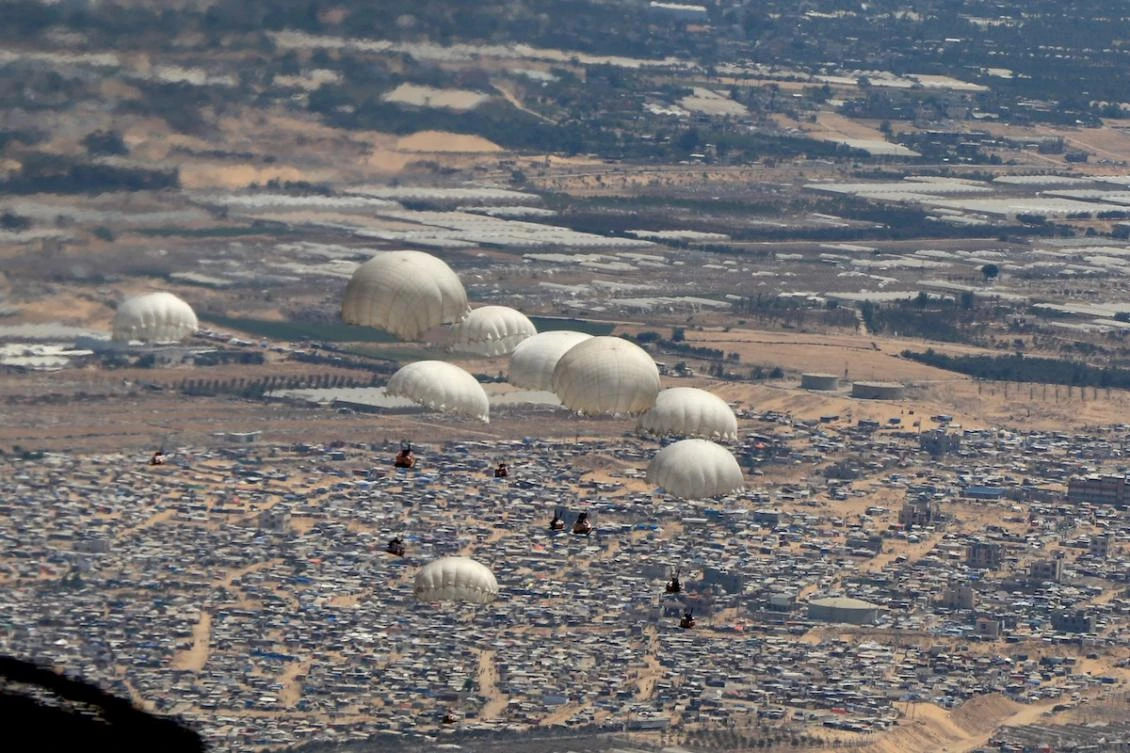
Israeli army radio citing a military official reported that Israel would allow foreign countries to parachute aid into Gaza starting on Friday. (FILE/AFP)
Short Url
Updated 25 July 2025
Follow

Israel will let foreign countries drop aid into Gaza, as UN says third of Gazans ‘not eating for days’

  • The Gaza health ministry says more than 100 people have died from starvation
  • In the first two weeks of July, UNICEF treated 5,000 children facing acute malnutrition

DUBAI: Israel will allow foreign countries to parachute aid into Gaza starting on Friday, Israeli army radio quoted a military official as saying.

An Israeli military spokesperson did not immediately reply to a Reuters request for comment on the report.

The Gaza health ministry says more than 100 people have died from starvation in the Palestinian enclave since Israel cut off supplies to the territory in March.

Israel, which has been at war with the Palestinian militant group Hamas in Gaza since October 2023, lifted that blockade in May but has restrictions in place that it says are needed to prevent aid from being diverted to militant groups.

In the first two weeks of July, the UN children’s agency UNICEF treated 5,000 children facing acute malnutrition in Gaza.

World Health Organization chief Tedros Adhanom Ghebreyesus said on Wednesday Gaza was suffering man-made mass starvation caused by a blockade on aid into the enclave.

Almost a third of people in Gaza are “not eating for days,” the United Nations food aid agency told AFP on Friday, saying the crisis has reached “new and astonishing levels of desperation.”

The Rome-based World Food Programme had previously warned of a “critical risk of famine” in war-raged Gaza, over which international condemnation of Israel’s actions has been growing.

“Nearly one person in three is not eating for days. Malnutrition is surging with 90,000 women and children in urgent need of treatment,” a WFP statement said.

It said that 470,000 people are expected to face “catastrophic hunger” — the most critical category under the UN’s Integrated Food Security Phase classification — between May and September this year.

“Food aid is the only way for people to access any food as food prices are through the roof,” the WFP said.

“People are dying from lack of humanitarian assistance.”

Aid groups have warned of surging numbers of malnourished children in Gaza, which Israel placed under an aid blockade in March amid its war with Hamas.

Israeli attacks on Lebanon kill four, including security officer and child

Updated 54 min 22 sec ago
Follow

Israeli attacks on Lebanon kill four, including security officer and child

  • Lebanon’s health ministry says Israeli strike on village of Yanuh in the south killed three people
  • Israeli gunfire also killed one person in the border village of Aita Al-Shaab

BEIRUT: Israeli attacks on Lebanon killed four people on Monday including a Lebanese security forces member and his child, hours after the Israeli army seized a member of Islamist group Jamaa Islamiya.
Israel frequently strikes Lebanon despite a November 2024 ceasefire aimed at ending more than a year of hostilities with militant group Hezbollah.
On Monday, Lebanon’s health ministry said an Israeli strike on the village of Yanuh in the south killed three people.
The Israeli military said the strike targeted Ahmad Ali Salameh, who it alleged was Hezbollah’s head of artillery and had been working to restore the group’s capabilities.
In addition to Salameh, the strike killed a member of Lebanon’s security forces and his three-year-old child, who were passing by, according to Lebanon’s state-run National News Agency (NNA).
The Israeli military said the incident was “under review” after it was made “aware of the claim that uninvolved civilians were killed.”
Later on Monday, the health ministry reported that Israeli gunfire killed one person in the border village of Aita Al-Shaab, with the Israeli military saying it killed a Hezbollah member.
It alleged he was “gathering intelligence on (Israeli) troops and operated to rehabilitate Hezbollah’s terrorist infrastructure in southern Lebanon.”
In addition to recurring attacks, the Israeli army still has troops deployed on five border positions in Lebanon it deems strategic.
Monday’s incidents come hours after the Jamaa Islamiya group, an ally of Palestinian militants Hamas, accused Israel of seizing one of its officials, Atwi Atwi, from his home in the Hasbaya district, south Lebanon, and taking him to an unknown location.
The group, which has claimed responsibility for multiple attacks against Israel during the war with Hezbollah, condemned “the Israeli occupation forces’ infiltration.”
The Israeli military said that it “apprehended a senior terrorist” in the group who was then “transferred for further questioning in Israeli territory.”
Atwi’s capture came hours after Lebanese Prime Minister Nawaf Salam completed a two-day visit to the south, which suffered extensive damage during the conflict with Hezbollah, with thousands displaced.
Salam in a statement condemned Atwi’s “abduction,” calling it a “blatant attack on Lebanese sovereignty, a violation of the ceasefire agreement and “a breach of international law.”
Hezbollah meanwhile called on the state to “take deterrent measures and firm and clear positions, and to act immediately at all political, diplomatic and legal levels, and to work seriously to protect citizens.”
Lebanon accuses Israel of having abducted several other citizens since the start of the hostilities.
Hezbollah lawmaker Hussein Al-Hajj Hassan said last month that Israel was holding “20 Lebanese prisoners,” alleging 10 had been abducted “inside Lebanese territory after the ceasefire.”
Lebanon says Israel must release these detainees and withdraw from the border positions it retains, in addition to halting air strikes on Lebanon.