

Court frees men accused in 2006 train bombings India blamed on Pakistan-based group

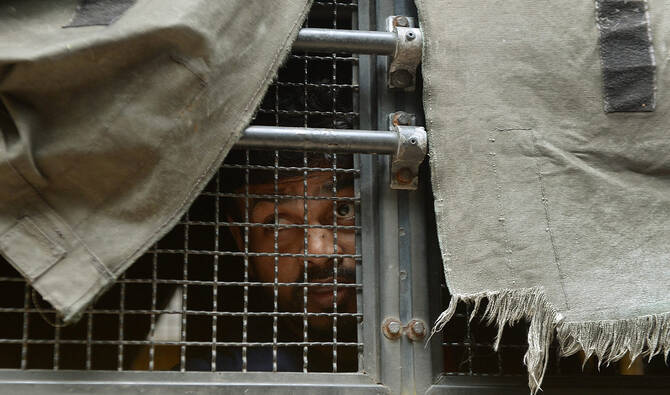
An Indian prisoner, convicted of involvement in the 2006 Mumbai train blasts, looks out from a police van on his way to a special court in Mumbai on September 16, 2015. (AFP/File)
Short Url
Updated 25 July 2025
Follow

Court frees men accused in 2006 train bombings India blamed on Pakistan-based group

  • Pakistan has always denied state complicity in evening rush-hour attacks that killed 187 people and wounded hundreds 
  • Ansari, now 48, was one of 12 men convicted in 2015 for murder, conspiracy, waging war against India 

MUMBAI: Nearly two decades lost, a family fractured and a city still without closure — the scars of the 2006 Mumbai train bombings remain, even as the men once blamed for the deadly attacks walk free.

After 19 years behind bars, Mohammad Sajid Margub Ansari can finally hold his daughter in his arms.

Ansari, now 48, was one of 12 men convicted in 2015 for murder, conspiracy and waging war against India over the 2006 train blasts.

The evening rush-hour attacks, carried out with pressure-cooker bombs hidden in bags beneath newspapers and umbrellas, killed 187 people and wounded hundreds more.

Five of the accused were sentenced to death, while the other seven — including Ansari — were given life imprisonment.

At the time of the blasts, Ansari was just 29, running a modest mobile and computer repair shop.

He was arrested soon after the explosions, reportedly accused of assembling the bombs and sheltering two Pakistani nationals.

But this week, a two-judge bench of the Bombay High Court overturned the convictions, ruling that the prosecution had “utterly failed” to prove the men were responsible.

The prosecution appealed to the Supreme Court to halt their release, but it declined to intervene.

“It feels amazing to be free,” Ansari told AFP. “We are innocent.”

Freedom, however, feels bittersweet for Ansari.

“My whole youth is gone. My family had to face financial troubles,” he said.

His wife was pregnant when Ansari was arrested, leaving him to miss his daughter’s entire childhood. In her early years, she wouldn’t even come near him.

“As a dad that felt terrible, that I could not hold my own daughter,” he said.

“I used to feel very helpless and think why do we have to go through all this when I am innocent.”

The 2006 attacks were initially blamed on the Pakistan-based militant group Lashkar-e-Taiba, although a little-known outfit, Lashkar-e-Qahhar, later claimed responsibility.

Pakistan denied the allegations.

For survivor Chirag Chauhan, who was paralyzed from the waist down in one of the blasts, the acquittal of the men felt like being dragged “back to square one.”

“We don’t know what to do and where to start from. The entire system is hopeless,” he told AFP.

In 2006, Chauhan, now 40, was returning home from chartered accountancy training when the train he boarded was hit by an explosion.

Prosecutors said the explosives were deliberately placed in first-class coaches to target the city’s wealthy Gujarati community.

They also said the bombings were intended as revenge for riots in the western state of Gujarat in 2002, which left around 2,000 people dead, most of them Muslims.

A spinal cord injury left Chauhan requiring the use of a wheelchair.

“After 19 years if the accused are let free, who carried out the blasts then?” he asked.

But he also said there should be a “fair investigation,” noting that the now freed men could have been framed.

“All are equally to be blamed, the judiciary, the investigative agencies, everyone,” he said.

For Ansari, his years behind bars demand more than an acquittal.

“The agencies should be ashamed of what they did and should definitely apologize to us,” he said.

While his old mobile and computer repair shop is no longer an employment option, given the advances in technology since he was imprisoned, Ansari is aiming to rebuild his life.

He plans to finish the undergraduate law degree which he enrolled in while in prison.

“I hope to put it to good use,” he said.


Old Delhi iftars revive Mughal heritage, one course at a time

Updated 4 sec ago
Follow

Old Delhi iftars revive Mughal heritage, one course at a time

  • Dastarkhwan-e-Jahaanuma iftars have been held in Old Delhi since 2017
  • Muslim and non-Muslim participants arrive from across India and abroad

NEW DELHI: On a rooftop in Delhi’s historic walled city, guests from across India sit on cushions around a low table overlooking Jama Masjid, waiting for its sunset call to prayer — the signal to start a special iftar that will take them back four centuries, to the Mughal era, if only for a while.

Mughals ruled the Indian subcontinent between the 16th and 19th centuries. Originally from Central Asia, they carried traditions borrowed from Arabs, Persians and Ottomans, which they merged with the various local Indian styles — a fusion that marked the global revival of Islamic architecture and culture.

Jama Masjid is one of the most iconic examples of the Mughal style — a scenic background to the curated iftars that bring 40 to 50 people from across India to share a meal, knowledge and experience.

“People getting together from different walks of life, different parts of the country, different religions, different cultures coming together — it was absolutely and completely amazing,” said Arvind Sirohi, who took part in the event with his wife.

“Lovely storytelling, amazing food, and end of the day, right next to Jama Masjid in Old Delhi. The ambience, the environment, the atmosphere came together so beautifully.”

The community-led iftar experience is called Dastarkhwan-e-Jahaanuma — from Urdu words meaning a “spread of food” and “showing the world.”

For Veena Sirohi, it did exactly what the name promised by bringing together people from different communities, different parts of India, and abroad.

“I think that’s a great way of synthesizing different cultures, bringing people together, bringing the human aspect of what we all are ... we are actually all one,” she told Arab News.

“And we had some wonderful comperes who told us about … the history of Ramadan, what goes behind it, how the food is curated, and how each and every item has a specific place in the menu.”

Served in gilded bowls and plates from traditional Indian crockery, with rose petals dotting the dastarkhwan cloth, the dishes were some of the festive Ramadan delicacies, offering a taste of Mughal culinary heritage.

Among them was mutanjan, or fragrant rice cooked with ghee, sugar, saffron, cardamom, and studded with nuts, which for many Indian Muslims is traditionally the first dish to break the fast.

It was followed by shabde, a rich, slow-cooked aromatic meat stew or the Delhi biryani — a fragrant, mildly spiced saffron rice and meat dish, where marinated chicken or mutton is layered with basmati rice and cooked slowly.

The hearty feast closed with nihari, a hearty stew simmered overnight with spices and bone marrow, which emerged in the 18th century and was originally eaten by Mughal royals for breakfast.

“These are the traditional dishes which are not usually available in the market, but are specially prepared by the bawarchees (cooks) of Old Delhi. Some of the dishes are occasional dishes,” said Abu Sufiyan Khan, the founder of Tales of City, the cultural experience company that has been curating Dastarkhwan-e-Jahaanuma since 2017.

The special iftars are hosted once a week throughout the fasting month, usually on weekends. There are variations in dishes served as they come from different kitchens, as Tales of City collaborates with various local artisans and cooks.

“We are curating this with different experts and every time the menu changes,” Khan said.

“We bring all these dishes onto a single dastarkhwan, and we share this meal with the people coming from all over India to break bread together in the holy month of Ramadan, know each other, learn about each other’s culture, and create a dialogue space where we can have more meaningful conversations and an opportunity to get to know each other.”

Those who take part, like Ayandrali Dutta, a food critic, appreciate everything about the experience, especially as it takes place in Old Delhi, where the vibe is always “jovial, lively, in all positive ways” during Ramadan.

“You get to meet interesting people, you get to hear interesting stories ... It’s a great initiative to show what Ramadan is, what kind of food is eaten, talk about the cultures between Lucknow and Delhi and other parts of the country. And it just brings a lot of happiness,” she said.

“I loved it. My heart is happy, my belly is full. Nothing else I can ask for.”