

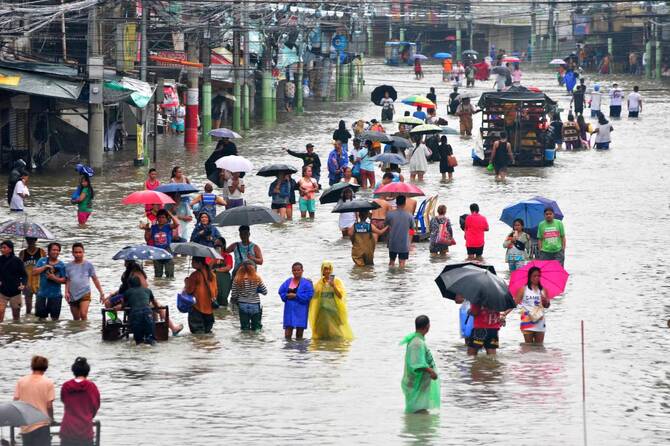
Tropical storm adds to Philippines’ weather toll with 25 dead and 278,000 evacuated this week

The Philippines, which lies between the Pacific Ocean and the South China Seas, is battered by about 20 typhoons and storms each year. (AFP)
Short Url
Updated 25 July 2025
Follow

Tropical storm adds to Philippines’ weather toll with 25 dead and 278,000 evacuated this week

  • Tropical storm Co-may, locally called Emong, made landfall Thursday night with maximum sustained winds of 120kph hour and gusts of up to 165kph
  • At least 77 towns and cities, mostly in Luzon, have declared a state of calamity, a designation that speeds emergency funds and freezes the prices of commodities

MANILA: A tropical storm was blowing across the Philippines’ mountainous north Friday, worsening more than a week of bad weather that has caused at least 25 deaths and prompted evacuations in villages affected by flooding and landslides.

The storm was Typhoon Co-may when it made landfall Thursday night in the town of Agno in Pangasinan province with maximum sustained winds of 120 kilometers (74 miles) per hour and gusts of up to 165 kph (102 mph). It was weakening as it advanced northeastward and had sustained winds of 100 kph (62 mph) Friday morning.

Co-may was intensifying seasonal monsoon rains that had swamped a large swath of the country for more than a week.

Disaster-response officials have received reports of at least 25 deaths since last weekend, mostly due to flash floods, toppled trees, landslides and electrocution. Eight other people were reported missing.

There were no immediate reports of deaths or injuries directly caused by Co-may, locally called Emong, the fifth weather disturbance to hit the Philippines since the rainy season started in last month. More than a dozen more tropical storms were expected to batter the Southeast Asian country the rest of the year, forecasters said.

The government shut down schools in metropolitan Manila for the third day Friday and suspended classes in 35 provinces in the main northern region of Luzon. At least 77 towns and cities, mostly in Luzon, have declared a state of calamity, a designation that speeds emergency funds and freezes the prices of commodities, including rice.

The days of stormy weather have forced 278,000 people to leave their homes for safety in emergency shelters or relatives’ homes. Nearly 3,000 houses have been damaged, the government’s disaster response agency said.

Travel by sea and air has been restricted in northern provinces being pounded or in the typhoon’s path.

Thousands of army forces, police, coast guard personnel, firefighters and civilian volunteers have been deployed to help rescue people in villages swamped in floodwaters or isolated due to roads blocked by landslides, fallen trees and boulders.

After returning from his White House meeting with US President Donald Trump, President Ferdinand Marcos Jr. visited emergency shelters Thursday in Rizal province to help distribute food packs to displaced residents. He later convened an emergency meeting with disaster-response officials, where he underscored the need for the government and the people to adapt to and brace for climate change and the larger number of and more unpredictable natural calamities it’s setting off.

“Everything has changed,” Marcos said. “Let’s not say, `The storm may come, what will happen?’ because the storm will really come.”

The United States, Manila’s longtime treaty ally, has pledged to provide military aircraft to airlift food and other aid to remote island provinces and the countryside if the calamity worsens, the Philippines military said.

The Philippines, which lies between the Pacific Ocean and the South China Seas, is battered by about 20 typhoons and storms each year. It’s often hit by earthquakes and has about two dozen active volcanoes, making it one of the world’s most disaster-prone countries.


UN urges Rwanda to leave eastern Congo and extends peacekeeping mission for a year

Updated 2 sec ago
Follow

UN urges Rwanda to leave eastern Congo and extends peacekeeping mission for a year

KINSHASA: The UN Security Council has urged Rwanda to withdraw its forces from eastern Congo and extended the UN peacekeeping mission in Congo, known as MONUSCO, for a year, as fighting in the region escalated despite a US-mediated peace deal.
The UN’s most powerful body on Friday condemned an offensive by the Rwanda-backed M23, demanded Rwanda stop supporting the rebels and withdraw its troops. The Security Council also renewed the peacekeepers’ mandate, keeping about 11,500 military personnel in the country, in a unanimously adopted resolution.
The resolution comes as M23 claimed Wednesday to have withdrawn from Uvira, a strategic city in eastern Congo it seized last week, after pressure from the US Congo’s government said the withdrawal was “staged” and that the rebels were still in the city.
US deputy ambassador Jennifer Locetta told the Security Council on Friday that M23 must immediately withdraw at least 75 kilometers (47 miles) away from Uvira.
M23 took control of the city last week in a deadly offensive that came despite a US-mediated peace agreement signed earlier this month by the Congolese and Rwandan presidents in Washington.
The accord didn’t include the rebel group, which is negotiating separately with Congo and agreed earlier this year to a ceasefire that both sides accuse the other of violating. However, the accord obliges Rwanda to halt support for armed groups like M23 and work to end hostilities.
Congo, the US and UN experts accuse Rwanda of backing M23, which has grown from hundreds of members in 2021 to around 6,500 fighters, according to the UN
More than 100 armed groups are vying for a foothold in mineral-rich eastern Congo, near the border with Rwanda, most prominently M23. The conflict has created one of the world’s most significant humanitarian crises, with more than 7 million people displaced, according to the UN agency for refugees.
The MONUSCO force arrived in Congo in 2010, after taking over from an earlier UN peacekeeping mission to protect civilians and humanitarian personnel and to support the Congolese government in its stabilization and peace consolidation efforts.
However, frustrated Congolese have said that no one is protecting them from rebel attacks, leading to protests against the UN mission and others that have at times turned deadly.
In 2023, at Congo’s request, the UN Security Council voted unanimously to draw down the peacekeeping force and gradually hand over its security responsibilities to Congo’s government.