

Global real estate giant quits advisory role in Pakistan’s Roosevelt Hotel privatization

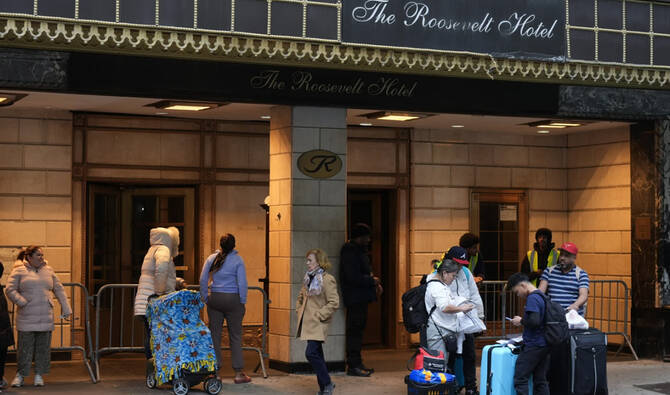
Migrants wait for a ride, with their belongings, in front of the Roosevelt Hotel in New York on February 25, 2025. (AP/File)
Short Url
Updated 24 July 2025
Follow

Global real estate giant quits advisory role in Pakistan’s Roosevelt Hotel privatization

  • Jones Lang LaSalle steps down over conflict of interest as Pakistan seeks to sell stake in NYC hotel
  • Privatization of iconic hotel is part of IMF-backed reform push to offload loss-making state assets

ISLAMABAD: Global real estate firm Jones Lang LaSalle (JLL) has stepped down from its role as financial adviser for the privatization of Pakistan’s Roosevelt Hotel in New York, citing a conflict of interest due to client interest in the property, the government said on Thursday.

Pakistan plans to sell a minority stake in the century-old Manhattan hotel and is seeking a redevelopment partner as part of a broader effort to offload loss-making state-owned assets under a $7 billion agreement with the International Monetary Fund (IMF). The Roosevelt Hotel, viewed as one of Pakistan’s most valuable foreign holdings, was closed in 2020 and has since operated intermittently, including as a migrant shelter.

JLL was appointed in January last year to advise the government on the potential sale transaction of the Roosevelt Hotel, the privatization ministry said in a statement.

“The Privatization Commission of Pakistan announces that Jones Lang LaSalle (JLL), a leading global real estate services firm, acting as Financial Adviser for privatization of Roosevelt Hotel, has formally conveyed its decision to resign from the assignment owing to the emergence of a potential conflict of interest,” the ministry said.

It added that JLL had conducted due diligence on the hotel and submitted due diligence and transaction structure reports, in which it analyzed a range of transaction structure options in line with international best practices and market dynamics.

The ministry said JLL has cited “heightened interest” in Roosevelt Hotel from many of its clients, post cancelation of its lease agreement with New York City, as the reason for the decision to withdraw from its role.

“This, JLL says, has put them in a compromising position, therefore they have decided to resign in order to avoid any perceived or actual conflict of interest,” the ministry explained.

The statement said Pakistan’s Privatization Commission is initiating the process to hire a new financial adviser on a fast-track basis to ensure that the process for Roosevelt Hotel’s privatization is carried forward in a “transparent and competitive manner.”

“The Government of Pakistan and the Privatization Commission remain fully committed to conclude the ongoing privatization of Roosevelt Hotel expeditiously, in accordance with all applicable legal requirements,” the statement concluded.

The Roosevelt Hotel has long been one of Pakistan’s most prominent but politically sensitive overseas assets. Acquired by the Pakistan International Airlines Investment Limited (PIAIL) in 1979, the hotel occupies a full city block on Madison Avenue and 45th Street.

Over the past two decades, successive Pakistani governments have floated plans to sell, lease, or redevelop the property, but no proposal has advanced beyond early-stage planning.


Pakistan offers Kyrgyzstan Arabian Sea access as two states sign 15 cooperation accords

Updated 05 December 2025
Follow

Pakistan offers Kyrgyzstan Arabian Sea access as two states sign 15 cooperation accords

  • Pakistan and Kyrgyzstan sign MOUs spanning trade, energy, agriculture, ports, education, security cooperation
  • Kyrgyz president is on first visit to Pakistan in 20 years as both sides push connectivity and CASA-1000 power links

ISLAMABAD: Pakistan on Thursday offered Kyrgyzstan the shortest and most economical route to the Arabian Sea as the two countries signed 15 agreements and memoranda of understanding aimed at boosting cooperation across trade, energy, agriculture, education, customs data-sharing and port logistics.

The accords were signed during a visit to Islamabad by President Sadyr Zhaparov, the first by a Kyrgyz head of state to Pakistan in two decades, and part of Islamabad’s renewed push to link South Asia with landlocked Central Asian economies through ports, power corridors and transport routes.

For Pakistan, Kyrgyzstan offers access to hydropower through CASA-1000, a $1.2 billion regional electricity transmission project designed to carry surplus summer electricity from Kyrgyzstan and Tajikistan through Afghanistan into Pakistan. For Bishkek, Pakistan provides overland access to warm-water ports on the Arabian Sea, creating a shorter commercial route to global markets.

“President Asif Ali Zardari has reiterated Pakistan’s readiness to offer Kyrgyzstan the shortest and most economical route to the Arabian Sea,” Radio Pakistan reported after Zhaparov met the Pakistani president. 

The two leaders also discussed expanding direct flights to deepen business, tourism and people-to-people ties.

Zardari welcomed Kyrgyzstan’s completion of its segment of the CASA-1000 project and “reaffirmed Pakistan’s commitment to completing its part of the project, which is now at an advanced stage,” the state broadcaster said. 

Zhaparov thanked Islamabad for supporting Bishkek’s candidacy for a non-permanent UN Security Council seat and invited Zardari to visit Kyrgyzstan at a time of his convenience. Both sides expressed satisfaction with progress under the Quadrilateral Traffic in Transit Agreement, designed to facilitate road movement between Pakistan, Kyrgyzstan, Kazakhstan and China.

Earlier, both governments exchanged 15 sectoral cooperation documents covering commerce, mining, geosciences, power, agriculture, youth programs, the exchange of convicted persons, customs electronic data systems and a sister-city linkage between Islamabad and Bishkek.

According to APP, the MOUs were signed by ministers representing foreign affairs, commerce, economy, energy, power, railways, interior, culture, health and tourism. Agreements also covered cooperation between Pakistan’s Foreign Service Academy and the Diplomatic Academy of Kyrgyzstan, as well as collaboration between universities, youth ministries and cultural institutions.

“Our present mutual trade, comprising of about $15–16 million will be enhanced to $200 million in the next two years,” Prime Minister Shehbaz Sharif said after the agreements were signed, calling them “a framework for structured, result-oriented engagement and closer institutional linkages.”

Sharif said Pakistan was ready to serve as a maritime outlet for the landlocked Central Asian republic, offering access to Karachi, Port Qasim and Gwadar to help Kyrgyz goods reach regional and global markets.