

Pakistan pushes for UN-OIC cooperation to counter ‘alarming resurgence’ of Islamophobia

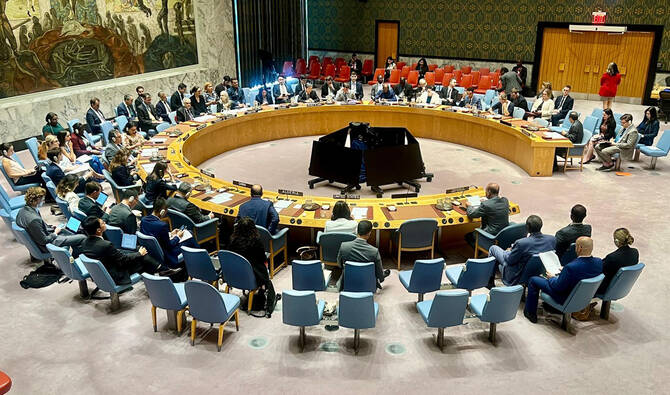
Pakistan’s Deputy Prime Minister Ishaq Dar addresses the United Nations Security Council while presiding over its meeting as Council President, at UN Headquarters in New York on July 24, 2025. (Photo courtesy: MOFA)
Short Url
Updated 24 July 2025
Follow

Pakistan pushes for UN-OIC cooperation to counter ‘alarming resurgence’ of Islamophobia

  • Deputy PM Ishaq Dar chairs meeting of the UN Security Council in New York on UN-OIC cooperation
  • Pakistani deputy premier says religious hatred “morally indefensible,” strikes at UN Charter’s foundation

ISLAMABAD: Pakistan’s Deputy Prime Minister Ishaq Dar on Thursday pushed for greater cooperation between the Organization of Islamic Cooperation (OIC) and the United Nations (UN) to counter rising extremism and “alarming resurgence” of Islamophobia worldwide.

As the president of the UN Security Council for July, Pakistan chaired a meeting at the multilateral forum to discuss the cooperation between the OIC and the UN. The briefing was titled: ‘Cooperation between the United Nations and regional and subregional organizations.’

In 2022, the UN General Assembly adopted a resolution sponsored by 60 OIC members states, spearheaded by Pakistan, which designated Mar. 15 as the International Day to Combat Islamophobia.

Speaking at the briefing, Dar noted that the UN-OIC engagement continues to grow, from mediation and political transition to coordinated responses in humanitarian emergency, advocacy on issues of disarmament, development, and protection of religious and cultural heritage.

“Excellencies, nowhere in this cooperation is it more necessary than in encountering the rising tide of extremism, particularly the alarming resurgence of Islamophobia,” Dar said during his address.


Pakistan’s Deputy Prime Minister Ishaq Dar addresses the United Nations Security Council while presiding over its meeting as Council President, at UN Headquarters in New York on July 24, 2025. (Photo courtesy: MOFA)

He added that religious hatred is not only “morally indefensible,” but also strikes at the very foundation of the UN Charter. The deputy premier noted that the global community’s endorsement of Pakistan’s initiative to designate 15 March as the International Day to Combat Islamophobia, followed by the adoption of a resolution leading to the appointment of a UN Special Envoy on Islamophobia, are “milestones” that reaffirm the OIC and UN’s shared resolve.

“There has long been a strong voice on this issue, and we must further institutionalize its role in global efforts to promote respect, inclusion, and interfaith harmony,” Dar said.


Pakistan’s Deputy Prime Minister Ishaq Dar gestures while presiding over a United Nations Security Council meeting at UN Headquarters in New York on July 24, 2025. (Photo courtesy: MOFA)

Presidential statements are formal expressions of the Security Council’s consensus but are not legally binding. They require unanimous approval and are often preceded by complex negotiations.

Founded in 1969, the OIC includes 57 member states across four continents and serves as a platform for collaboration on political, economic and social issues affecting Muslim communities worldwide.


Islamabad dismisses claims about paying up to 8 percent interest on foreign loans as ‘misleading’

Updated 22 February 2026
Follow

Islamabad dismisses claims about paying up to 8 percent interest on foreign loans as ‘misleading’

  • Pakistan has long relied on external loans to help bridge persistent gaps in public finances and foreign exchange reserves
  • Pakistan’s total external debt, liabilities stand at $138 billion at an overall average cost of around 4 percent, ministry says

KARACHI: Pakistan’s finance ministry on Sunday dismissed as “misleading” claims that the country is paying up to 8 percent interest on external loans, saying the overall average cost of external public debt is approximately 4 percent.

Pakistan has long relied on external loans to help bridge persistent gaps in public finances and foreign exchange reserves, driven largely by a narrow tax base, chronic trade deficits, rising debt-servicing costs and repeated balance-of-payments pressures.

Over the decades, successive governments have turned to multilateral and bilateral lenders, including the International Monetary Fund, the World Bank and the Asian Development Bank, to support budgetary needs and shore up foreign exchange reserves.

The finance ministry on Sunday issued a clarification in response to a “recent press commentary” regarding the country’s external debt position and associated interest payments, and said the figures required contextual explanation to ensure accurate understanding of Pakistan’s external debt profile.

“Pakistan’s total external debt and liabilities currently stand at $138 billion. This figure, however, encompasses a broad range of obligations, including public and publicly guaranteed debt, debt of Public Sector Enterprises (both guaranteed and non-guaranteed), bank borrowings, private-sector external debt, and intercompany liabilities to direct investors. It is therefore important to distinguish this aggregate figure from External Public (Government) Debt, which amounts to approximately $92 billion,” it said.

“Of the total External Public Debt, nearly 75 percent comprises concessional and long-term financing obtained from multilateral institutions (excluding the IMF) and bilateral development partners. Only about 7 percent of this debt consists of commercial loans, while another 7 percent relates to long-term Eurobonds. In light of this composition, the claim that Pakistan is paying interest on external loans ‘up to 8 percent’ is misleading.

The overall average cost of External Public Debt is approximately 4 percent, reflecting the predominantly concessional nature of the borrowing portfolio.”

With respect to interest payments, public external debt interest outflows increased from $1.99 billion in Fiscal Year (FY) 2022 to $3.59 billion in FY2025, representing an increase of 80.4 percent, not 84 percent as reported. In absolute terms, interest payments rose by $1.60 billion over this period, not $1.67 billion, it said.

According to the State Bank of Pakistan’s records, Pakistan’s total debt servicing payments to specific creditors during the period under reference were as follows: the IMF received $1.50 billion, of which $580 million constituted interest; Naya Pakistan Certificates payments totaled $1.56 billion, including $94 million in interest; the Asian Development Bank received $1.54 billion, including $615 million in interest; the World Bank received $1.25 billion, including $419 million in interest; and external commercial loans amounted to nearly $3 billion, of which $327 million represented interest payments.

“While interest payments have increased in absolute terms, this rise cannot be attributed solely to an expansion in the debt stock,” the ministry said. “Although the overall debt stock has increased slightly since FY2022, the additional inflows have primarily originated from concessional multilateral sources and the IMF’s Extended Fund Facility (EFF) under the ongoing IMF-supported program.”

Pakistan secured a $7 billion IMF bailout in Sept. 2024 as part of Prime Minister Shehbaz Sharif’s efforts to stabilize the South Asian economy that narrowly averted a default in 2023. The government has since been making efforts to boost trade and bring in foreign investment to consolidate recovery.

“It is also important to note that the increase in interest payments reflects prevailing global interest rate dynamics. In response to the inflation surge of 2021–22, the US Federal Reserve raised the federal funds rate from 0.75-1.00 percent in May 2022 to 5.25–5.50 percent by July 2023. Although rates have since moderated to around 3.75 percent, they remain significantly higher than 2022 levels,” the finance ministry said.

“The government remains committed to prudent debt management, transparency, and the continued strengthening of Pakistan’s macroeconomic stability,” it added.