Filipino film opposed by Beijing draws global attention to disputed South China Sea

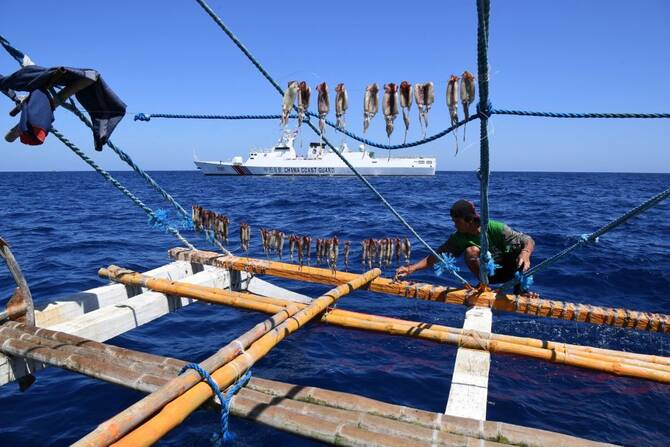
This photo taken on Feb. 15, 2024 shows a Filipino fisherman drying squid on a fishing boat while a Chinese coast guard ship monitors in the disputed waters of the South China Sea. (AFP)
Short Url
Updated 24 July 2025
Follow

Filipino film opposed by Beijing draws global attention to disputed South China Sea

  • ‘Food Delivery’ was pulled from Philippine premiere in March but will debut on Sunday
  • Chinese consulate tried to block it from a New Zealand festival where it won an award

MANILA: Pulled from screens days before its premiere, a Philippine documentary about the daily struggles of Filipino fishermen and coast guards is now winning big abroad, turning the spotlight onto the disputed South China Sea and Manila’s tensions with Beijing. 

“Food Delivery: Fresh from the West Philippine Sea,” by Filipino filmmaker Baby Ruth Villarama, was initially set for a Philippine premiere in March. However, it was dropped from the lineup of the PureGold CinePanalo Film Festival in Manila with organizers citing “external factors.”

The film’s title refers to the Philippine part of the South China Sea lying within the country’s exclusive economic zone, an area central to a long-running dispute over the strategic waterway between Manila and Beijing. 

Seeking to highlight the “human” side of tensions beyond geopolitical framing, it centers on the story of Filipino fishermen “who risk their lives every day” and the quiet efforts of Philippine coast guard personnel to keep them safe despite limited resources, Villarama told Arab News. 

“They see it as their duty, their lifeblood, and their birthright. What struck us most was not anger or fear, but a deep sense of quiet dignity. These are men who wake before sunrise, not minding what dangers await them, yet they sail because they must feed their families and uphold traditions passed down for generations,” she said. 

“They don’t use the word ‘patriotism,’ but they live it. For them, the West Philippine Sea isn’t an idea. It’s home. It’s where they survive, dream, and stand their ground. Their courage is unassuming, but it is fierce.”

The documentary went on to have its world premiere at the Doc Edge Festival in New Zealand, where it won the Tides of Change prize earlier this month.

“International recognition gave the film credibility, but it was really the solidarity of communities here and abroad that could make the screening possible on the 27th (of July),” Villarama said.  “We’re just hoping for the best.”

Before the film made its international debut in New Zealand, it faced pressure from the Chinese Consulate-General in Auckland, which lodged a formal protest to festival organizers and requested the film’s scheduled screenings were canceled. 

Despite a 2016 international tribunal ruling in favor of the Philippines’ claims China continues to assert its historical claims to the waters, through which an estimated $5.3 trillion worth of commercial goods transit annually.

In a letter to organizers later posted online, the Chinese consulate said the film was “rife with disinformation and false propaganda, serving as a political tool for Philippines to pursue illegitimate claims in the South China Sea.”

But for its creators, the film was always about the Filipino audience.

“We made ‘Food Delivery’ to hold up a mirror to the truth — not to divide, but to help us see more clearly what is happening in our own waters. Because no matter where we stand on politics or personal beliefs, one thing is certain: The West Philippine Sea is part of our story. It is part of who we are,” Chuck Gutierrez, co-founder of documentary producer Voyage Studios, told Arab News.

“The truth is, we did not make this film to antagonize anyone. Our goal was simple — to show the day-to-day reality faced by Filipinos at the West Philippine Sea. What we captured came from firsthand experiences, not secondhand narratives. These are voices that have long been unheard.” 

Winning the award in New Zealand was a “deeply affirming moment” for Gutierrez and his team. 

“It means that telling the truth, especially when it is inconvenient or uncomfortable, is still worth fighting for,” he said. “Despite the forces that tried to silence the story we were telling, the truth found its voice and resonated with an international audience.”


Mystery of CIA’s lost nuclear device haunts Himalayan villagers 60 years on

Updated 48 min 12 sec ago
Follow

Mystery of CIA’s lost nuclear device haunts Himalayan villagers 60 years on

  • Plutonium-fueled spy system was meant to monitor China’s nuclear activity after 1964 atomic tests
  • Porter who took part in Nanda Devi mission warned family of ‘danger buried in snow’

NEW DELHI: Porters who helped American intelligence officers carry a nuclear spy system up the precarious slopes of Nanda Devi, India’s second-highest peak, returned home with stories that sent shockwaves through nearby villages, leaving many in fear that still holds six decades later.

A CIA team, working with India’s Intelligence Bureau, planned to install the device in the remote part of the Himalayas to monitor China, but a blizzard forced them to abandon the system before reaching the summit.

When they returned, the device was gone.

The spy system contained a large quantity of highly radioactive plutonium-238 — roughly a third of the amount used in the atomic bomb dropped by the US on the Japanese city of Nagasaki in the closing stages of the Second World War.

“The workers and porters who went with the CIA team in 1965 would tell the story of the nuclear device, and the villagers have been living in fear ever since,” said Narendra Rana from the Lata village near Nanda Devi’s peak.

His father, Dhan Singh Rana, was one of the porters who carried the device during the CIA’s mission in 1965.

“He told me there was a danger buried in the snow,” Rana said. “The villagers fear that as long as the device is buried in the snow, they are safe, but if it bursts, it will contaminate the air and water, and no one will be safe after that.”

During the Sino-Indian tensions in the 1960s, India cooperated with the US in surveillance after China conducted its first nuclear tests in 1964. The Nanda Devi mission was part of this cooperation and was classified for years. It only came under public scrutiny in 1978, when the story was broken by Outsider magazine.

The article caused an uproar in India, with lawmakers demanding the location of the nuclear device be revealed and calling for political accountability. The same year, then Prime Minister Morarji Desai set up a committee to assess whether nuclear material in the area near Nanda Devi could pollute the Ganges River, which originates there.

The Ganges is one of the world’s most crucial freshwater sources, with about 655 million people in India, Nepal, and Bangladesh depending on it for their essential needs.

The committee, chaired by prominent scientists, submitted its report a few months later, dismissing any cause for concerns, and establishing that even in the worst-case scenario of the device’s rupture, the river’s water would not be contaminated.

But for the villagers, the fear that the shell containing radioactive plutonium could break apart never goes away, and peace may only come once it is found.

Many believe the device, trapped within the glacier’s shifting ice, may have moved downhill over time.

Rana’s father told him that the device felt hot when it was carried, and he believed it might have melted its way into the glacier, remaining buried deep inside.

An imposing mass of rock and ice, Nanda Devi at 7,816 m is the second-highest mountain in India after Kangchenjunga. 

When a glacier near the mountain burst in 2021, claiming over 200 lives, scientists explained that the disaster was due to global warming, but in nearby villages the incident was initially blamed on a nuclear explosion.

“They feared the device had burst. Those rescuing people were afraid they might die from radiation,” Rana said. “If any noise is heard, if any smoke appears in the sky, we start fearing a leak from the nuclear device.”

The latent fear surfaces whenever natural disasters strike or media coverage puts the missing device back in the spotlight. Most recently, a New York Times article on the CIA mission’s 60th anniversary reignited the unease.

“The apprehensions are genuine. After 1965, Americans came twice to search for the device. The villagers accompanied them, but it could not be found, which remains a concern for the local community,” said Atul Soti, an environmentalist in Joshimath, Uttarakhand, about 50 km from Nanda Devi.

“People are worried. They have repeatedly sought answers from the government, but no clear response has been provided so far. Periodically, the villagers voice their concerns, and they need a definitive government statement on this issue.”

Despite repeated queries whenever media attention arises, Indian officials have not released detailed updates since the Desai-appointed committee submitted its findings.

“The government should issue a white paper to address people’s concerns. The white paper will make it clear about the status of the device, and whether leakage from the device could pollute the Ganges River,” Soti told Arab News.

“The government should be clear. If the government is not reacting, then it further reinforces the fear.”