

Pakistan’s Naqvi says consulting India on Asia Cup 2026 schedule

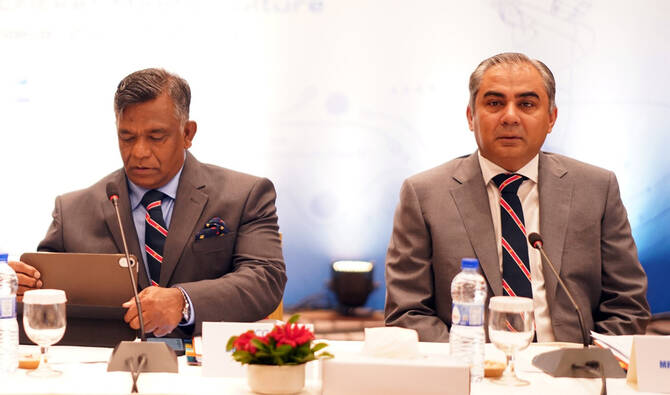
Asian Cricket Council President Mohsin Naqvi speaks during a meeting with the ACC member countries at the annual general council meeting in Dhaka on July 24, 2025. (Handout/PCB)
Short Url
Updated 24 July 2025
Follow

Pakistan’s Naqvi says consulting India on Asia Cup 2026 schedule

  • Mohsin Naqvi, also head of the Asian Cricket Council, chairs body’s annual general meeting in Dhaka
  • Fate of this year’s Asia Cup hangs in the balance after India and Pakistan’s brief military skirmish in May

ISLAMABAD: Asian Cricket Council (ACC) chief Mohsin Naqvi announced on Thursday that the body was holding consultations with the Board of Control for Cricket in India (BCCI) following which the schedule for the upcoming Asia Cup 2026 will be announced “very soon.”

The fate of this year’s Asia Cup, which is to be hosted by India most likely in September, was thrown into uncertainty following the days-long military skirmish between India and Pakistan in May. Bilateral cricket has been suspended since 2013 between the traditional rivals, who play each other only in multi-team events as per an International Cricket Council arrangement.

Naqvi, who is also the chairman of the Pakistan Cricket Board (PCB) and the country’s interior minister, spoke to reporters after presiding over the ACC’s annual general meeting in Dhaka. The ACC chief said all 25 members of the Asian body attended the meeting, some through video link, to discuss cricket in Asia.

“We are in consultations with the BCCI [about Asia Cup schedule] and hopefully we will resolve the [issues] very soon,” Naqvi said in response to a question.

When a reporter asked Naqvi whether the tournament will be held in the UAE, he said the ACC “will announce it soon.”

Naqvi said it was “a normal thing” for most ACC members to attend the meeting virtually, saying it isn’t possible for the various heads of cricket boards to gather in one place due to their varying schedules.

In his opening statement, the ACC chief said the annual general meeting “went very well.”

“We have all decided to work for cricket, none of us was [discussing] politics inside our organization,” Naqvi said.

Cricket matches between India and Pakistan draw in millions of television viewers worldwide and thousands to cricket stadiums around the world. India refused to travel to Pakistan for the Champions Trophy this year and played all their matches, including the March 9 final, in Dubai.

India will host the women’s 50-overs World Cup this year but Pakistan will play all their matches in Sri Lanka as per the ICC’s arrangement.

India’s head coach Gautam Gambhir is against playing Pakistan even in neutral venues but will follow whatever the BCCI decided, he said in May.



Pakistan accuses India of manipulating Indus waters, warns of risks to regional peace

Updated 6 sec ago
Follow

Pakistan accuses India of manipulating Indus waters, warns of risks to regional peace

  • India announced in April it was putting the Indus Waters Treaty in abeyance over a gun attack in disputed Kashmir it blamed on Pakistan
  • Islamabad says it has witnessed ‘unusual, abrupt variations’ in the flow of Chenab river, accusing New Delhi of ‘material breaches’ of treaty

ISLAMABAD: Pakistan on Friday accused India of manipulating flows of Indus waters in violation of a 1960 water-sharing treaty, warning that unilateral actions over the transboundary waters could heighten tensions and pose risks to regional peace.

The Indus Waters Treaty (IWT), mediated by the World Bank, divides control of the Indus basin rivers between the two nuclear-armed neighbors. India said in April it was holding the treaty “in abeyance” after a gun attack in Indian-administered Kashmir killed more than 26 tourists. New Delhi blamed the assault on Pakistan, Islamabad denied it.

The treaty grants Pakistan rights to the Indus basin’s western rivers — Indus, Jhelum, and Chenab — for irrigation, drinking, and non-consumptive uses like hydropower, while India controls the eastern rivers — Ravi, Beas, and Sutlej — for unrestricted use but must not significantly alter their flow. India can use the western rivers for limited purposes such as power generation and irrigation, without storing or diverting large volumes, according to the agreement.

Speaking at a televised press briefing, Pakistani Deputy Prime Minister Ishaq Dar accused New Delhi of “material breaches” of the IWT that may have consequences for regional stability, citing “unusual, abrupt variations” in the flow of Chenab river from April 30 to May 21 and from Dec. 7 to Dec. 15.

“These variations in water flows are of extreme concern for Pakistan as they point to unilateral release of water by India into River Chenab. India has released this water without any prior notification or any data- or information-sharing with Pakistan as required under the treaty,” he said.

“India’s most recent action clearly exemplifies the weaponization of water to which Pakistan has been consistently drawing attention of the international community.”

There was no immediate response from New Delhi to the statement.

Dar said this water “manipulation” occurs at a critical time in Pakistan’s agricultural cycle and directly threatens the lives and livelihoods as well as food and economic security of its citizens.

He shared that Indian actions prompted Indus Water Commissioner Mehar Ali Shah to write a letter to his Indian counterpart, seeking clarification on the matter as provided under the Indus Waters Treaty.

“We expect India to respond to the queries raised by Pakistan’s Indus water commissioner, refrain from any unilateral manipulation of river flows, and fulfill all its obligations in letter and spirit under the Indus Waters Treaty provisions,” the Pakistani deputy premier said.

Dar also accused India of consistently trying to undermine the IWT by building various dams, including Kishenganga and Ratle hydropower projects, which he said sets “a very dangerous precedent.”

“Alarmingly, India is now subverting the treaty’s own dispute resolution mechanism by refusing to participate in the Court of Arbitration and neutral expert proceedings. India is pursuing a deliberate strategy to sabotage the well-established arbitration process under the treaty provisions,” he said.

The South Asian neighbors have been arguing over hydroelectric projects on the shared Indus river system for decades, with Pakistan complaining that India’s planned hydropower dams will cut its flows.

In August, the International Court of Arbitration rendered an award on issues of general interpretation of the IWT, explaining the designed criteria for the new run-of-river hydropower projects to be constructed by India on the western rivers of Chenab, Jhelum and Indus, which Islamabad said vindicated its stance.

In its findings, the Court of Arbitration declared that India shall “let flow” the waters of the western rivers for Pakistan’s unrestricted use. In that connection, the specified exceptions for generation of hydro-electric plants must conform strictly to the requirements laid down in the Treaty, rather than to what India might consider an “ideal” or “best practices approach,” according to the Pakistani foreign office.

“Pakistan would like to reiterate that Indus Waters Treaty is a binding legal instrument that has made an invaluable contribution to peace and stability of South Asia,” Dar said.

“Its violation, on the one hand, threatens the inviolability of international treaties and on the other, it poses serious risks to regional peace and security, principles of good neighborhood, and norms that govern inter-state relations.”