

Pakistan’s deputy PM scheduled to chair Security Council meeting on UN-OIC cooperation today

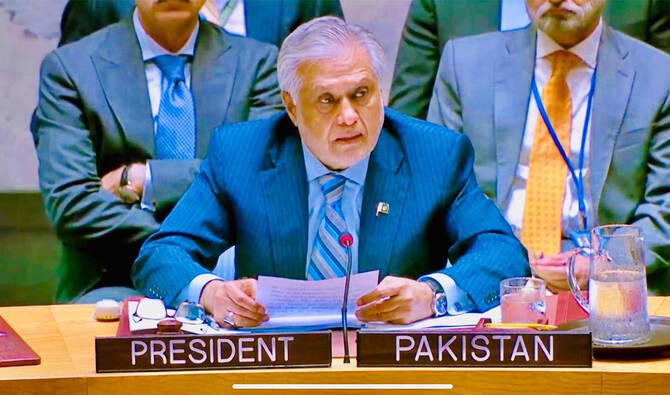
Pakistan's Deputy Prime Minister and Foreign Minister, Ishaq Dar, is presiding over the United Nations Security Council's open debate on the "Situation in the Middle East including the Palestinian Question" in New York, US, on July 23, 2025. (Pakistan's Foreign Office)
Short Url
Updated 24 July 2025
Follow

Pakistan’s deputy PM scheduled to chair Security Council meeting on UN-OIC cooperation today

  • Meeting is among the signature events of Pakistan’s UN Security Council presidency in the ongoing month
  • A presidential statement urging deeper UN-OIC engagement is expected to be adopted during the session

ISLAMABAD: Pakistan’s Deputy Prime Minister and Foreign Minister Ishaq Dar is expected to chair a United Nations Security Council (UNSC) meeting today, Thursday, on ties between the United Nations and the Organization of Islamic Cooperation (OIC), according to Security Council Report, an independent entity that closely monitors the Council’s work.

The meeting is among the signature events of Pakistan’s UNSC presidency this month and falls under the broader agenda of UN cooperation with regional and subregional entities.

A presidential statement, initiated by Pakistan, is expected to be adopted unanimously during the session.

“The agreed text of the draft presidential statement notes the interest of utilising the existing and potential capabilities of the OIC, including through encouraging its member countries to resolve differences peacefully through dialogue, reconciliation, consultation, negotiation, good offices, mediation, and judicial settlement of disputes,” Security Council Report said.

“Among other issues, it recognizes the importance of OIC interaction with the Peacebuilding Commission (PBC) in support of nationally owned peacebuilding efforts and commends OIC member states for their commitment to international peacekeeping and peacebuilding, including through the contribution of troops to UN peacekeeping operations,” it added.

Founded in 1969, OIC includes 57 member states across four continents and serves as a platform for collaboration on political, economic and social issues affecting Muslim communities.

Presidential statements are formal expressions of the Council’s consensus but are not legally binding. They require unanimous approval and are often preceded by complex negotiations.

In a concept note circulated earlier this month, Pakistan said the meeting aimed to take stock of UN-OIC collaboration and identify ways to deepen cooperation on peacekeeping, conflict prevention, counter-terrorism and institutional dialogue.

The note also posed questions about how the UN could help enhance the OIC’s conflict resolution capacity and better align institutional efforts on global peace and security.


Pakistan approves $713 million to ease power sector’s cash flow constraints

Updated 5 sec ago
Follow

Pakistan approves $713 million to ease power sector’s cash flow constraints

  • Finance minister chairs Economic Coordination Committee meeting to approve grants, review economic situation
  • Pakistan is grappling with a ballooning “circular debt,” or unpaid bills and subsidies, that has choked its power sector

KARACHI: Pakistan’s top economic body this week approved a grant of $713 million to ease the power sector’s cash flow constraints, the Finance Division said in a statement, as Islamabad looks to reform its priority sectors. 

The development took place as Finance Minister Muhammad Aurangzeb chaired a meeting of the Economic Coordination Committee (ECC) to approve grants for various projects and review the overall economic situation of the country. 

“[ECC approved] another Technical Supplementary Grant amounting to Rs200 billion ($713 million) under the head of Government of Pakistan investment in DISCOs’ equity to address cash flow constraints in the power sector,” the Finance Division said on Thursday. 

DISCOs, which handle billing, recoveries and grid maintenance, have long suffered from corruption and political interference. 

Pakistan has attempted to privatize its loss-making state-owned enterprises to raise funds and reform them as envisaged under a $7 billion International Monetary Fund (IMF) program secured last year. 

Prime Minister Shehbaz Sharif’s government plans to privatize three DISCOs, the Islamabad Electric Supply Company (IESCO), Faisalabad Electric Supply Company (FESCO) and Gujranwala Electric Power Company (GEPCO) in the months ahead. 

The Pakistani government, which owns or controls much of the power infrastructure, is grappling with a ballooning “circular debt,” or unpaid bills and subsidies, that has choked the power sector and weighed on the economy.

The liquidity crunch has disrupted supply, discouraged investment and added to fiscal pressure, making it a key focus under Pakistan’s IMF program.

The ECC also approved, on the interior ministry’s proposal, a provision of Rs 4.775 billion [$17.19 million] as payment to 945 families of “missing persons” as identified by the Commission of Inquiry on Enforced Disappearances. 

“The disbursement will be made under the supervision of the Commission in accordance with approved procedures,” it added. 

Taking stock of the economic situation, the ECC noted that cumulative inflation for the period July–November averaged 5 percent, which it said was “significantly lower” than the 7.9 percent figure recorded during the corresponding period of the previous year. 

It attributed this improvement to prudent fiscal management, effective price stabilization measures and close market monitoring by the government.