

Grenade attack kills one, injures three in southwest Pakistan

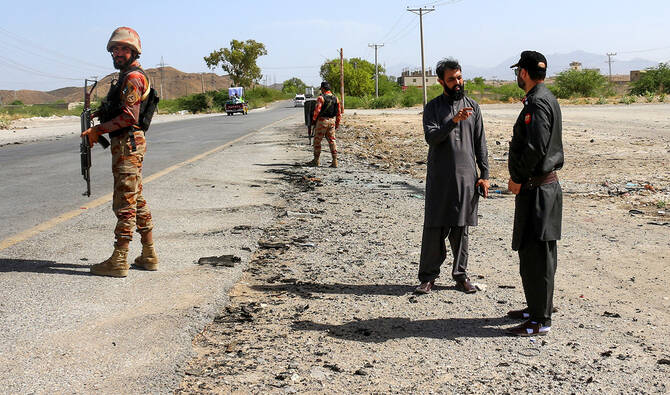
Security personnel stand guard at the site of a school bus bombing in Khuzdar district of Balochistan province on May 21, 2025. (AFP/File)
Short Url
Updated 24 July 2025
Follow

Grenade attack kills one, injures three in southwest Pakistan

  • Incident took place in the mountainous town of Aab-e-Gum, located in Balochistan’s Kachi district
  • No group has claimed responsibility, though the area is considered a stronghold of BLA separatists

QUETTA: A man was killed and three others injured in an attack on Wednesday night in southwestern Balochistan province after unknown individuals threw a hand grenade at a group of civilians sitting outside their house, a senior police official said.

The attack was reported at 10 PM in the mountainous town of Aab-e-Gum, located in Kachi district, after unidentified men lobbed a hand grenade at four people, Rana Muhammad Dilawar, Superintendent of Police in the area, told Arab News over the phone.

“One man identified as Ahmed was killed in the grenade attack and three others were injured,” he said, adding: “The injured were shifted to Mach District Headquarter Hospital before two of them were referred to Quetta.”

No group has claimed responsibility for the attack, though Pakistan’s restive province has been the site of a separatist insurgency for several decades, with militants belonging to groups like the Baloch Liberation Army (BLA) often targeting members of the Pakistani armed forces, state-backed tribal leaders and non-local workers in such attacks.

“Police have been investigating the motives behind targeting civilians with a grenade attack,” Dilawar said. “Hunt for the attackers is also underway in the area who fled by taking advantage of the dark.”

Aab-e-Gum is a small town located some 73 kilometers southeast of Quetta, surrounded by rugged mountains, and has remained a stronghold of ethnic Baloch separatist groups, particularly the BLA.

The group has previously targeted Punjab-bound passenger trains in the area that cross the Bolan Pass.


IMF Executive Board to review $1.2 billion loan disbursement for Pakistan today

Updated 4 sec ago
Follow

IMF Executive Board to review $1.2 billion loan disbursement for Pakistan today

  • Pakistan, IMF reached a Staff-Level Agreement in October for second review of $7 billion Extended Fund, climate fund program
  • Economists view IMF bailout packages as essential for cash-strapped Pakistan grappling with a prolonged macroeconomic crisis

ISLAMABAD: The Executive Board of the International Monetary Fund (IMF) is set to meet in Washington today to review a $1.2 billion loan disbursement for Pakistan, state media reported on Monday.

Pakistan and the IMF reached a Staff-Level Agreement (SLA) in October for the second review of a $7 billion Extended Fund Facility (EFF) and the first review of its $1.4 billion Resilience and Sustainability Facility (RSF). 

The agreement between the two sides took place after an IMF mission, led by the international lender’s representative Iva Petrova, held discussions with Pakistani authorities during a Sept. 24–Oct. 8 visit to Karachi, Islamabad and Washington D.C.

“The International Monetary Fund’s (IMF) Executive Board is set to meet in Washington today to review and approve $1.2 billion in loan for Pakistan,” state broadcaster Pakistan TV reported. 

Pakistan has been grappling with a prolonged macroeconomic crisis that has drained its financial resources and triggered a balance of payments crisis for the past couple of years. Islamabad, however, has reported some financial gains since 2022, which include recording a surplus in its current account and bringing inflation down considerably.

Economists view the IMF’s bailout packages as crucial for cash-strapped Pakistan, which has relied heavily on financing from bilateral partners such as Saudi Arabia, China and the United Arab Emirates, as well as multilateral lenders including the IMF, World Bank, Asian Development Bank and Islamic Development Bank. 

Speaking to Arab News last month, Pakistan’s former finance adviser Khaqan Najeeb said the $1.2 billion disbursement will further stabilize Pakistan’s near-term external position and unlock additional official inflows.

“Continued engagement also reinforces macro stability, as reflected in recent improvements in inflation, the current account, and reserve buffers,” Najeeb said.

Pakistan came close to sovereign default in mid-2023, when foreign exchange reserves fell below three weeks of import cover, inflation surged to a record 38% in May, and the country struggled to secure external financing after delays in its IMF program. Fuel shortages, import restrictions, and a rapidly depreciating rupee added to the pressure, while ratings agencies downgraded Pakistan’s debt and warned of heightened default risk.

The crisis eased only after Pakistan reached a last-minute Stand-By Arrangement with the IMF in June 2023, unlocking emergency support and preventing an immediate default.