

‘A free Ukraine’: Kyiv protests law threatening anti-corruption bodies

1 / 2
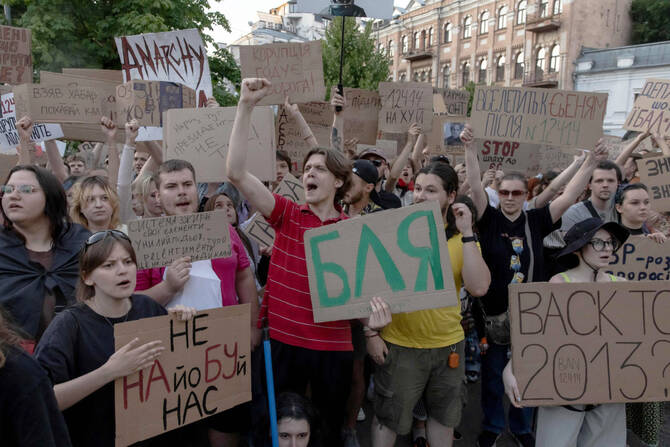
Protesters hold placards during a demonstration against a law that removes the independence of two key anti-corruption bodies in downtown Kyiv on July 23, 2025. (AFP)
2 / 2
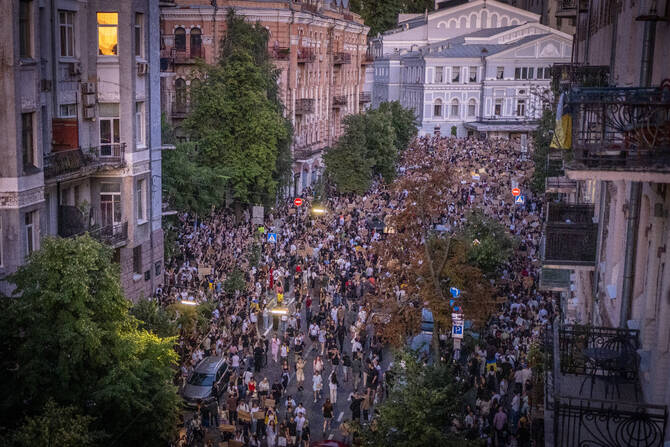
Thousands of people protest against a law targeting anti-corruption institutions near the president's office in Kyiv, Ukraine, on July 23, 2025. (AP)
Short Url
Updated 24 July 2025
Follow

‘A free Ukraine’: Kyiv protests law threatening anti-corruption bodies

  • Critics say the legislation would facilitate presidential interference in corruption probes and threatens the independence of key institutions in Ukraine
  • Zelensky says he will submit a new bill ensuring “all norms for the independence of anti-corruption institutions will be in place”

KYIV, Ukraine: At a rare protest in central Kyiv demonstrators rallied Wednesday against a law that curbs the power of anti-corruption agencies, warning the fight for Ukraine’s democracy was taking place both on the battlefield and at home.
The legislation, removing the independence of two key anti-corruption bodies, sparked the first major protests in Ukraine since it began fighting off the Russian invasion over three years ago.
“Our struggle takes place on two fronts. Our main enemy is external, but we have an internal battle too,” said protester Viacheslav Bykov.
“We don’t want Ukraine to be part of Russia, we don’t want a corrupt or authoritarian Ukraine. We want a free Ukraine,” he added.
Several thousand demonstrators — mostly young — gathered outside a theater in Kyiv, calling for a veto to the law passed by Ukraine’s parliament on Tuesday.
The law places the National Anti-Corruption Bureau of Ukraine (NABU) and Specialized Anti-Corruption Prosecutor’s Office (SAPO) under the direct authority of the prosecutor general, who is appointed by the president.
Critics say the legislation would facilitate presidential interference in corruption probes and threatens the independence of key institutions in Ukraine.

European Commission weighs in

Zelensky responded to the backlash on Wednesday evening, saying he would submit a new bill ensuring “all norms for the independence of anti-corruption institutions will be in place.”
Kyiv’s partners had reacted with alarm, including European Commission head Ursula von der Leyen, who the EU said demanded explanations from Zelensky over the change.
Civil society groups warn the bill is part of a broader pattern of pressure on anti-corruption activists and bodies.
Some European allies worry the moves will undermine anti-corruption reforms key to Ukraine’s bid to join the European Union — a fear shared by many protesting on Wednesday.
“We’ve worked for years to move closer to Europe... only to be thrown back 10 years in a single day,” said protester Anya Kutsevol.
Ukraine’s two anti-corruption bodies, NABU and SAPO, were born a decade ago in the wake of the 2014 Maidan revolution.
Those pro-European protests, centered on Kyiv’s main square, also called Maidan, ousted a Kremlin-backed leader who scrapped a key partnership agreement with the EU.
The Kremlin, which refused to accept Ukraine’s democratic turn toward Europe, then launched a first assault over Ukraine that led Moscow-backed separatists to occupy Crimea and parts of the eastern Donbas region.
“Ukraine is Europe,” Kutsevol said, “we won’t be returned to Russia. We’ll keep fighting for Europe.”

‘Undermining unity’
Some fear that a political crisis over the legislation could work in Russia’s favor by undermining unity within the country, which is struggling to hold the front.
Kremlin spokesman Dmitry Peskov seized on the opportunity to say there was “a lot of corruption” in Ukraine.
“If I were Russia, I would do the same,” said another protester, Yevgen Popovychenko, convinced Moscow would try to exploit the protests.
He was holding a banner that read: “Don’t take me back” to the years of Maidan, where he took to the streets as a 21-year-old.
As he stood in the crowd, he said he was having flashbacks from Maidan, a feeling shared by his friends.
But many other protesters were only children during the famed 2014 demonstrations — including 25-year-old Kutsevol.
“When tires were still burning, I was 14. What good was I?” she said.
Wednesday’s was her first political protest, and she teared up looking at people gathered around her for the second day in a row, despite martial law banning large gatherings.
She vowed to keep defending Ukraine’s democracy.
“We’re adults now. Now it’s our turn.”



Senate to question military leaders on Trump’s National Guard deployments

Updated 7 sec ago
Follow

Senate to question military leaders on Trump’s National Guard deployments

  • Hearing expected to feature tough questioning for Pentagon leaders over the legality of the deployments
  • National Guard deployments in some places were done over the objections of mayors and governors
WASHINGTON: Senators for the first time are poised to question military leaders over President Donald Trump’s use of the National Guard in American cities, an extraordinary move that has prompted legal challenges as well as questions about states’ rights and the use of the military on US soil.
The hearing Thursday before the Senate Armed Services Committee is expected to feature tough questioning for Pentagon leaders over the legality of the deployments, which in some places were done over the objections of mayors and governors.
The hearing will bring the highest level of scrutiny to Trump’s use of the National Guard outside of a courtroom since the deployments began and comes a day after the president faced another legal setback over his muscular use of troops in larger federal operations.
Trump has justified the use of the military in American cities by saying the National Guard is needed to support federal law enforcement, protect federal facilities and combat crime.
Democratic Sen. Tammy Duckworth, D-Illinois, said she had threatened to hold up the annual defense bill if Republican leadership continued to block the hearing, which she said is long overdue.
“Donald Trump is illegally deploying our nation’s service members under misleading if not false pretexts,” Duckworth told The Associated Press.
Duckworth, a combat veteran who served in the Illinois National Guard, said domestic deployments have traditionally involved responding to major floods and tornadoes, not assisting immigration agents who are detaining people in aggressive raids.
Duckworth said she has questions for the military about how Trump’s deployments are affecting readiness, training and costs. She also wants to know if Guard members will have legal protections if an immigration agent wrongfully harms a civilian.
“I’m deeply concerned that our nation’s military is being put in jeopardy by these policies,” Duckworth said.
The hearing comes two weeks after two West Virginia National Guard members deployed to Washington were shot just blocks from the White House in what the city’s mayor described as a targeted attack. Spc. Sarah Beckstrom died a day after the Nov. 26 shooting, and her funeral took place Tuesday. Staff Sgt. Andrew Wolfe is still hospitalized in Washington.
Meanwhile, a federal judge in California on Wednesday ruled that the Trump administration must stop deploying the California National Guard in Los Angeles and return control of the troops to the state.
US District Judge Charles Breyer in San Francisco granted a preliminary injunction sought by California officials, but also put the decision on hold until Monday. The White House said it plans to appeal.
Trump called up more than 4,000 California National Guard troops in June without Gov. Gavin Newsom’s approval to further the Trump administration’s immigration enforcement efforts.
The move was the first time in decades that a state’s National Guard was activated without a request from its governor and marked a significant escalation in the administration’s efforts to carry out its mass deportation policy. The troops were stationed outside a federal detention center in downtown Los Angeles where protesters gathered and later sent on the streets to protect immigration officers as they made arrests.
The number had dropped to several hundred by late October. The 100 or so California troops that remain in Los Angeles are guarding federal buildings or staying at a nearby base and are not on the streets with immigration enforcement officers, according to US Northern Command.
Trump also had announced National Guard members would be sent to Washington, D.C., Illinois, Oregon, Louisiana and Tennessee. Other judges have blocked or limited the deployment of troops to Portland, Oregon, and Chicago, while Guard members have not yet been sent to New Orleans.