

Pakistan backs ‘inclusive’ political process in Syria, ceasefire in Gaza at Security Council debate

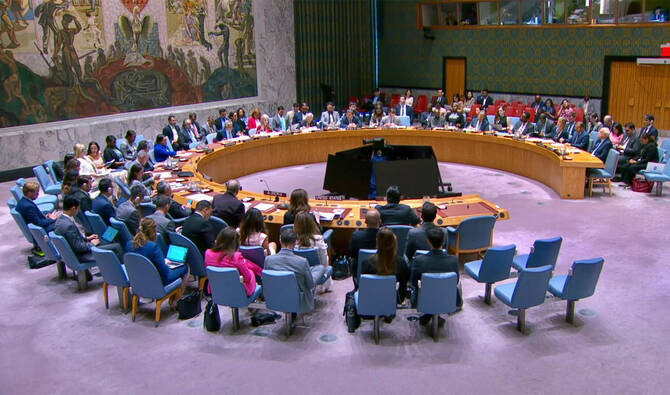
Member countries are attending United Nations Security Council's open debate on the "Situation in the Middle East including the Palestinian Question" in New York, US, on July 23, 2025. (Pakistan's Foreign Office)
Short Url
Updated 24 July 2025
Follow

Pakistan backs ‘inclusive’ political process in Syria, ceasefire in Gaza at Security Council debate

  • Violent clashes between Druze, Bedouin clans in Syria killed over 250 people this month 
  • Ishaq Dar calls for the restoration of humanitarian supply lines in Gaza to prevent famine 

ISLAMABAD: Pakistan’s Deputy Prime Minister Ishaq Dar on Wednesday backed an “inclusive” political process to stabilize a Syria rocked by clashes and demanded an unconditional ceasefire in Gaza, as he spoke at a United Nations Security Council debate on the evolving Middle East situation. 

Syria has been rocked by violent clashes between the Druze minority and Bedouin clans that broke out on July 13, killing over 250 people as per media reports and threatening to disrupt the country’s post-war transition. The violence also displaced 128,571 people, according to the United Nations International Organization for Migration.

Israel carried out a series of attacks on government targets in Syria in support of the Druze clan last week, including a strike on a tank convoy and the shelling of the Defense Ministry in Damascus. Syrian President Ahmed Al-Sharaa ordered a fragile ceasefire between Bedouin and Druze groups last Saturday. 

Dar, who is in New York to participate in events being held under Pakistan’s presidency of the UN Security Council, spoke at an open debate titled, “The Situation in the Middle East and the Question of Palestine.”

“Pakistan supports the stabilization of Syria through an inclusive political process,” the deputy prime minister, who also serves as Pakistan’s foreign minister, said. “Syria’s unity, sovereignty, and territorial integrity must be upheld.”

He called on Israel to immediately withdraw from the separation zone established under the 1974 Disengagement Agreement and vacate the Syrian Golan Heights as per the UN Security Council’s resolutions.

‘GRAVEYARD FOR INNOCENT LIVES’

The Pakistani deputy prime minister criticized Israel for its military operations in Gaza, saying that the world was witnessing the “collapse of humanity” through Tel Aviv’s actions.

“Gaza has become a graveyard for innocent lives as well as for international law, particularly international humanitarian law,” he said, noting that over 58,000 Palestinians have been killed in Israel’s war since October 2023. 

He urged the UN Security Council to pursue with unity and urgency an “immediate, permanent, and unconditional ceasefire” in Gaza. 

Dar also called for unfettered, sustained and secure access to humanitarian relief items for all civilians and the protection of aid workers, medical teams and UN personnel there. 

“Immediate steps should be taken to ensure the delivery of life-saving food and medical assistance, restore humanitarian supply lines, and prevent famine conditions from taking hold,” he said. 

Pakistan has consistently called for an independent Palestinian state in the Middle East with Al-Quds Al-Sharif as its capital based on the pre-1967 border. 


Pakistan says defense pact with Saudi Arabia elevated brotherly ties to ‘new heights’

Updated 25 February 2026
Follow

Pakistan says defense pact with Saudi Arabia elevated brotherly ties to ‘new heights’

  • Pakistan, Saudi Arabia signed strategic defense pact last year pledging aggression against one will be treated as attack on both
  • Deputy PM Ishaq Dar says enduring bonds with Islamic and Arab nations form vital pillar of Pakistan’s foreign policy 

ISLAMABAD: Deputy Prime Minister Ishaq Dar said on Wednesday that Pakistan’s defense pact with Saudi Arabia elevated its brotherly ties with the Kingdom to “new heights,” stressing that close ties with Arab and Islamic nations form a key pillar of Islamabad’s foreign policy. 

Pakistan and Saudi Arabia signed a Strategic Mutual Defense Agreement on Sept. 17 last year, pledging that aggression against one country would be treated as an attack on both, enhancing joint deterrence and formalizing decades of military and security cooperation.

Both nations agreed in October 2025 to launch an economic cooperation framework to strengthen trade and investment ties. 

“In the Middle East, our landmark Strategic Mutual Defense Agreement with Saudi Arabia has elevated our brotherly ties to new heights,” Dar said while speaking at the Pakistan Governance Forum 2026 event in Islamabad. 

The Pakistani deputy prime minister was speaking on the topic “Navigating International Relations Amidst Changing Geo-Politics.”

Dar noted that Pakistan has reinforced partnerships with other Middle Eastern nations such as the UAE, Qatar, Jordan, Oman, Egypt and Bahrain. He said these partnerships have yielded “concrete agreements” in investment, agriculture, infrastructure, and energy sectors. 

“Our enduring bonds with Islamic and Arab nations form a vital pillar of our foreign policy, and we will continue to expand our partnerships across Asia, Latin America, and Africa,” he said. 

Dar pointed out that the presidents of Kazakhstan, Uzbekistan and Kyrgyzstan have undertaken visits to Pakistan in recent months, reflecting Central Asian nations’ desire to boost cooperation with Islamabad.

On South Asia, the Pakistani deputy PM said Pakistan has successfully transformed its fraternal ties with Bangladesh into “a substantive partnership.”

“Similarly, the trilateral mechanism involving China, Pakistan, and Bangladesh has been launched with a view to expanding and deepening regional cooperation and synergy,” the Pakistani minister said. 

He said Islamabad has strengthened its “all-weather” partnership with China via the second phase of the multi-billion-dollar China-Pakistan Economic Corridor agreement and “unwavering support” from both sides for each other’s core interests. 

Dar said Pakistan had also reinvigorated its partnership with the US, advancing cooperation in trade, technology, investment, and regional stability. 

“This calibrated approach has enhanced our ability to navigate complexity with skill and confidence, ensuring that our national interests are served without compromising our core foreign policy principles,” he said.