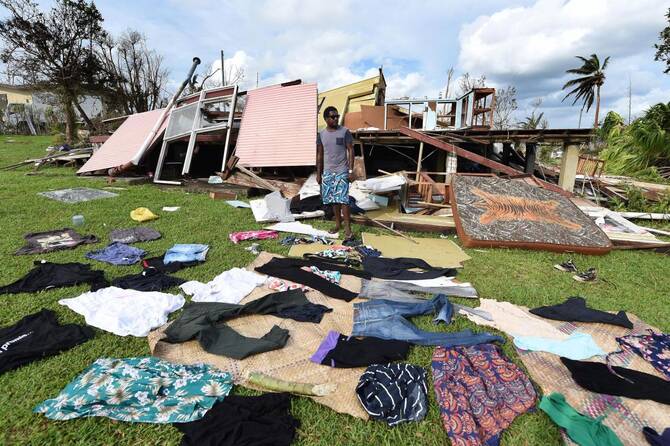

THE HAGUE: The United Nations’ top court in a landmark advisory opinion Wednesday said countries could be in violation of international law if they fail to take measures to protect the planet from climate change, and nations harmed by its effects could be entitled to reparations.
Advocates immediately cheered the International Court of Justice opinion on nations’ obligations to tackle climate change and the consequences they may face if they don’t.
“Failure of a state to take appropriate action to protect the climate system ... may constitute an internationally wrongful act,” court President Yuji Iwasawa said during the hearing. He called the climate crisis “an existential problem of planetary proportions that imperils all forms of life and the very health of our planet.”
The non-binding opinion was hailed as a turning point in international climate law.
Notably, the court said a “clean, healthy and sustainable environment” is a human right. That paves the way for other legal actions, including states returning to the ICJ to hold each other to account as well as domestic lawsuits, along with legal instruments like investment agreements.
The case was led by the Pacific island nation of Vanuatu and backed by more than 130 countries.
All UN member states including major greenhouse gas emitters like the United States and China are parties to the court.
Climate activists had gathered outside the crowded court with a banner that read: “Courts have spoken. The law is clear. States must ACT NOW.” They watched the ruling on a giant screen, clapping and cheering at times during the two-hour hearing. When it was over, others emerged from the courtroom laughing and hugging.
“Today, the tables have turned. The world’s highest court provided us with a powerful new tool to protect people from the devastating impacts of the climate crisis — and to deliver justice for the harm their emissions have already caused,” former UN human rights chief Mary Robinson said in a statement.
“The ICJ’s decision brings us closer to a world where governments can no longer turn a blind eye to their legal responsibilities. It affirms a simple truth of climate justice: Those who did the least to fuel this crisis deserve protection, reparations, and a future,” said Vishal Prasad, director of Pacific Islands Students Fighting Climate Change.
After years of lobbying by vulnerable island nations who fear they could disappear under rising sea waters, the UN General Assembly asked the ICJ in 2023 for an advisory opinion, an important basis for international obligations.
A panel of 15 judges was tasked with answering two questions: What are countries obliged to do under international law to protect the climate and environment from human-caused greenhouse gas emissions? Second, what are the legal consequences for governments when their acts, or lack of action, have significantly harmed the climate and environment?
“The stakes could not be higher. The survival of my people and so many others is on the line,” Arnold Kiel Loughman, attorney general of the island nation of Vanuatu, told the court during a week of hearings in December.
In the decade up to 2023, sea levels rose by a global average of around 4.3 centimeters (1.7 inches), with parts of the Pacific rising higher still. The world has also warmed 1.3 degrees Celsius (2.3 Fahrenheit) since preindustrial times because of the burning of fossil fuels.
Ralph Regenvanu, Vanuatu’s minister for climate change, called the ruling a “very important course correction in this critically important time. For the first time in history, the ICJ has spoken directly about the biggest threat facing humanity.”
Activists could bring lawsuits against their own countries for failing to comply with the decision, which ran to over 130 pages.
The senior attorney at the Center for International Environmental Law, Erika Lennon, said the ruling also can be used as leverage at the next UN climate conference later this year in the Brazilian city of Belém.
“States must take this ICJ ruling and use it to advance ambitious outcomes at COP30 and beyond. People and the planet deserve it,” she said.
The United States and Russia, both of whom are major petroleum-producing states, are staunchly opposed to the court mandating emissions reductions.
But those who cling to fossil fuels could go broke doing it, the UN secretary-general told The Associated Press in an exclusive interview this week.
Simply having the court issue an opinion is the latest in a series of legal victories for the small island nations. Earlier this month, the Inter-American Court of Human Rights found that countries have a legal duty not only to avoid environmental harm but also to protect and restore ecosystems. Last year, the European Court of Human Rights ruled that countries must better protect their people from the consequences of climate change.
In 2019, the Netherlands’ Supreme court handed down the first major legal win for climate activists when judges ruled that protection from the potentially devastating effects of climate change was a human right and that the government has a duty to protect its citizens.
The presiding judge on Wednesday acknowledged that international law had “an important but ultimately limited role in resolving this problem,” and said a lasting solution will need the contribution of all fields of human knowledge “to secure a future for ourselves and those who are yet to come.”