


LONDON: It is one of the more extraordinary and unexpected images to have emerged from the chaos and destruction in Gaza.
Two men, wearing high-visibility vests and stepping carefully through the rubble-strewn streets of Khan Younis, are carrying a priceless Roman-era pottery jar, supported between them on a folded carpet serving as a makeshift sling.
The incongruous photograph tells a story of hope and determination — hope that Palestine has a future, and determination that, whatever tomorrow might bring, the heritage of an entire people will not be destroyed.
The photograph was taken during the summer last year, when the men, members of the Heritage Guardians Team from the Khan Younis-based Mayasem Association for Culture and Arts, were taking part in the evacuation of thousands of artifacts from Al-Qarara Museum, which had been severely damaged in the fighting.
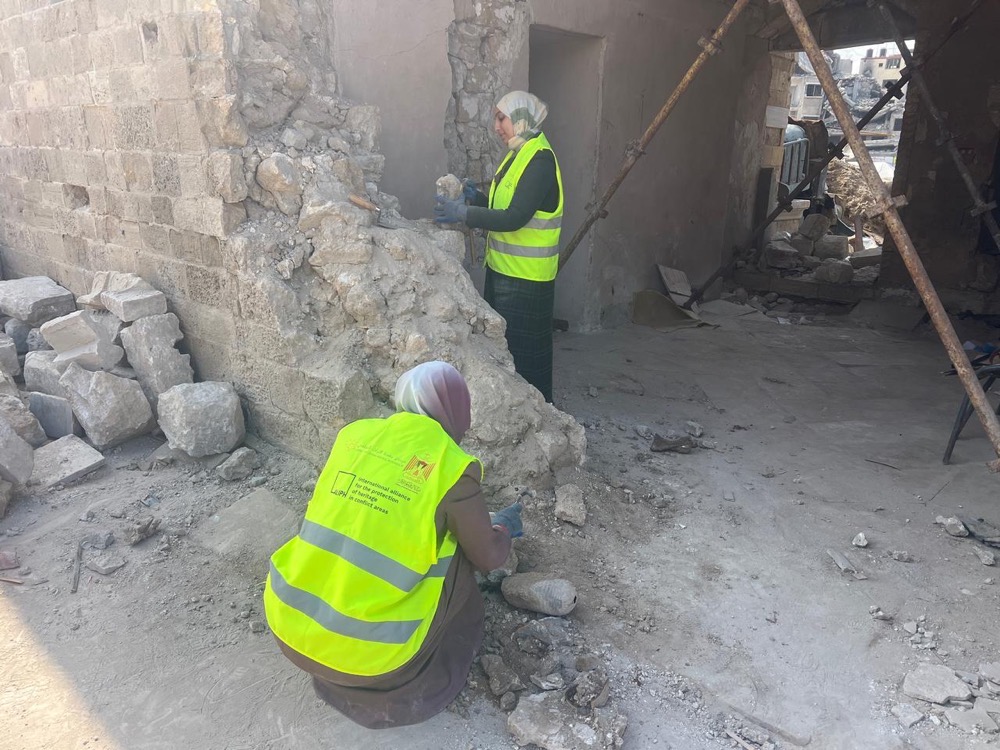
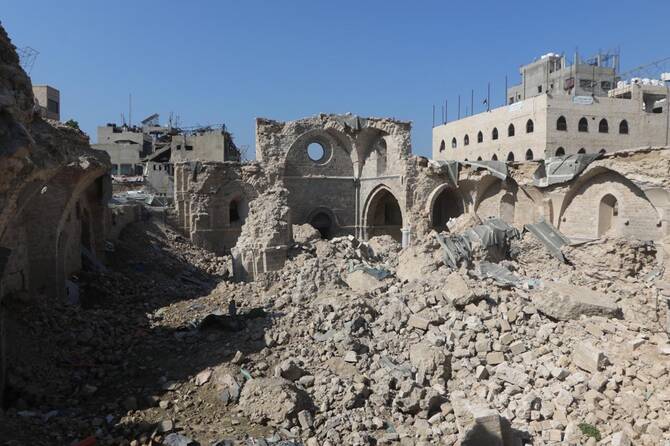
Emergency restoration work at Qasr Al-Basha in Gaza, almost completely destroyed in 2023. (Center for Cultural Heritage Preservation)
Today, thanks to emergency funding supplied by ALIPH, the International Alliance for the Protection of Heritage, those artefacts are stored in a relatively safe and secret place, in the hope that one day they can be returned to a restored museum.
The rescue of Palestine’s past is just one of 550 projects in 54 countries that have been funded by ALIPH since 2017.
The alliance was founded by France and the UAE at an international conference on heritage in danger, held in Abu Dhabi in December 2016 in the wake of widespread destruction of monuments, museums and heritage sites in conflict areas. Saudi Arabia was one of ALIPH’s founding members and remains one of its biggest contributors.
This month ALIPH announced additional funding of $16 million for 28 new projects supporting heritage in Gaza, Africa, Syria and Ukraine, bringing the total amount committed worldwide by the organization since 2017 to $116 million.
Much of that money has been spent on major projects, such as ALIPH’s response to the explosion in the port of Beirut in 2020. Since expanded to cover 37 individual projects — 26 of which have been completed — the commitment to Lebanon has reached $5.4 million.
ALIPH’s funding for Iraq, much of it in response to the destruction of multiple heritage sites by Daesh, has seen more than $31 million invested in 49 initiatives.

Smoke billowing during an Israeli strike on the besieged Palestinian territory. (AFP)
It began in 2018 with the massive project to rehabilitate the Mosul Museum, in which ALIPH invested $15.8 million in collaboration with the Louvre, the Smithsonian Institution, and the World Monuments Fund, working with local partners and Iraq’s State Board of Antiquities and Heritage.
ALIPH has also spent $3 million on 18 projects in Syria since 2019, working with 11 local operators to protect and restore archaeological sites, monuments, historic neighborhoods, museums and religious buildings.
The new program that ALIPH wants to implement in the coming months includes the rehabilitation of the Palmyra museum and its artifacts, and the stabilization of damaged monuments at the ancient site, where the destruction inflicted there by Daesh in 2015 was one of the key events that led to the alliance’s foundation.
But it is the much smaller sums invested in timely, emergency interventions, such as several funded by ALIPH in Gaza, that often have a disproportionately significant impact.

Muhannad Abu Lehia, left, and Mahmoud Abdul Ghafour, members of the Heritage Guardians Team of Mayasem Association for Culture and Arts, carry a Roman pottery jar to safety from the bombed Al-Qarara Museum in Khan Younis, Gaza. (Mayasem Association for Culture and Arts)
“We have quite a large number of small projects,” said Elke Selter, ALIPH’s director of programs. “And a lot of these are acute emergencies, when you actually can’t spend large amounts of money and just need to pay for an evacuation, for boxes to move objects, for tarpaulins to cover a hole in a roof, or for wooden panels to put in front of broken windows.”
The cost of such interventions, which can make all the difference to the future of a heritage site, can be just a few thousand dollars.
Larger, general applications for funding can be made through the regular calls for projects that are advertised on ALIPH’s website — the current call, in partnership with the EU, is for projects in Kazakhstan, Kyrgyzstan, Tajikistan, Turkmenistan, and Uzbekistan, and closes on July 31.
But ALIPH is also open year-round to requests for emergency assistance grants, worth up to $75,000 each, for which applicants must submit a brief, precise proposal for interventions designed “to halt or prevent irremediable heritage degradation that cannot wait until the next call for projects.”
“I believe that our emergency response is one of ALIPH’s main strategic advantages,” said Selter.
“We do very important projects also, before and after emergencies, but there are many others doing that too. In terms of being actively present, and being able to provide funding within 48 hours, if needed, we’re alone.”

Israeli troops deploy by Israel's border fence with the Gaza Strip. (AFP)
Part of the consideration of each emergency application is the risk posed to those on the ground.
With only a couple of dozen staff at headquarters in Geneva, ALIPH is “primarily a financial instrument, and so it’s not ALIPH that puts on its boots and its helmets and goes on site,” said Selter.
“But we work with local operators and provide funding to people on the ground who ask for it, and who are, at that moment, doing whatever they can to save heritage that is clearly important to them.
“These people are going to do it either way, so we can either help them, or not. And if you know that you’re one of the only ones that can help, I think there’s a duty to do so.”
ALIPH takes steps to ensure projects are as safe as possible.
“We try to do whatever we can in our power to make sure that the teams are as safe as they can possibly be, given the situations in which they work,” Selter added.
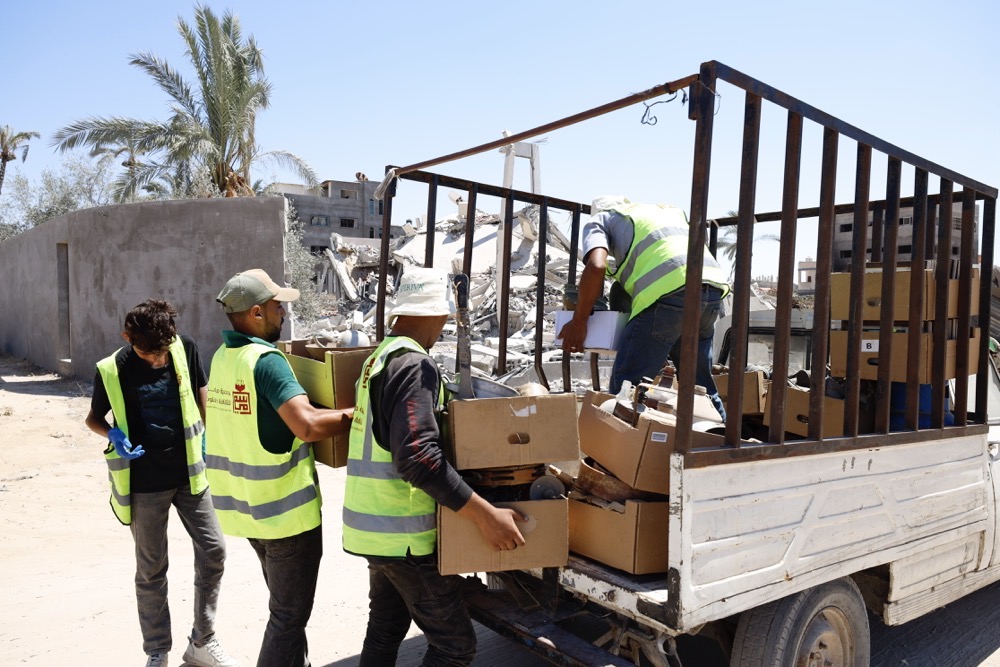
A truck bound for a secret destination is loaded with rescued artefacts from the ethnographic collection at Al-Qarara Museum. (Mayasem Association for Culture and Arts)
“In Gaza, for instance, we’ve put them in touch with UNMAS, the UN demining service, so that sites could first be checked.
“We stay in touch throughout a project, and in the particular case of Gaza we also make sure they understand that, for us, things like reporting deadlines are not essential.
“Of course, it’s important that the administration at some point is in order, but we don’t need them to risk their lives in order to send us a report within a deadline.”
In Gaza last year, ALIPH partnered with the Khan Younis-based Mayasem Association for Culture and Arts and teams from Al-Qarara Museum and The Palestinian Museum in Birzeit in the West Bank to inventory and evacuate Al-Qarara’s collection of more than 3,000 artefacts.
INNUMBERS
• 550 Projects that have been funded by ALIPH since 2017.
• $16m Additional funding for new projects unveiled by ALIPH this month.
• 28 New projects to support heritage in Gaza, Africa, Syria and Ukraine.
In April 2024, ALIPH also supported the urgent rescue from the rubble of surviving artifacts from the Rafah Museum, which, before it was almost completely destroyed by Israeli bombing, housed hundreds of objects related to Palestinian heritage, including a unique collection of traditional thobes.
ALIPH is currently supporting emergency protection and stabilization measures for the historic Qasr Al-Basha in Gaza, being undertaken by the Palestinian Center for Cultural Heritage Preservation.

Hamas fighters secure an area before handing over three Israeli hostages to a Red Cross team in Deir El-Balah. (AFP/File)
Once the seat of Mamluk and Ottoman power, the palace became a museum in 2010, housing collections of the Palestinian Antiquities Department, before it was almost completely destroyed in 2023.
Equally devastated was Al-Omari Mosque in the heart of Gaza’s old city, which was built in 1149 and has been repeatedly damaged, most recently in December 2023. Almost all that remains intact is the building’s minaret.
ALIPH is supporting the Ramallah-based Palestinian NGO Riwaq, the Center for Architectural Conservation, which is carrying out emergency stabilization and documenting the destruction to support any future work.
In February this year, ALIPH funded a damage assessment and stabilizing built heritage workshop in Cairo.
Run by the Egyptian Foundation for Heritage Rescue and the Center for Cultural Heritage Preservation of Bethlehem, it has prepared 20 Palestinian heritage professionals to form teams and intervene in Gaza as soon as the situation allows.

ALIPH has also spent $3 million on 18 projects in Syria since 2019. (Iconem)
More than 60 heritage professionals from Gaza, the West Bank and Cairo also attended an ALIPH-funded online course on risk management and undertaking emergency cultural heritage protection measures.
“We were really surprised that we had more than 60 participants,” said project manager Gala-Alexa Amagat.
“Something we see in every conflict we work in is that people attach such importance to preserving the heritage that they have.
“A lot of the people in Gaza who attended actually walked very far every morning to get to a place where they could get a connection and connect to that training, which was completely beyond what we expected.”
ALIPH relies on the generosity of donors, including nine member countries, public donors such as the EU, and private individuals and philanthropic foundations. Its next donor conference will be held in Abu Dhabi at the end of next year.
“Of course, the funding landscape is under serious pressure,” said Selter.
“But on the other hand, after eight years, ALIPH is becoming better known, which makes funding a bit easier. People know us now, and those who were hesitant at the beginning can see that we have delivered.

Working amid the chaos of the badly damaged Al-Qarara Museum, members of the Aliph-funded Mayasem Association for Culture and Arts carefully document artefacts prior to their evacuation. (Mayasem Association for Culture and Arts)
“We hope that our donors will remain committed and that they’re happy with the results that we’ve delivered.”
Ultimately, those results stand as a testament to the dedication of thousands of individuals around the world, from South America in the west to Indonesia in the east, many of whom are working in dangerous circumstances.
“The past belongs to all of us, and it is vital to protect our heritage to build a shared future,” said Valery Freland, ALIPH’s executive director.
“We are much more than just a funder. But the real heroes are our partners on the ground, who often face great challenges, but are committed to protecting the world’s heritage.”


