

In meeting with UN chief, Pakistan deputy PM calls for settlement of Palestine, Kashmir disputes

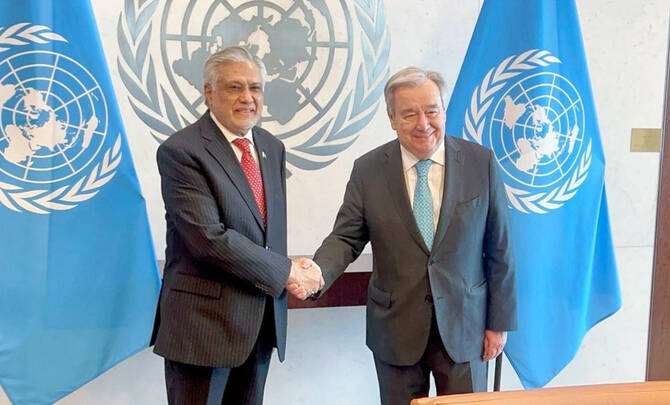
Pakistan’s deputy prime minister and foreign minister, Ishaq Dar, shakes hands with United Nations (UN) Secretary-General Antonio Guterres in New York on July 21, 2025. (PID)
Short Url
Updated 22 July 2025
Follow

In meeting with UN chief, Pakistan deputy PM calls for settlement of Palestine, Kashmir disputes

  • The meeting came amid Dar’s visit to the US to preside over key UN Security Council events during Pakistan’s presidency for July
  • The South Asian country is using its presidency of the UN Security Council to help refocus global attention on the crisis in Gaza

ISLAMABAD: Pakistan’s deputy prime minister and foreign minister, Ishaq Dar, has called for a just settlement of the Palestine and Kashmir disputes, the Pakistani foreign office said on Monday, following Dar’s meeting with United Nations (UN) Secretary-General Antonio Guterres in New York.

The meeting came amid Dar’s week-long visit to the United States (US) to preside over key events in the UN Security Council during Pakistan’s presidency for the month of July, according to the Pakistani foreign office.

The Pakistani deputy PM reassured the UN chief of Pakistan’s resolute commitment to multilateralism and the central role of the United Nations in addressing the most pressing global challenges.

“The DPM/FM reiterated Pakistan’s unwavering support for Palestinian statehood, an immediate ceasefire in Gaza, and firm opposition to Israel’s annexation plans in the West Bank,” the Pakistani foreign ministry said. 

Pakistan has maintained that the only viable remedy to the Palestine dispute was the realization of the two-state solution, which includes the establishment of Palestine as a viable, secure and contiguous state on the basis of pre-1967 borders.

The South Asian country is using its presidency of the UN Security Council to help refocus global attention on the crisis in Gaza and the wider Israeli-Palestinian conflict.

Dar reassured Secretary-General Guterres of Pakistan’s focus on strengthening the UN’s role in resolving conflicts, promoting sustainable development and upholding fundamental rights of all peoples, according to the foreign office. He said

Pakistan is fully committed to the purposes and principles of the UN Charter, especially the need to advance peace through dialogue and diplomacy.

The Pakistani deputy PM also discussed issues of critical national and regional importance to Pakistan, including the Jammu and Kashmir dispute, India’s violation of the Indus Waters Treaty (IWT) and “externally sponsored terrorism” in Pakistan.

“He stressed the imperative of a just settlement of the Jammu and Kashmir dispute in accordance with the resolutions of the Security Council,” the Pakistani foreign office said. “The DPM/FM lauded the Secretary-General’s leadership and sincere efforts for de-escalation of recent tensions between Pakistan and India.”

The Muslim-majority Himalayan region of Kashmir has been divided between Pakistan and India since their independence from British rule in 1947. Both countries rule parts of the Himalayan territory but claim it in full.

In May, the two neighbors engaged in a four-day military conflict over a militant attack in Indian-administered Kashmir that New Delhi blamed on Pakistan. Islamabad denied the charge.

Soon after the attack, which killed 26 tourists, New Delhi suspended the World Bank-brokered Indus Waters Treaty, which ensures water for 80 percent Pakistani farms, while Pakistan closed its airspace for Indian aircraft in a raft of measures against each other.

Dar on Monday also stressed the need for concessional financing and debt relief for developing nations to bridge funding gaps in meeting global sustainable development goals (SDGs).

The deputy premier was speaking at a debate of the High-Level Political Forum on Sustainable Development’s (HLPF) Ministerial Segment in New York for the follow-up and review of the 2030 Agenda for Sustainable Development and its 17 SDGs on Monday.

Dar said only 35 percent of the Agenda 2030 SDGs were on track and the compounding effects of the pandemic, food, fuel and finance crises as well as intensifying climate impacts had reversed the hard-won development gains and deepened inequalities.

“While national efforts are essential, these cannot succeed in isolation,” he said, calling for a “deep reform” of the international financial architecture to implement the SDGs.


Pakistan, global crypto exchange discuss modernizing digital payments, creating job prospects 

Updated 05 December 2025
Follow

Pakistan, global crypto exchange discuss modernizing digital payments, creating job prospects 

  • Pakistani officials, Binance team discuss coordination between Islamabad, local banks and global exchanges
  • Pakistan has attempted to tap into growing crypto market to curb illicit transactions, improve oversight

ISLAMABAD: Pakistan’s finance officials and the team of a global cryptocurrency exchange on Friday held discussions aimed at modernizing the country’s digital payments system and building local talent pipelines to meet rising demand for blockchain and Web3 skills, the finance ministry said.

The development took place during a high-level meeting between Finance Minister Muhammad Aurangzeb, Pakistan Virtual Assets Regulatory Authority (PVARA) Chairman Bilal bin Saqib, domestic bank presidents and a Binance team led by Global CEO Richard Teng. The meeting was held to advance work on Pakistan’s National Digital Asset Framework, a regulatory setup to govern Pakistan’s digital assets.

Pakistan has been moving to regulate its fast-growing crypto and digital assets market by bringing virtual asset service providers (VASPs) under a formal licensing regime. Officials say the push is aimed at curbing illicit transactions, improving oversight, and encouraging innovation in blockchain-based financial services.

“Participants reviewed opportunities to modernize Pakistan’s digital payments landscape, noting that blockchain-based systems could significantly reduce costs from the country’s $38 billion annual remittance flows,” the finance ministry said in a statement. 

“Discussions also emphasized building local talent pipelines to meet rising global demand for blockchain and Web3 skills, creating high-value employment prospects for Pakistani youth.”

Blockchain is a type of digital database that is shared, transparent and tamper-resistant. Instead of being stored on one computer, the data is kept on a distributed network of computers, making it very hard to alter or hack.

Web3 refers to the next generation of the Internet built using blockchain, focusing on giving users more control over their data, identity and digital assets rather than big tech companies controlling it.

Participants of the meeting also discussed sovereign debt tokenization, which is the process of converting a country’s debt such as government bonds, into digital tokens on a blockchain, the ministry said. 

Aurangzeb called for close coordination between the government, domestic banks and global exchanges to modernize Pakistan’s payment landscape.

Participants of the meeting also discussed considering a “time-bound amnesty” to encourage users to move assets onto regulated platforms, stressing the need for stronger verifications and a risk-mitigation system.

Pakistan has attempted in recent months to tap into the country’s growing crypto market, crack down on money laundering and terror financing, and promote responsible innovation — a move analysts say could bring an estimated $25 billion in virtual assets into the tax net.

In September, Islamabad invited international crypto exchanges and other VASPs to apply for licenses to operate in the country, a step aimed at formalizing and regulating its fast-growing digital market.