

Pakistan warns of fresh floods this week as monsoon-related deaths rise to 221

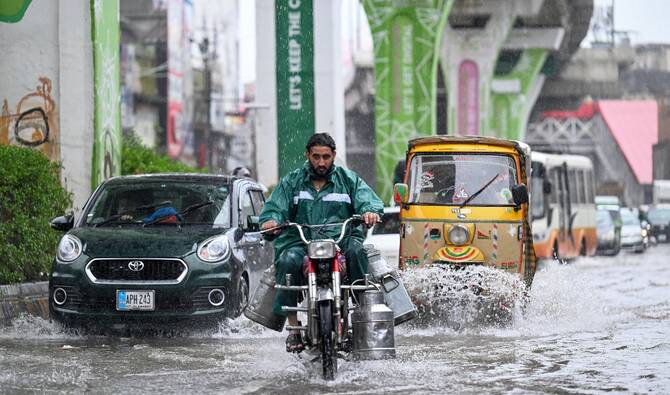
Commuters make their way through a flooded street during heavy monsoon rains in Rawalpindi on July 17, 2025. (AFP/ file)
Short Url
Updated 21 July 2025
Follow

Pakistan warns of fresh floods this week as monsoon-related deaths rise to 221

  • Punjab reports highest number of deaths at 135, followed by 46 in Khyber Pakhtunkhwa
  • Landslides may block roads in Galliyat, Kashmir and Gilgit-Baltistan during forecast period

ISLAMABAD: Pakistan is likely to witness more floods as a fresh rainy spell is likely to continue till July 25, the Pakistan Meteorological Department (PMD) on Monday, with the number of monsoon-related deaths rising to 221 since late June.

Pakistan’s most populous Punjab province has reported the highest number of deaths at 135, followed by 46 in Khyber Pakhtunkhwa, 22 in Sindh, 16 in Balochistan, and one each in the federal capital of Islamabad and Azad Kashmir.

The deceased included 104 children, 77 men and 40 women, according to a latest situation report shared by the National Disaster Management Authority (NDMA).

“Heavy rains may generate flash floods in local streams of Chitral, Dir, Swat, Shangla, Mansehra, Kohistan, Abbottabad, Buner, Charsadda, Nowshera, Swabi, Mardan, Murree, Galliyat, Islamabad/Rawalpindi, Hill torrents of DG Khan, Northeast Punjab and Kashmir from July 21-25,” the PMD said on Monday.

“Heavy Downpour may cause urban floods in low-lying areas of Islamabad/Rawalpindi, Gujranwala, Lahore, Sialkot, Sargodha, Faisalabad, Okara, Nowshera and Peshawar.”

During this period, landslides and mudslides may block roads in vulnerable areas of Murree, Galliyat, Kashmir and Gilgit-Baltistan, according to the PMD. Heavy rains, windstorms and lightning could also damage weak structures, electric poles, billboards, vehicles and solar panels.

Monsoon season brings South Asia 70 to 80 percent of its annual rainfall, arriving in early June in India and late June in Pakistan, and lasting through until September.

The annual rains are vital for agriculture and food security, and the livelihoods of millions of farmers. But increasingly erratic and extreme weather patterns are turning the rains into a destructive force.

In 2022, record-breaking monsoon rains combined with glacial melt submerged nearly a third of Pakistan, killing more than 1,700 people and displacing over 8 million. In May, at least 32 people were killed in severe storms, including strong hailstorms.


Pakistan high court pauses tree-cutting in Islamabad until Feb. 2

Updated 10 sec ago
Follow

Pakistan high court pauses tree-cutting in Islamabad until Feb. 2

  • Islamabad High Court asks CDA to ‘explain and justify’ tree-cutting at next hearing
  • CDA officials say 29,000 trees were cut due to allergies, deny felling in green belts

ISLAMABAD: The Islamabad High Court has ordered an immediate halt to tree-cutting in the federal capital until Feb. 2, seeking justification from civic authorities over the legality of a large-scale felling drive that has seen thousands of trees removed in recent months.

The interim order, issued by a single-judge bench led by Justice Khadim Hussain Soomro, came during proceedings on a petition challenging the Capital Development Authority’s (CDA) tree-cutting operations in Islamabad’s Shakarparian area and H-8 sector.

At the outset of the hearing, the petitioner’s counsel argued that trees were being felled in violation of the Pakistan Environmental Protection Act 1997, the Islamabad Wildlife Ordinance 1979 and the city’s master plan.

“Respondents shall not cut trees till the next date of hearing,” Justice Soomro said in the court order released on Friday while referring to CDA officials.

“Respondents are directed to come fully prepared and to file paragraph-wise comments before the next date of hearing, along with a comprehensive report explaining the justification and legal basis for the cutting of trees,” he added.

According to the court order, the petitioner maintained that the CDA had not made any public disclosure regarding the legal basis for the operation and that the felling was causing environmental harm.

The petition sought access to the official record of tree-cutting activities and called for the penalization of CDA officials responsible for the act under relevant criminal and environmental laws.

It also urged the court to impose a moratorium on infrastructure projects in Islamabad, order large-scale replanting as compensation and constitute a judicial commission headed by a retired Supreme Court judge to probe the alleged violations.

CDA officials acknowledge around 29,000 paper mulberry trees have been cut in the capital in recent months, arguing that the species triggers seasonal allergies such as sneezing, itchy eyes and nasal congestion.

They also maintain that no trees have been removed from designated green belts and that the number of replacement trees planted exceeds those felled.

Designed in the 1960s by Greek architect Constantinos Doxiadis, Islamabad was conceived as a low-density city with green belts and protected natural zones at its core.

Critics, however, say the recent felling has extended beyond paper mulberry trees and question whether authorities are adhering to the city’s master plan and the legal protections governing forested and green areas.

The court has adjourned its hearing until Feb. 2, 2026.