

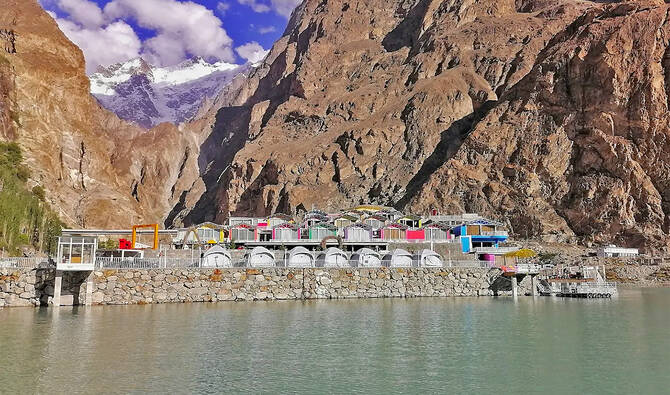

KHAPLU, Gilgit-Baltistan: Environmental experts, residents and activists have praised the government’s move this week to ban the construction of new hotels around lakes in Pakistan’s northern Gilgit-Baltistan (GB) region for five years, noting it would help protect the area’s natural sites.
Pakistan’s mountainous GB region is home to over 13,000 glaciers, more than any other country apart from the polar regions, as well as picturesque lakes, orchards and mountains. As per the GB Tourism Department, over one million tourists visited the area in 2024.
The rise of tourism in the area has led to the construction of new hotels, which have sparked concerns of increasing pollution, waste, lack of regulation and straining of water and power resources in the area.
A video by foreign vlogger George Buckley in June, showing allegedly untreated sewage being discharged into the region’s picturesque Attabad Lake, went viral on social media. It prompted calls for thorough checks and inspections of hotels in the area.
“Gilgit-Baltistan is becoming a forest of concrete due to the influx of tourism,” Syed Asrar ul Hasnain, an official of GB’s Environmental Protection Authority (EPA), told Arab News over the phone.
“The region was going toward an unregulated type of development. Due to this situation, our department sent a recommendation to the government to ban the issuing of NOCs [no objection certificates] for the new construction of hotels,” he added.
Hasnain vowed that authorities would ensure that hotels that were already functional in the region would also be monitored.
“The main objective behind the ban is the protection of natural beauties and the environment,” he said. “And initially, the ban is for five years.”
Kamal Khan, commissioner for the Baltistan region, said the construction of new hotels near lakes and “environmentally sensitive regions” in all four districts of the Baltistan region has been banned as well.
He stressed that sewerage treatment plants (STPs) should be part of hotels constructed near water bodies.
“[Unfortunately], the operational hotels don’t have STPs in the region,” Khan said. “And after filling the pits, the sewage water is mixed in the water body, and it is hazardous for human life and health.”
Noting that GB has a “fragile environment,” Khan vowed to protect it through such measures.
“We have directed all existing and functional hotels to make STPs in their hotel, if the hotels have a high number of rooms,” the commissioner said. “If they do not implement our order, we will seal the hotels.”
’GOOD OMEN’
Dr. Salaar Ali, head of the Department of Environmental Science at the University of Baltistan, appreciated the government’s move, saying it would help protect the natural environment.
“The lakes are not only a tourist destination, but many like Sadpara Lakes are a source of drinking water for the residents,” Dr. Ali told Arab News.
“And the protection of these lakes and areas should be our priority.”
He also called on authorities to ban the use of motorboats in the region, saying they were responsible for littering in freshwater bodies.
Kiran Qasim, a resident of Gilgit and a journalist, described the ban as a “very effective” measure, saying it would also help mitigate the effects of climate change.
“The construction around natural lakes also disturbs plants, birds and fish, etcetera,” she explained. “Instead of imposing a ban for only five years, the ban should be for a long period.”
Zahoor Ilahi, a social activist from Hunza Valley, said authorities should promote environmentally friendly constructions such as huts.
“On the other side, multi-story buildings are dangerous for our environment,” he said. “And there should be no exception for big investors. Laws should be implemented equally.”
Manzoor Hussain, the president of the Hotel Association of Hunza, described the ban as a “good omen” but echoed the same concern.
“We second this move, but there should be no difference between the rich and the poor,” Hussain said, calling on authorities to seal hotels that don’t meet environmental standards.
“The laws should be implemented to protect the environment, in a real manner, not just to get fame on social media,” Hussain said.


