Bangladesh’s Islamist party projects force with a big rally in Dhaka

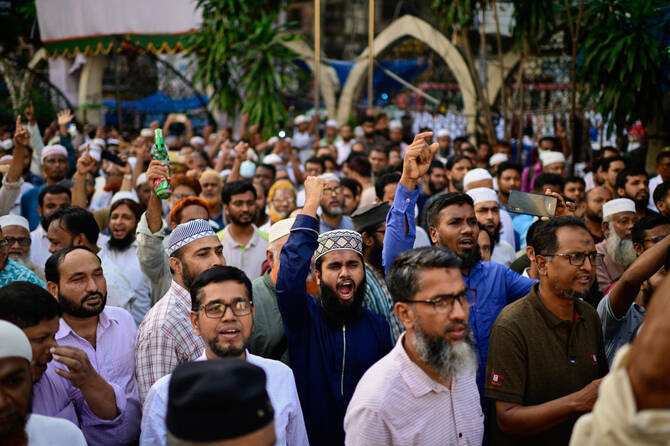
Jamaat-e-Islami activists condemn Wednesday’s attack in Gopalganj on National Citizen Party (NCP) leaders by supporters of the ousted Prime Minister Sheikh Hasina, during a protest in front of Baitul Mukarram National Mosque in Dhaka, July 17, 2025. (AP)
Short Url
Updated 19 July 2025
Follow

Bangladesh’s Islamist party projects force with a big rally in Dhaka

  • An interim government headed by Nobel Peace Prize laureate Muhammad Yunus said the next election would be held in April
  • Jamaat-e-Islami said earlier it would mobilize 1 million people on Saturday

DHAKA: Hundreds of thousands of supporters of Bangladesh’s largest Islamist party rallied in the capital on Saturday to show their strength ahead of elections expected next year, as the South Asian nation stands a t a crossroads after the ouster of former Prime Minister Sheikh Hasina.

An interim government headed by Nobel Peace Prize laureate Muhammad Yunus said the next election would be held in April but his administration did not rule out a possibility of polls in February as strongly demanded by the Bangladesh Nationalist Party and its allies.

Jamaat-e-Islami, which had sided with Pakistan during Bangladesh’s war of independence in 1971, said earlier it would mobilize 1 million people on Saturday.

While Hasina was in power from 2009 until she was toppled in student-led protests last year and fled to India, top leaders of Jamaat-e-Islami were either executed or jailed on charges of crimes against humanity and other serious crimes in 1971.

In late March in 1971 Pakistan’s military had launched a violent crackdown on the city of Dhaka, then part of East Pakistan, to quell a rising nationalist movement seeking independence for what is today known as Bangladesh.

The party on Saturday placed a seven-point demand to the Yunus-led administration to ensure a free, fair and peaceful election, the trial of all mass killings, essential reforms and proclamation and implementation of a charter involving last year’s mass uprising. It also wants the introduction of a proportional representation system in the election.

Thousands of supporters of Jamaat-e-Islami had spent the night on the Dhaka University campus before the rally. On Saturday morning, they continued to stream toward the Suhrawardy Udyan, a historical ground where the Pakistani army had surrendered to a joint force of India and Bangladesh on Dec. 16 in 1971, ending the nine-month war.

It was the first time the party was allowed to hold a rally on this ground since 1971. To many, the decision signaled a shift supported by Yunus’ government in which Islamists are gaining momentum with further fragmentation of Bangladesh’s politics and shrinking of liberal forces.

Hasina, whose father was the independence leader and the country’s first president, is a fierce political rival of Jamaat-e-Islami.

The party is expected to contest 300 parliamentary seats and is attempting to forge alliances with other Islamist groups and parties in hopes of becoming a third force in the country behind the BNP, headed by former Prime Minister Khaleda Zia, and Hasina’s former ruling Awami League party.

The party has a close connection with a new political party formed by students who led the anti-Hasina uprising. Both Jamaat-e-Islami and the students’ National Citizen Party also promote anti-India campaign.

The Yunus-led administration has banned the Awami League and Hasina has been in exile in India since Aug. 5. She is facing charges of crimes against humanity. The United Nations said in February that up to 1,400 people may have been killed during the anti-Hasina uprising in July-August last year.


Report highlights role of British Muslim charitable giving in supporting UK public services

Updated 05 December 2025
Follow

Report highlights role of British Muslim charitable giving in supporting UK public services

  • The study, “Building Britain: British Muslims Giving Back,” finds that donations from British Muslims are helping to bolster overstretched service

LONDON: British Muslim charitable giving is playing an increasingly significant role in supporting frontline public services across the UK, according to a new report by policy and research organization Equi.

The study, “Building Britain: British Muslims Giving Back,” finds that donations from British Muslims are helping to bolster overstretched services, including local councils, the NHS and welfare systems, at a time of growing financial pressure.

The report estimates that Muslim donors contribute around £2.2 billion ($2.9 billion) annually, making them the UK’s most generous community.

This figure is around four times the national giving average and rises to almost 10 times the average among higher earners.

According to the findings, Muslim-led charities are providing a wide range of support, including housing assistance, emergency cash grants, food provision and mental health services, easing demand on statutory services.

Equi points to evidence from 2023 showing that housing support delivered by the National Zakat Foundation helped prevent evictions that would have cost councils an estimated £28.8 million, with every £1 of charitable spending generating £73 in public sector savings.

The report also highlights a generational shift, with younger British Muslims increasingly directing their donations toward domestic causes such as homelessness, child poverty and mental health challenges.

Despite their growing impact, Muslim charities face a number of barriers, including de-banking, restrictive funding rules, securitization measures and what the report describes as limited recognition from government. Equi argues that these challenges are constraining the sector’s ability to maximize its contribution.

“British Muslim giving is not just generosity but a lifeline for public services that needs recognizing,” said Equi Managing Director Prof. Javed Khan.

“From preventing evictions to supporting mental health, these donations are saving millions for the taxpayer and strengthening communities across Britain. The evidence is clear that Muslim-led action is delivering frontline support where the state is struggling,” he added.

Equi is calling on policymakers to engage more closely with Muslim-led charities and to move beyond what it describes as symbolic recognition.

The report recommends measures such as UK-based match-funding schemes and greater faith literacy within policymaking, which it says could unlock billions of pounds in additional domestic spending while maintaining the UK’s global humanitarian commitments.

The study concluded that with greater collaboration between government and Muslim charities, charitable giving could play an even more transformative role in strengthening public services and social cohesion across the country.