

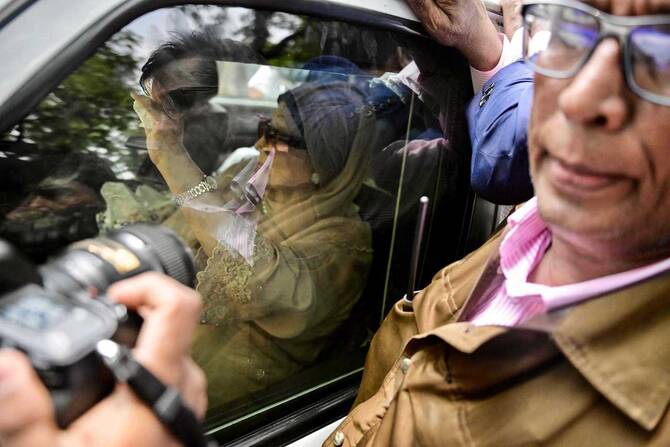

DHAKA: Bangladesh’s former Prime Minister Khaleda Zia drew large crowds of supporters on Tuesday as she returned to Dhaka after four months of medical treatment in London.
The 78-year-old leader of the main opposition — the Bangladesh Nationalist Party — was welcomed by thousands of supporters, some waving Bangladesh and BNP flags, who gathered amid tight security outside Dhaka’s main airport and along the road leading to her residence.
Zia’s homecoming comes at a transformative period for Bangladesh, which has been governed by an interim administration led by Nobel prize laureate Prof. Muhammad Yunus, since former Prime Minister Sheikh Hasina was ousted in a student-led mass uprising last August.
“The spontaneous students-led uprising of Aug. 5 has brought a new pride and prospect for the country. Amid this changed political landscape, Begum Zia’s influence over politics has increased even further,” Zahir Uddin Swapan, a member of the BNP advisory council, told Arab News, using the South Asian term of respect for a woman of high rank.
“Today’s grand reception by the countrymen following her arrival is a strong testimony of that.”
Zia arrived on Tuesday morning on a special air ambulance arranged by Qatar’s Emir Sheikh Tamim bin Hamad Al-Thani, who also arranged her transport to London in January for long-sought medical treatment.
She has been confined to a wheelchair with rheumatoid arthritis, and has also battled various ailments including diabetes and cirrhosis of the liver.
The three-time prime minister was Hasina’s chief political rival.
In 2018, during Hasina’s 15 years of uninterrupted rule, she was convicted and sentenced to 17 years in prison on charges of embezzlement from charitable trusts, which were denounced by the BNP as politically motivated.
In 2020, Hasina suspended Zia’s jail term and placed her on house arrest on health grounds, under the condition that she refrain from traveling abroad and participating in politics.
Zia was released from house arrest a day after Hasina fled Dhaka, and has since been acquitted of the corruption charges against her.
With her return becoming the talk of the nation, experts said that Zia’s presence in the country was important for the future of Bangladesh.
“Her return at this point of time can be very positive to unite the different political forces against fascism because Khaleda Zia is a unifying character in Bangladesh,” Mahmudur Rahman, owner and editor of Bengali daily Amar Desh, told Arab News.
“Her very presence is important for political unity in this country. So I think this will strengthen our fight, our struggle against fascism and against hegemonic power.”
Hasina and Zia have dominated Bangladeshi politics since 1991, alternating in power after inheriting the political movements of the two assassinated rulers who led the country in its first decade.
Hasina led the Awami League of her father, state founder Mujibur Rahman, who was assassinated in 1975, while Zia took over the BNP from her husband, military ruler Ziaur Rahman, who was killed in 1981.
Before political rivalry embittered their relationship and fuelled a lengthy feud, the two women leaders had joined hands to lead a popular uprising for democracy that toppled military ruler Hossain Mohammad Ershad from power in 1990.
After Bangladesh held what was hailed as its first free election in 1991, Zia became the nation’s first woman prime minister.
“All the politicians, young and old, looked to her as sort of a guardian, as sort of a mother figure for Bangladesh. So her importance and her influence on the politics of Bangladesh is immense,” Rahman said.
Bangladesh is now expected to hold its first vote since Hasina’s ouster, with the country’s interim government stating that elections could take place by the end of 2025 or in the first half of 2026.
Zia’s return is symbolic for many Bangladeshis, as she is a figure of both integrity and sovereignty, said Prof. A.S.M. Amanullah, sociologist and vice-chancellor of the National University.
“Her return to Bangladesh means a lot. She is the symbol of democracy. She has become the symbol of trust. And, throughout the process of the last one decade she has become the unparalleled leader of democracy.
“And, at the same time, the people of this country, they love her very much,” Amanullah told Arab News.
Her importance was tied to her track record of unwillingness to compromise on or “sacrifice the democratic process” in Bangladesh, he added.
“That is (at) the point she became the leader of the mass(es) (of) people because of her uncompromising role during the Ershad regime, and at the same time during the last 15 years or so,” Amanullah said.
“Irrespective of political affiliation and irrespective of political parties and irrespective of class, caste, and creed, she became an unparalleled political figure in Bangladesh.”


