

Pakistan says Kashmir tourist attack probe ‘inconclusive’ as US blacklists militant group

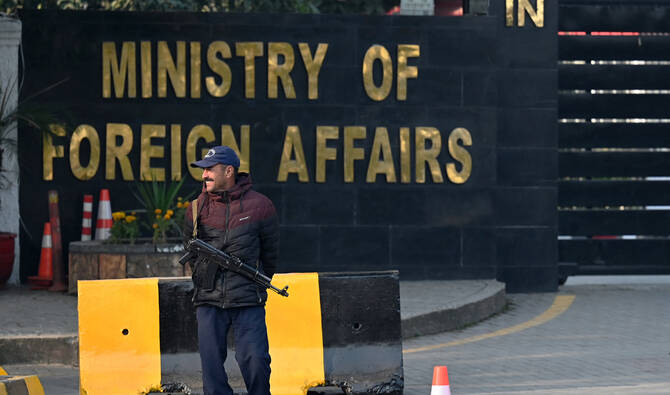
A Pakistani police officer stands guard outside the Ministry of Foreign Affairs in Islamabad on January 18, 2024. (AFP/File)
Short Url
Updated 18 July 2025
Follow

Pakistan says Kashmir tourist attack probe ‘inconclusive’ as US blacklists militant group

  • US designated The Resistance Front a ‘terrorist organization’ for briefly claiming responsibility for Pahalgam attack
  • Islamabad says New Delhi has ‘a track record of exploiting such designations to push anti-Pakistan propaganda’

ISLAMABAD: Pakistan said on Friday a probe into the April killing of 26 tourists in Indian-administered Kashmir remained inconclusive, hours after the United States designated a Lashkar-e-Taiba-affiliated group as a terrorist entity, and accused India of using such listings to spread an anti-Pakistan narrative internationally.

The group in question, The Resistance Front (TRF), also known as Kashmir Resistance, was blacklisted by Washington on Thursday as a “foreign terrorist organization” and “specially designated global terrorist” in connection with the April 22 attack in Pahalgam.

In a statement, US Secretary of State Marco Rubio said the group had claimed responsibility for the assault before withdrawing its statement, and described TRF as a “front and proxy” of Lashkar-e-Taiba, a Pakistan-based outfit banned under US law.

Responding to the development, Pakistan’s foreign office said it had “zero tolerance” for militant entities, though any link between TRF and Lashkar-e-Taiba “belies ground realities,” noting the latter was a defunct group that had been banned in Pakistan.

“Investigations into the Pahalgam incident, that happened in the internationally recognized disputed region of IIOJK, are still inconclusive,” the statement read, using Pakistan’s official abbreviation for Indian Illegally Occupied Jammu and Kashmir.

“Pakistan has effectively and comprehensively dismantled concerned outfits, arrested and prosecuted the leadership, and deradicalized its cadres,” it continued.

The foreign office also said India had a track record of leveraging such terror listings to deflect global scrutiny from its human rights record in Kashmir and elsewhere.

“India has a track record of exploiting such designations to push anti-Pakistan propaganda with a view to divert international attention from its irresponsible and rogue behavior, including ongoing human rights atrocities, especially in IIOJK,” the statement said.

Pakistan cited its cooperation with international partners against extremist groups and the arrest of high-profile militants, including Sharifullah, the alleged mastermind of the 2021 Abbey Gate bombing in Kabul that killed 13 US service members and about 170 Afghan civilians.

In April, after India blamed Pakistan for the Pahalgam attack, Islamabad called for a neutral and impartial investigation.

The attack triggered days of cross-border hostilities, with India targeting what it described as “terrorist infrastructure” in Pakistan on May 7. The escalation — involving missiles, drones and artillery — left dozens dead before a ceasefire was announced on May 10.

The foreign office said Pakistan urged the international community to adopt “objective and non-discriminatory policies” on counterterrorism and called for other groups, such as the Majeed Brigade of the Balochistan Liberation Army (BLA), to be designated under US law.

Pakistan has repeatedly accused the BLA and other separatist groups operating in the volatile southwestern province of Balochistan of being Indian proxies, a claim New Delhi denies.

With input from Reuters


Pakistan high court pauses tree-cutting in Islamabad until Feb. 2

Updated 10 sec ago
Follow

Pakistan high court pauses tree-cutting in Islamabad until Feb. 2

  • Islamabad High Court asks CDA to ‘explain and justify’ tree-cutting at next hearing
  • CDA officials say 29,000 trees were cut due to allergies, deny felling in green belts

ISLAMABAD: The Islamabad High Court has ordered an immediate halt to tree-cutting in the federal capital until Feb. 2, seeking justification from civic authorities over the legality of a large-scale felling drive that has seen thousands of trees removed in recent months.

The interim order, issued by a single-judge bench led by Justice Khadim Hussain Soomro, came during proceedings on a petition challenging the Capital Development Authority’s (CDA) tree-cutting operations in Islamabad’s Shakarparian area and H-8 sector.

At the outset of the hearing, the petitioner’s counsel argued that trees were being felled in violation of the Pakistan Environmental Protection Act 1997, the Islamabad Wildlife Ordinance 1979 and the city’s master plan.

“Respondents shall not cut trees till the next date of hearing,” Justice Soomro said in the court order released on Friday while referring to CDA officials.

“Respondents are directed to come fully prepared and to file paragraph-wise comments before the next date of hearing, along with a comprehensive report explaining the justification and legal basis for the cutting of trees,” he added.

According to the court order, the petitioner maintained that the CDA had not made any public disclosure regarding the legal basis for the operation and that the felling was causing environmental harm.

The petition sought access to the official record of tree-cutting activities and called for the penalization of CDA officials responsible for the act under relevant criminal and environmental laws.

It also urged the court to impose a moratorium on infrastructure projects in Islamabad, order large-scale replanting as compensation and constitute a judicial commission headed by a retired Supreme Court judge to probe the alleged violations.

CDA officials acknowledge around 29,000 paper mulberry trees have been cut in the capital in recent months, arguing that the species triggers seasonal allergies such as sneezing, itchy eyes and nasal congestion.

They also maintain that no trees have been removed from designated green belts and that the number of replacement trees planted exceeds those felled.

Designed in the 1960s by Greek architect Constantinos Doxiadis, Islamabad was conceived as a low-density city with green belts and protected natural zones at its core.

Critics, however, say the recent felling has extended beyond paper mulberry trees and question whether authorities are adhering to the city’s master plan and the legal protections governing forested and green areas.

The court has adjourned its hearing until Feb. 2, 2026.