Pakistan posts first annual current account surplus in 14 years

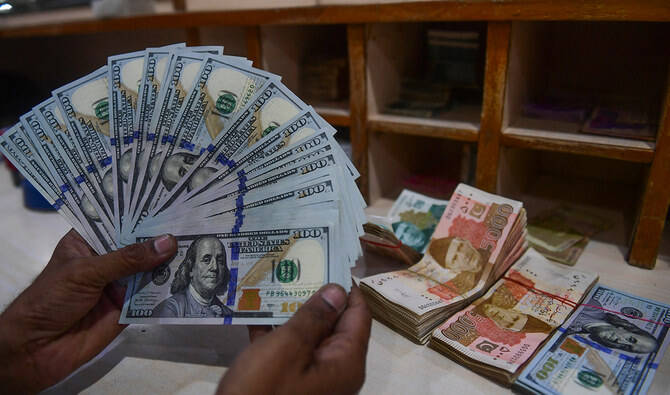
A foreign currency dealer counts US dollars at a shop in Karachi, Pakistan, on May 19, 2022. (AFP/File)
Short Url
Updated 18 July 2025
Follow

Pakistan posts first annual current account surplus in 14 years

  • Stock market hits record 140,000 points amid macroeconomic rebound under IMF program
  • Remittances top $38 billion, foreign direct investment, textile exports also rise in FY25

KARACHI: Pakistan has posted a full-year current account surplus for the first time in 14 years, alongside record-breaking performance in its equity market, reflecting broad signs of economic stabilization under the country’s $7 billion IMF program approved in September 2024.

Khurram Schehzad, adviser to the finance ministry, shared the data on social media, highlighting a $328 million current account surplus in June 2025.

“Country’s Current Account (CA) for June 2025 closes in $328Mn Surplus, taking full-year Surplus to over $2.1Bn — annual Surplus recorded after 14 years, and the largest Surplus in 22 years,” the adviser wrote on X. 

He said textile exports rose by 7.4 percent year-on-year to $17.9 billion, foreign direct investment increased 5 percent to $2.5 billion, and remittances surged 27 percent to a record $38 billion.

The Real Effective Exchange Rate (REER) dropped further to 96.6, enhancing the Pakistani rupee’s competitiveness against the dollar, which would support the country’s exports and keep the external account in check, Schehzad said.

He also cited a rally in the Pakistan Stock Exchange, where the benchmark KSE-100 index crossed 140,000 points for the first time, with market capitalization exceeding Rs16.8 trillion (about $60 billion). He noted that Pakistan is currently ranked the fourth-best performing equity market globally in July 2025 to date.

According to Topline Securities, the FY25 current account surplus of $2.1 billion (0.5 percent of GDP) marks a sharp turnaround from a $2 billion deficit in FY24, driven by a 27 percent increase in remittances and a 16 percent drop in services deficit. The goods deficit, however, grew to $27 billion.

Topline added that the surplus was bolstered by record-high March remittances of over $4 billion and structural reforms that reduced the exchange rate differential between official and informal channels.

Looking ahead, the brokerage house expects a mild current account deficit of $0.5–1.5 billion (0.1–0.3 percent of GDP) in FY26.

The economic turnaround follows structural reforms implemented under the IMF program, including currency market liberalization, energy pricing reforms and taxation measures aimed at unlocking further global financing and restoring investor confidence.


Pakistan likely to import around 7 million cotton bales this year as local production nearly halves

Updated 5 sec ago
Follow

Pakistan likely to import around 7 million cotton bales this year as local production nearly halves

  • Pakistan produced 5.3 million cotton bales by mid-December against 10 million targeted, government data shows
  • While the imports may ensure smooth supply of raw material, they may put pressure on foreign exchange reserves

KARACHI: Pakistan is likely to import around 7 million cotton bales this year owing to a decline of nearly half the annual target set by the Federal Committee on Agriculture (FCA), industry stakeholders said on Tuesday.

Pakistan’s cotton production stood at 5.3 million bales each weighing 170 kilograms as of Dec. 15, according to state-run Pakistan Central Cotton Committee (PCCC) data. The FCA had set a target of 10.2 million bales in April.

Karachi Cotton Brokers Forum (KCBF) Chairman Naseem Usman Osawala sees the country’s cotton production declining by 46 percent this season, compared to the FCA target.

“The country is expected to produce about 5.5 million bales this year,” he told Arab News, adding Pakistan would have to import around 7 million bales to meet requirement of its textile industry which consumes about 12 million bales a year.

The country had sown cotton over 2.002 million hectares, which was down by 11 percent from the targeted 2.26 million hectares.

Muhammad Waqas Ghani, head of research at Karachi-based JS Global Capital brokerage firm, said the South Asian country is likely to miss its cotton output target of 10 million bales.

“At the current rate of arrival, the output can reach 7 million bales at its best,” he added.

Cotton is a raw material for Pakistan’s largest textile industry and was the worst hit crop by climate-induced floods earlier this year.

Osawala said Pakistan’s cotton production has been falling because of an increasing number of sugar mills being established in the country’s cotton-producing regions.

Courts in Pakistan have been issuing significant rulings to bar the establishment of sugar mills in the designated cotton belt areas of the Punjab province. In 2018, the Supreme Court ordered relocation of three sugar mills from cotton-producing districts in southern Punjab to protect the crop.

Since cotton prices are low in the international market, textile millers would go for more imports, according to the KCBF chairman.

On Dec. 22, the price of cotton in the New York market stood at as much as 65.85 cents per pound, 1.64 cents lower than last year, according to the PCCC data.

Osawala said Pakistan’s increasing textile imports are also “hurting local cotton production.”

According to the Pakistan Bureau of Statistics’ (PBS) July-November data, the country had imported raw cotton, synthetic fiber, synthetic and artificial silk yarn and worn clothing worth $2.82 billion, 5 percent more than the imports during the same period last year.

Speaking of the impact of Pakistan’s falling cotton production, Kamran Arshad, chairman of All Pakistan Textile Mills Association (APTMA), said the millers would have to import “a lot of cotton” this year.

“I think approximately 7-7.5 million bales will have to be imported this year,” he said.

The textile and apparel sector is Pakistan’s largest exporter, accounting for more than half of the country’s overall exports and contributing around 8.5 percent of the gross domestic product (GDP) by employing nearly 40 percent of the industrial labor force. But high energy costs and outdated infrastructure among other factors continue to slow growth and leave the country trailing regional peers.

In the last fiscal year, Pakistan imported as much as 6.2 million cotton bales each weighing 220 kilograms, mostly from Brazil and the United States, according to KCBF Chairman Arshad.

Shankar Talreja, head of research at Karachi-based Topline Securities, said Pakistan is likely to import cotton worth $1.2 billion this year “considering the requirement.”

“The full-year import of cotton is likely to remain over $1 billion,” Talreja said.

Economic experts say while importing more cotton would ensure smooth supply of raw material to Pakistan’s textile sector, it may put pressure on the country’s foreign exchange reserves that rose to $15.9 billion last week after the International Monetary Fund (IMF) released a $1.2 billion tranche under Pakistan’s $7 billion loan program.