

Pakistan launches major electric vehicle push, targets students and unemployed

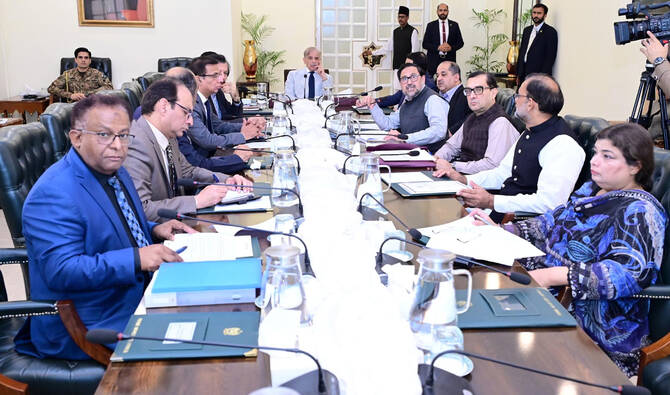
Prime Minister Shehbaz Sharif (center) chairs a meeting on the usage of electric vehicles, in Islamabad, Pakistan, on July 18, 2025. (PID)
Short Url
Updated 18 July 2025
Follow

Pakistan launches major electric vehicle push, targets students and unemployed

  • The scheme, likely to be launched soon, will provide free electric bikes to students who perform exceptionally well at the intermediate level
  • Last month, Pakistan also unveiled a new Electric Vehicle Policy 2025–2030, which targets 30 percent of all new vehicle sales to be electric by 2030

ISLAMABAD: The Pakistani federal government is targeting students and unemployed individuals in a major scheme to promote the use of electric vehicles, Prime Minister Shehbaz Sharif announced on Friday, saying the move will save billions of dollars in fuel imports, help protect environment and promote local industry.

The prime minister said this while presiding over a meeting in Islamabad to review promotion of electric vehicles in the country and the government assistance in acquisition of electric bikes, rickshaws and loaders, according to Sharif’s office.

The proposed scheme comes amid the cash-strapped South Asian country’s efforts to avoid costly oil imports that shrank five percent to $15 billion from July 2024 till May 2025, according to latest official figures. Islamabad is currently trying to formulate a plan to make electric vehicles accessible to people.

Officials briefed participants of Friday’s meeting that steps were being taken to enable people to acquire electric bikes, rickshaws and loaders through low-cost loans and the government will assist provision of more than 100,000 electric bikes and 3,000 rickshaws and loading vehicles.

“The federal government, including the federal board, will provide electric bikes to the toppers of boards across the country,” Sharif was quoted as saying. “The government will provide electric rickshaws and loaders to unemployed people for employment on a priority basis.”

Under the scheme, which is likely to be launched soon, free electric bikes will be provided to students who have shown exceptional performance at the intermediate level in educational boards across the country, according to Sharif’s office. A special quota of 25 percent has been kept for women, while the quota of provinces has been allocated in proportion to the population.

Pakistan last month unveiled a new Electric Vehicle (EV) Policy 2025–2030, which targets 30 percent of all new vehicle sales to be electric by 2030. The policy, which covers cars, buses, motorcycles and rickshaws, aims to accelerate the country’s shift toward sustainable transport, reduce fossil fuel dependence, and curb climate-warming emissions.

Sharif instructed officials to ensure a complete ecosystem for the production and maintenance of electric vehicles in the country, preferring people belonging to the economically weaker section in the government’s scheme.

“Third-party validation should be done for the entire mechanism of distribution of electric vehicles and government assistance in it,” he said.

Officials informed the meeting’s participants that four new battery manufacturing companies are starting their operations in the country, which will create new business opportunities and employment in Pakistan.

“The prime minister instructed [officials] to ensure that the electric bikes, rickshaws and loaders provided in the proposed scheme meet the best quality and safety standards,” Sharif’s office said.


Pakistan disburses record $9.2 billion agricultural loans in FY25, central bank says

Updated 57 min 40 sec ago
Follow

Pakistan disburses record $9.2 billion agricultural loans in FY25, central bank says

  • State Bank says farm lending rose 16 percent year-on-year to Rs2.58 trillion
  • Inflation eased to 5.8 percent in January as GDP growth hits 3.7 percent in Q1 FY26

KARACHI: Pakistan disbursed a record Rs2.58 trillion ($9.2 billion) in agricultural loans during fiscal year 2024–25, a 16 percent increase from the previous year, State Bank of Pakistan (SBP) Governor Jameel Ahmad said on Thursday while chairing a meeting of the Agricultural Credit Advisory Committee (ACAC).

Agricultural financing is considered critical to Pakistan’s rural economy, where farming contributes nearly one-fifth of GDP and employs a large share of the workforce. The government has repeatedly emphasized expanding credit access to small farmers as part of broader efforts to boost productivity, stabilize food supply and support economic recovery under an IMF-backed reform program.

According to official data shared at the meeting, agricultural credit disbursement reached Rs2.58 trillion in FY25, marking a record high. In the first half of FY26 alone, banks disbursed Rs1,412 billion in agricultural loans, while the number of borrowers increased to 2.97 million.

“During fiscal year 2025, record agricultural loans of Rs2.58 trillion were disbursed, reflecting an annual growth of 16 percent,” the State Bank governor said, according to a statement issued after the meeting.

He added that Pakistan had regained macroeconomic stability and that the economy was moving toward sustainable growth.

The governor said GDP growth in the first quarter of FY26 stood at 3.7 percent, while full-year growth was projected between 3.75 percent and 4.75 percent.

He also noted that headline inflation had declined to 5.8 percent in January 2026.

The committee reviewed measures to further expand credit access, including greater use of the central bank’s Zarkhez-e scheme to facilitate agricultural lending. Members also discussed promoting electronic warehouse receipt financing to enhance post-harvest liquidity and reduce distress sales of crops.

The statement said the purpose of electronic warehouse receipt financing was to “reduce forced sales of crops and strengthen linkages within the agricultural market.”

Agricultural lending has been a focus of Pakistan’s financial inclusion strategy, particularly as policymakers seek to improve rural incomes, stabilize food prices and strengthen export-oriented crop production amid broader economic reforms.