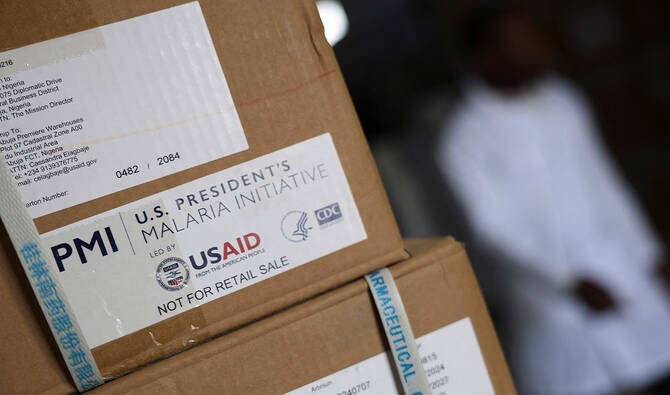

WASHINGTON, US: The United States’ destruction of a warehouse worth of emergency food that had spoiled has drawn outrage, but lawmakers and aid workers say it is only one effect of President Donald Trump’s abrupt slashing of foreign assistance.
The Senate early Thursday approved nearly $9 billion in cuts to foreign aid as well as public broadcasting, formalizing a radical overhaul of spending that Trump first imposed with strokes of his pen on taking office nearly six months ago.
US officials confirmed that nearly 500 metric tons of high-nutrition biscuits, meant to keep alive malnourished children in Afghanistan and Pakistan, were incinerated after they passed their expiration date in a warehouse in Dubai.
Lawmakers of the rival Democratic Party said they had warned about the expiring food since March. Senator Tim Kaine said that the inaction in feeding children “really exposes the soul” of the Trump administration.
Michael Rigas, the deputy secretary of state for management, acknowledged to Kaine that blame lay with the shuttering of the US Agency for International Development (USAID), which was merged into the State Department after drastic cuts.
“I think that this was just a casualty of the shutdown of USAID,” Rigas said Wednesday.
State Department spokeswoman Tammy Bruce, however, took a more defiant tone Thursday, saying the biscuits represented less than one percent of US global food aid, using figures that appeared to come from before Trump’s cutbacks.
“We will not be lectured about the issue of food aid or what we do for the rest of the world,” she said.
The Atlantic magazine, which first reported the episode, said that the United States bought the biscuits near the end of Biden administration for around $800,000 and that the Trump administration’s burning of the food was costing taxpayers another $130,000.
For aid workers, the biscuit debacle was just one example of how drastic and sudden cuts have aggravated the impact of the aid shutdown.
Kate Phillips-Barrasso, vice president for global policy and advocacy at Mercy Corps, said that large infrastructure projects were shut down immediately, without regard to how to finish them.
“This really was yanking the rug out, or turning the the spigot off, overnight,” she said.
She pointed to the termination of a USAID-backed Mercy Corps project to improve water and sanitation in the turbulent east of the Democratic Republic of Congo. Work began in 2020 and was scheduled to end in September 2027.
“Infrastructure projects are not things where 75 percent is ok. It’s either done or it’s not,” she said.
The House of Representatives is expected late Thursday to finalize the end of funding for what White House Press Secretary Karoline Leavitt called “$9 billion worth of crap.”
It includes ending all $437 million the United States would have given to several UN bodies including the children’s agency UNICEF and the UN Development Programme. It also pulls $2.5 billion from development assistance.
Under pressure from moderate Republicans, the package backs off from ending PEPFAR, the anti-HIV/AIDS initiative credited with saving 25 million lives since it was launched by former president George W. Bush more than two decades ago.
Republicans and the Trump-launched Department of Government Efficiency, initially led by tycoon Elon Musk, have pointed to projects they argue do not advance US interests.
“We can’t fund transgender operas in Peru with US taxpayer dollars,” House Speaker Mike Johnson told reporters, an apparent reference to a US grant under the Biden administration for the staging of an opera in Colombia that featured a transgender protagonist.
The aid cuts come a week after the State Department laid off more than 1,300 employees as Secretary of State Marco Rubio ended or merged several offices, including those on climate change, refugees and human rights.
Rubio called it a “very deliberate step to reorganize the State Department to be more efficient and more focused.”
Senate Democrats issued a scathing report that accused the Trump administration of ceding global leadership to China, which has been increasing spending on diplomacy and disseminating its worldview.
The rescissions vote “will be met with cheers in Beijing, which is already celebrating America’s retreat from the world under President Trump,” said Jeanne Shaheen, the top Democrat on the Senate Foreign Relations Committee.