Britain seeks German help against people smuggling gangs on landmark Merz visit

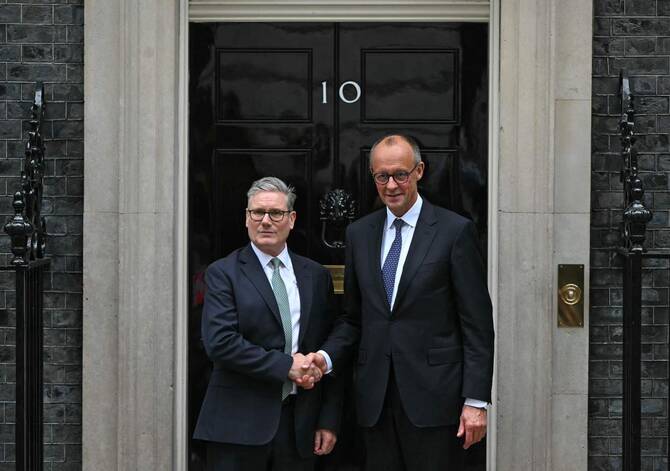
Britain’s Prime Minister Keir Starmer shakes hands with Germany’s Chancellor Friedrich Merz, as they pose for a photo outside 10 Downing Street in London on July 17, 2025. (AFP)
Short Url
Updated 17 July 2025
Follow

Britain seeks German help against people smuggling gangs on landmark Merz visit

  • Keir Starmer and Friedrich Merz signed the first ever ‘friendship treaty’ between their countries at London’s Victoria and Albert Museum
  • Undocumented migration has become a major headache for Starmer’s year-old Labour government, as support for the anti-immigrant Reform UK party soars

LONDON: Britain sought a firm commitment Thursday from Germany to change its law to help smash people smuggling gangs, as the two countries agreed to boost defense ties on the first official UK visit by German Chancellor Friedrich Merz.

The trip comes a week after undocumented migrants also topped the political agenda during a state visit to Britain by French President Emmanuel Macron.

UK Prime Minister Keir Starmer and Merz signed the first ever “friendship treaty” between their countries at London’s Victoria and Albert Museum before heading for talks at the PM’s Downing Street office.

Merz said London and Berlin had agreed an exchange program for German and British students.

Speaking in German, he said he believed allowing the “young generation” to get to know each other and their respective countries was a “good basis for the further development of our relations.”

The two leaders were also expected to unveil a deal to jointly produce military goods such as Boxer armored vehicles and Typhoon jets, which could lead to “billions of pounds of additional defense exports,” Downing Street said.

They were to commit to developing a precision strike missile with a range of more than 2,000 kilometers (1,250 miles) in the next decade.

“Chancellor Merz’s commitment to make necessary changes to German law to disrupt the supply lines of the dangerous vessels which carry illegal migrants across the Channel is hugely welcome,” Starmer said ahead of the talks.

His office said it was hoped the German legal changes could be made “this year.”

Undocumented migration has become a major headache for Starmer’s year-old Labour government, as support for the upstart anti-immigrant Reform UK party soars.

More than 22,500 would-be asylum seekers have arrived on England’s southeastern coast by small boat from northern France this year alone.

The “friendship treaty” also seeks to improve post-Brexit ties with its neighbors.

Macron’s trip in early July was the first state visit to the country by a European Union head of state since Brexit — the UK’s acrimonious 2020 departure from the bloc.

A German government source said “we shouldn’t underestimate” how much relations with the UK had improved since the “traumatic” experience of Brexit.

The friendship deal would be a “foundation on which we go further to tackle shared problems,” Starmer said.

The two leaders were also to discuss continued support for Ukraine, with both countries expected to play a role in US President Donald Trump’s plan to send weapons to Kyiv with financing from other NATO countries.

The visit is Merz’s first to the UK as chancellor, although he has already met Starmer several times, including on a trip by train to Ukraine just days after he took office in early May.

The wide-ranging treaty will refer to the turbulent security situation faced by both countries, and include a mutual defense pact.

“There is no strategic threat to one which would not be a strategic threat to the other,” pact says, with a pledge the two countries “shall assist one another, including by military means, in case of an armed attack.”

While Britain and Germany already have a commitment to mutual defense as NATO members, the treaty aims to pave the way for greater defense cooperation, including operations on NATO’s eastern flank.

German Foreign Minister Johann Wadephul accompanied Merz, meeting with his British counterpart, David Lammy.

On migration, Merz’s government is expected to make a commitment to modify German law by the end of the year to criminalize the facilitation of “illegal migration.”

This will include action against storage facilities used by migrant smugglers to conceal small boats intended for Channel crossings.

The two countries will also commit to improving train connections.

Last month Eurostar said it planned to launch a new route from London to Frankfurt in the early 2030s — the first such direct connection between the UK and Germany.


Nowhere to pray as logs choke flood-hit Indonesian mosque

Updated 9 sec ago
Follow

Nowhere to pray as logs choke flood-hit Indonesian mosque

  • Before the disaster, the mosque bustled with worshippers — locals and students alike — attending daily and Friday prayers
  • Indonesia consistently ranks among the countries with the highest annual deforestation rates

ACEH TAMIANG, Indonesia: Almost two weeks on from devastating floods, Muslim worshippers in Indonesia’s Sumatra who gathered at their local mosque on Friday for prayers were blocked from entering by a huge pile of thousands of uprooted trees.
The deadly torrential rains had inundated vast tracts of rainforest nearby, leaving residents of the Darul Mukhlisin mosque and Islamic boarding school to search elsewhere for places of worship that had been less damaged.
“We have no idea where all this wood came from,” said Angga, 37, from the nearby village of Tanjung Karang.
Before the disaster, the mosque bustled with worshippers — locals and students alike — attending daily and Friday prayers.
“Now it’s impossible to use. The mosque used to stand near a river,” said Angga. “But the river is gone — it’s turned into dead land.”
Village residents told AFP the structure likely absorbed much of the impact of trees and logs carried by the torrents, preventing even greater destruction downstream.
When AFP visited the site, the mosque was still encircled by a massive heap of timber — a mix of uprooted trees and felled logs, likely from nearby forests.
By Friday, the death toll from one of northern Sumatra’s worst recent disasters — including in Aceh, where a tsunami wreaked havoc in 2004 — had reached 995 people, with 226 still missing and almost 890,000 displaced, according to the National Disaster Mitigation Agency.

- Uncontrolled logging -

Authorities have blamed the scale of devastation partly on uncontrolled logging.
Environmentalists say widespread forest loss has worsened floods and landslides, stripping the land of tree cover that normally stabilizes soil and absorbs rainfall.
Indonesia consistently ranks among the countries with the highest annual deforestation rates.
President Prabowo Subianto, visiting Aceh Tamiang district on Friday, assured victims the government was working to restore normalcy.
“We know conditions are difficult, but we will overcome them together,” he said, urging residents to “stay alert and be careful.”
“I apologize for any shortcomings (but) we are working hard,” he said.
Addressing environmental concerns, Prabowo called for better forest protection.
“Trees must not be cut down indiscriminately,” he said.
“I ask local governments to stay vigilant, to monitor and safeguard our nature as best as possible.”
But frustrations were growing, with flood victims complaining about the pace of relief efforts.
Costs to rebuild after the disaster could run up to 51.82 trillion rupiah ($3.1 billion) and the Indonesian government has so far shrugged off suggestions that it call for international assistance.
Back in nearby Babo Village, Khairi Ramadhan, 37, said he planned to seek out another mosque for prayers.
“I’ll find one that wasn’t hit by the flood,” he said. “Maybe some have already been cleaned. I don’t want to dwell on sorrow anymore.”