

In Bangladeshi slums, women lead climate action to escape poverty

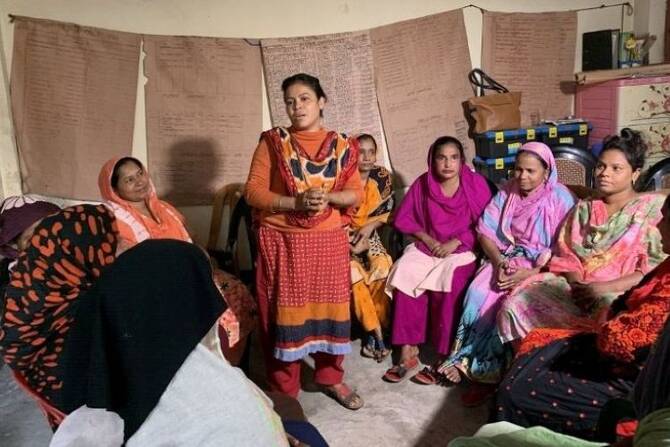
Josna Begum, center, who leads the Women’s Squad in Barisal, southern Bangladesh, meets her team and community members in the city’s Hatkhola slum area, October 2021. (Bangladesh Red Crescent)
Short Url
Updated 17 July 2025
Follow

In Bangladeshi slums, women lead climate action to escape poverty

  • Red Crescent-supported Women’s Squad was established in Barisal’s slums in 2018
  • 23-member team leads hygiene and health efforts, negotiations with authorities, NGOs

DHAKA: Growing up in a poor, densely populated neighborhood of a southern Bangladeshi city, Josna Begum has for most of her life lived in conditions where even access to clean water was rare.

As climate change-related heatwaves and floods took an increasing toll in recent years, she joined a women’s community project in 2018 and soon rose to lead it — helping make Hatkhola, the slum area where she lives in Barisal city, a safer and healthier place — and support other women in escaping poverty.

“My locality is one of the most underprivileged areas of Barisal city. Here, people are mostly unaware of their rights and responsibilities,” Josna told Arab News.

“Women didn’t have a voice. We had no chance to share our opinions at home, in the community, or in any official space. We wanted to unite so we could solve our issues ourselves.”

A mother of three, Josna, 44, has been volunteering with the Women’s Squad — an all-women team established by the Bangladesh Red Crescent and British Red Cross in slum areas of Barisal. She currently serves as the team’s leader in the Hatkhola locality.

“We build awareness about climate change impacts like untimely heavy rain, drought, heatwaves, repeated cyclones, floods. We encourage people to plant more trees to help reduce the effects of climate change. We also make people aware of the importance of keeping the canals clean so they can hold enough water during heavy rainfall,” she said.

“We work to keep the environment clean where we live. To motivate the community, all 23 members of our women’s squad do the drainage cleaning tasks ourselves. We raise awareness about the effects of waterlogging, which causes diseases like dengue, malaria.”

Josna initially faced objections from her husband, a daily-wage worker, but this changed when he saw the effects of her work.

The Women’s Squad has managed to obtain a submersible water pump from the Red Crescent, and convinced local authorities to repair five tube wells, securing clean water for over 700 families, who did not have access before.

They have also persuaded local officials to repair a 106-meter-long drainage system, helping prevent waterlogging during the rain season, and are now focused on improving sanitation in the neighborhood that until recently had no proper bathrooms or toilets.

“Now, seeing my success, all family members are happy and encouraging me to keep going,” Josna said.

“With support from the Red Crescent Society, we secured two bathrooms, and just weeks ago, we coordinated the construction of another toilet with the help of a local NGO. This new facility is fully equipped, including features to accommodate people with disabilities.”

To uplift the community, the women also help households plant trees and grow vegetables on whatever small plots of land they have. With support from NGOs, they organize vocational training for those interested in learning to drive, sew, perform basic electrical work, or service mobile phones.

Moly Begum, another member of the Women’s Squad, who leads the team in Barisal’s Stadium Colony area, is proud of the effect their engagement has in changing not only the quality of life, but also the social standing of women.

“I didn’t have any recognition in the family and society. Nobody listened to my words. I thought, if I could get engaged with some social work, people would know me in the community, and I would be able to serve them,” she said.

“My area is an underprivileged poor area. There are many distressed women in my community. Violence against women and children was very common here ... That’s why I got involved with the Women’s Squad.”

Over the past seven years, much of what she hoped to achieve has materialized or borne fruit, as her team members went door-to-door with their advocacy and helped organize various forms of support from NGOs and local authorities.

They have been intervening in incidents of domestic violence or child marriage, as they also tried to make sure more children in the marginalized community would get access to education, while women gain some financial independence.

“The members of the Women’s Squad approached every house in the community. We encouraged the guardians to send their children to school. We convinced them that every child is equal, whether a boy or a girl,” Moly told Arab News.

“Women are now engaged in small-scale income-generating activities. Many in my community are now running tea stalls, clothing shops, selling pickles, cakes. All these things happened due to our Women’s Squad’s work.”


Venezuela says oil exports continue normally despite Trump blockade

Updated 9 sec ago
Follow

Venezuela says oil exports continue normally despite Trump blockade

  • Trump warned “Venezuela is completely surrounded by the largest Armada ever assembled in the History of South America”
  • Oil prices surged in early trading Wednesday in London on news of the blockade, which comes a week after US troops seized a sanctioned oil tanker

CARACAS: Venezuela struck a defiant note Wednesday, insisting that its crude oil exports were not impacted by US President Donald Trump’s announcement of a potentially crippling blockade.
Trump’s declaration on Tuesday marked a new escalation in his months-long campaign of military and economic pressure on Venezuela’s leftist authoritarian President Nicolas Maduro.
Venezuela, which has the world’s largest proven oil reserves, shrugged off the threat of more pain, insisting that it was proceeding with business as usual.
“Export operations for crude and byproducts continue normally. Oil tankers linked to PDVSA operations continue to sail with full security,” state oil company Petroleos de Venezuela (PDVSA) said.
Trump said Tuesday he was imposing “A TOTAL AND COMPLETE BLOCKADE OF ALL SANCTIONED OIL TANKERS going into, and out of, Venezuela.”
Referring to the heavy US military presence in the Caribbean — including the world’s largest aircraft carrier — he warned “Venezuela is completely surrounded by the largest Armada ever assembled in the History of South America.”
Oil prices surged in early trading Wednesday in London on news of the blockade, which comes a week after US troops seized a sanctioned oil tanker that had just left Venezuela with over 1 million barrels of crude.
Maduro held telephone talks with UN Secretary-General Antonio Guterres to discuss what he called the “escalation of threats” from Washington and their “implications for regional peace.”
Guterres’s spokesman said the UN chief was working to avoid “further escalation.”

- ‘We are not intimidated’ -

Venezuela’s economy, which has been in freefall over the last decade of increasingly hard-line rule by Maduro, relies heavily on petroleum exports.
Trump’s campaign appears aimed at undermining domestic support for Maduro but the Venezuelan military said Wednesday it was “not intimidated” by the threats.
The foreign minister of China, the main market for Venezuelan oil, defended Caracas in a phone call with his Venezuelan counterpart Yvan Gi against the US “bullying.”
“China opposes all unilateral bullying and supports all countries in defending their sovereignty and national dignity,” he said.
Last week’s seizure of the M/T Skipper, in a dramatic raid involving US forces rappelling from a helicopter, marked a shift in Trump’s offensive against Maduro.
In August, the US leader ordered the biggest military deployment in the Caribbean Sea since the 1989 US invasion of Panama — purportedly to combat drug trafficking, but taking particular aim at Venezuela, a minnow in the global drug trade.
US strikes on alleged drug-smuggling boats in the Caribbean and eastern Pacific have left at least 95 people dead since.
Caracas believes that the anti-narcotics operations are a cover for a bid to topple Maduro and steal Venezuelan oil.
The escalating tensions have raised fears of a potential US intervention to dislodge Maduro.
Mexican President Claudia Sheinbaum waded into the dispute on Wednesday, declaring that the United Nations was “nowhere to be seen” and asked that it step up to “prevent any bloodshed.”

- Oil lifeline -

The US blockade threatens major pain for Venezuela’s crumbling economy.
Venezuela has been under a US oil embargo since 2019, forcing it to sell its production on the black market at significantly lower prices, primarily to Asian countries.
The country produces one million barrels of oil per day, down from more than three million in the early 2000s.
Capital Economics analysts predicted that the blockade “would cut off a key lifeline for Venezuela’s economy” in the short term.
“The medium-term impact will hinge largely on how tensions with the US evolve — and what the US administration’s goals are in Venezuela.”