

Fertilizer sector fuels Pakistan stock market rally as benchmark index hits record high

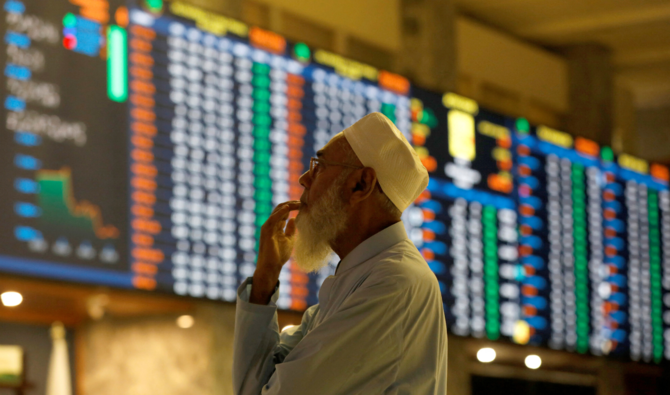
A stock broker reacts while monitoring the market on the electronic board displaying share prices during trading session at the Pakistan Stock Exchange, in Karachi, Pakistan July 3, 2023. (REUTERS)
Short Url
Updated 17 July 2025
Follow

Fertilizer sector fuels Pakistan stock market rally as benchmark index hits record high

  • Fauji and Engro fertilizer stocks contribute nearly 600 points to KSE-100 gain
  • Surging investor sentiment, dividend expectations, possible Moody’s upgrade drive momentum

ISLAMABAD: Pakistan’s main stock index surged to a new record on Thursday, closing above the 138,000 mark for the first time, driven by strong institutional inflows and a sharp rally in fertilizer and blue-chip stocks, according to analysts and market data.

The benchmark KSE-100 index closed at 138,665.49 points, gaining 2,285.53 points or 1.68 percent from the previous close of 136,379.96, a bullish move that traders said reflected investor optimism ahead of earnings season and growing expectations of a credit rating upgrade.

Fertilizer companies led the rally, with Fauji Fertilizer Company Limited (FFC) and Engro Fertilizers Limited (EFERT) together adding 563 points to the index. Other top contributors included United Bank Limited (UBL), Systems Limited (SYS), Engro Holdings (ENGROH), and Hub Power Company Limited (HUBC), which added another 763 points collectively, brokerage firm Topline Securities said in its daily report.

“This rally was driven by heavy institutional flows, with local investors stepping in to scoop up value,” Topline said. “With sentiment back in high gear, today’s bullish close sets an upbeat tone heading into the heart of earnings season.”

Investor activity remained high with 778 million shares traded, while the total value of trades stood at Rs39.95 billion ($140.2 million). Pakistan International Bulk Terminal (PIBTL) led volumes, with 82.6 million shares exchanged during the session.

Ahsan Mehanti, CEO of Arif Habib Commodities, said investor confidence was boosted by anticipated strong corporate earnings, attractive dividend expectations and government engagement with Moody’s over a potential rating upgrade.

“Government affirmation over talks with industrials on budgetary measures, and the finance minister’s presentation to Moody’s of compelling evidence for a ratings improvement played a catalytic role in today’s close,” Mehanti said.


Pakistan’s Punjab to hold Basant kite festival from Feb. 6-8 after 25-year ban

Updated 7 sec ago
Follow

Pakistan’s Punjab to hold Basant kite festival from Feb. 6-8 after 25-year ban

  • Province to start safety antenna installation campaign on all motorbikes from tomorrow
  • Basant ban began in the mid-2000s after fatal incidents involving metal-coated kite strings

ISLAMABAD: Pakistan’s most populous Punjab province will hold the iconic spring kite-flying Basant festival from Feb. 6-8 next year after the provincial government lifted its long-running 25-year ban earlier this month, a senior minister said on Wednesday.

The ban due to fatal kite-string accidents was lifted after the provincial administration passed the Punjab Kite Flying Ordinance 2025, marking a cautious comeback for a festival that once symbolized the arrival of spring in the region.

Basant, one of Punjab’s most celebrated cultural festivals, used to draw thousands to rooftops across Lahore and other cities. However, from 2005 onward, it was repeatedly banned after dozens of people were killed or injured by dangerous metal and chemically coated kite strings that could slash motorcyclists and pedestrians, many of them children.

Courts and provincial administrations upheld these prohibitions for years, making the revival of Basant one of Punjab’s most politically sensitive cultural decisions.

“[Chief Minister] Punjab Maryam Nawaz Sharif has approved the revival of our beloved Heritage Basant Festival on February 6th, 7th and 8th celebrated across Lahore after 25 years, a tradition rooted in history and admired worldwide,” Punjab Senior Minister Marriyum Aurangzeb said in a post on X.

“The Basant Ordinance 2025 will be fully enforced and implemented. Every kite string and seller registered, QR coded and monitored. Basant belongs to the people, its success is our collective responsibility.”

Aurangzeb added that a citywide campaign to install safety antennas on all motorbikes will begin tomorrow.

“Every motorbike in Lahore will have Antenna for safety before and during Basant Inshallah,” Aurangzeb added. “Safety is CM Punjab’s priority. Let every kite soar and every ride be safe together, we’ll make Lahore happy historic and secure!“

Under new regulations, the government has made it mandatory for anyone making or selling kites to register. Each kite must carry a QR code linking to the seller’s identity.

The rules also prohibit children under the age of 18 from flying kites, making their guardians responsible for any violations. Fines for minors are set at Rs 50,000 ($179) for a first offense and Rs 100,000 ($358) for a second offense. Kite flying will only be allowed with formal authorization.

In Punjab, kite flying will require permission from the deputy commissioners, and kites may only be purchased from registered vendors.

The ordinance introduces strict penalties for adults as well, including three to five years in prison and a fine of Rs 2 million ($7,160) for violations.

The government has said the new regulatory framework was intended to revive the Basant festival in a controlled and safe manner, balancing public enthusiasm for the celebration with longstanding concerns over fatal injuries caused by unsafe kite strings.

Officials say that the ordinance also aims to formalize the small but extensive economy surrounding Basant, which includes kite manufacturing, string production, dyes, paper supply, bamboo cutting, wholesalers and thousands of seasonal vendors.

For decades, this value chain has operated informally, with no licensing, safety regulations, or tax registration, generating minimal direct revenue for the provincial government.

By bringing manufacturers and sellers into a documented system through mandatory registration and QR-coded products, officials argue that the government can expand its tax base, ensure safer production standards and create more predictable business opportunities for cottage-industry workshops that rely on the Basant season for income.