

Protester in UK threatened with arrest by armed police over Palestinian flag

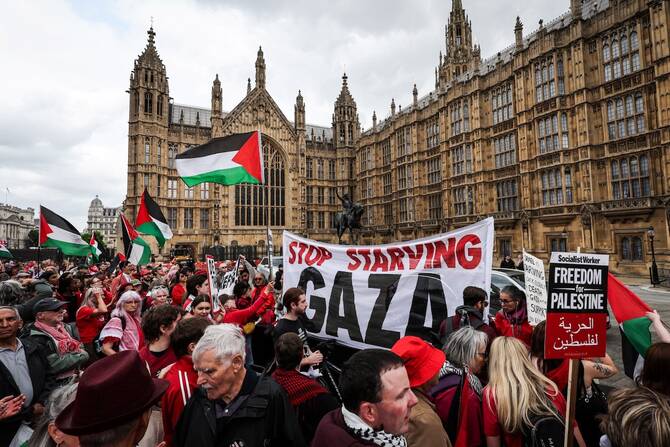
Protesters wave Palestinian flags at the Palace of Westminster, home to the Houses of Parliament, in central London, on June 4, 2025. (AFP)
Short Url
Updated 17 July 2025
Follow

Protester in UK threatened with arrest by armed police over Palestinian flag

  • Laura Murton, 42, held signs saying ‘Free Gaza’ and ‘Israel is committing genocide’
  • Amnesty International UK describes footage of incident as ‘very concerning’

LONDON: British armed police threatened a peaceful protester with arrest under the Terrorism Act after accusing her of supporting Palestine Action, the activist group that was banned earlier this month.

Laura Murton, 42, held signs saying “Free Gaza” and “Israel is committing genocide” at the demonstration in the city of Canterbury, The Guardian reported on Thursday.

Officers told her that she had expressed views supporting Palestine Action. Neither of the signs held by Murton mentioned the group by name.

Murton, who filmed her encounter with the armed police officers, asked whether she supported any banned groups and replied: “I do not.”

One officer told her: “Mentioning freedom of Gaza, Israel, genocide, all of that — all come under proscribed groups, which are terror groups that have been dictated by the government.” He added that the phrase “Free Gaza” expressed support for Palestine Action.

The government’s proscription of the group means it is an offense to express support for it and is punishable by law.

The officer accused Murton of committing that offense, and said she would be arrested unless she provided her name and address, which she did.

Murton told The Guardian: “I don’t see how anything I was wearing, how anything I was displaying, anything I was saying, could be deemed as supportive of the proscribed group.

“It’s terrifying. I was standing there thinking, this is the most authoritarian, dystopian experience I’ve had in this country, being told that I’m committing terrorist offenses by two guys with firearms.

“I ended up giving my details, and I really resent the fact I had to do that because I don’t think that was lawful at all.”

Lawyer’s representing Palestine Action’s co-founder, Huda Ammori, said in court submissions that the group’s proscription would likely produce a “wide chilling effect on speech and assembly of those seeking to speak out against Israel’s serious violations of international law.”

One of the officers who confronted Murton said: “We could have jumped out, arrested you, dragged you off in a van.” The police were “trying to be fair” in dealing with her, he added.

Murton said she was motivated to protest because “day to day, people are getting killed (in Gaza), and I can’t handle that … I can’t handle sitting and doing nothing.”

Amnesty International UK’s law and human rights director, Tom Southerden, described the footage as “very concerning.”

He added: “We have long criticized UK terrorism law for being excessively broad and vaguely worded and a threat to freedom of expression. This video documents one aspect of exactly the kind of thing we were warning about.”


Zelensky presses EU to tap Russian assets at crunch summit

Updated 3 sec ago
Follow

Zelensky presses EU to tap Russian assets at crunch summit

  • “Russian assets must be used to defend against Russian aggression and rebuild what was destroyed by Russian attacks. It’s moral. It’s fair. It’s legal,” Zelensky said
  • German Chancellor Friedrich Merz was among those agreeing strongly as he said there was “no better option“

Brussels: Ukrainian President Volodymyr Zelensky told EU leaders Thursday they had the “moral” and legal right to use frozen Russian assets to fund Kyiv — as pressure grew on key player Belgium to drop its opposition at a summit showdown.
The 27-nation bloc is scrambling to bolster its ally Ukraine, as US President Donald Trump pushes for a deal with President Vladimir Putin to end the fighting.
Officials have insisted leaders’ talks in Brussels will last as long as it takes to hammer out an agreement, saying both Ukraine’s survival — nearly four years into the war — and Europe’s credibility are at stake.
“We will not leave the European summit without a solution for the funding of Ukraine,” European Commission head Ursula von der Leyen said.
The EU’s executive wants to fund a loan to Ukraine by using frozen assets from Russia’s central bank, though it is holding on to a back-up plan for the bloc to raise the money itself.
The EU estimates Ukraine needs an extra 135 billion euros ($159 billion) to stay afloat over the next two years — with the cash crunch set to start in April.
Zelensky said Kyiv needed a decision on its financing by the end of the year and that the move could give it more leverage in talks to end the war.
“Russian assets must be used to defend against Russian aggression and rebuild what was destroyed by Russian attacks. It’s moral. It’s fair. It’s legal,” Zelensky said.
German Chancellor Friedrich Merz was among those agreeing strongly as he said there was “no better option.”
But Belgium’s Prime Minister Bart De Wever — who held talks with Zelensky on the sidelines — seemed unconvinced so far.
“I have not seen a text that could persuade me to give Belgium’s agreement,” he told Belgian lawmakers before the summit kicked off.
The vast bulk of the assets are held by international deposit organization Euroclear in Belgium, and the government fears it could face crippling financial and legal reprisals from Moscow.
EU officials say they have gone out of their way to allay Belgian worries and that multiple layers of protection — including guarantees from other member states — mean the risks are minimal.
“At this stage, the guarantees offered by the Commission remain insufficient,” De Wever said.

- Ukraine’s looming cash crunch -

In a bid to plug Kyiv’s yawning gap, the Commission has proposed tapping 210 billion euros of frozen assets, initially to provide Kyiv 90 billion euros over two years.
The unprecedented scheme would see the funds loaned to the EU, which would then loan them on to Ukraine.
Kyiv would then only pay back the “reparations loan” once the Kremlin compensates it for the damage.
In theory, other EU countries could override Belgium and ram the initiative through with a weighted majority, but that would be a nuclear option that few see as likely for now.
De Wever insisted that the EU should go for its alternative plan of raising money itself — but diplomats said that option had been shelved as it needed unanimity and Hungary was firmly against.
Bubbling close to the surface of the EU’s discussion are the US efforts to forge a deal to end the war.
Zelensky said Ukrainian and US delegations would hold new talks on Friday and Saturday in the United States.
He said he wanted Washington to give more details on the guarantees it could offer to protect Ukraine from another invasion.
“What will the United States of America do if Russia comes again with aggression?” he asked. “What will these security guarantees do? How will they work?“