

Oil Updates — prices gain on geopolitical risks, inventory worries

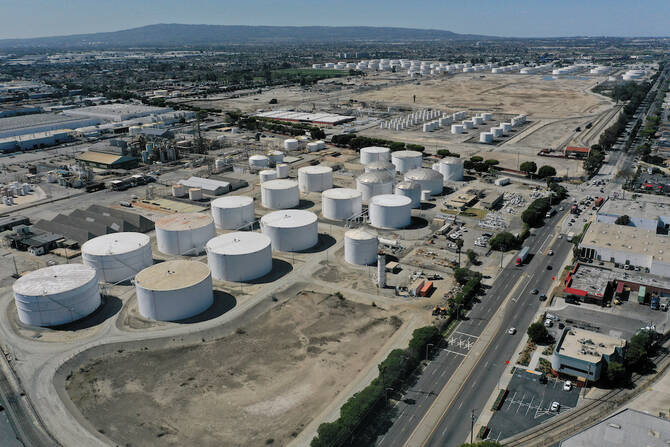
US crude inventories fell by 3.9 million barrels to 422.2 million barrels last week. File/Reuters
Short Url
Updated 17 July 2025
Follow

Oil Updates — prices gain on geopolitical risks, inventory worries

LONDON: Oil prices rose on Thursday, even as global trade tensions appeared to cool, with analysts pointing to low inventories and renewed Middle East risks as factors supporting the market.

Brent crude futures were up 31 cents, or around 0.5 percent, to $68.83 a barrel at 03:03 p.m. Saudi time. US West Texas Intermediate crude futures were up 61 cents, or 0.9 percent, at $66.99.

US President Donald Trump has said letters notifying smaller countries of their US tariff rates would go out soon, and has also alluded to prospects of a deal with Beijing on illicit drugs and a possible agreement with the EU.

“Near-term prices (are) set to remain volatile due to the uncertainty over the final scale of US tariffs and the resultant impact on global growth,” said Ashley Kelty, an analyst at Panmure Liberum, adding that prices would likely settle lower in the medium term.

The oil market on Thursday was also reacting to a tightened inventory scenario, said John Evans, analyst at PVM Oil Associates.

Last week, the International Energy Agency said that oil output increases were not leading to higher inventories, which showed markets were thirsty for more oil.

“Oil thinking has been distracted from the Middle East, and the reminders of Israel’s attacks into Syria and the drone attacks on oil infrastructure in Kurdistan are timely and once again add a little fizz to proceedings,” Evans said.

Drone attacks on oilfields in Iraq's semi-autonomous Kurdistan region have slashed crude output by up to 150,000 barrels per day, two energy officials said on Wednesday, as infrastructure damage forced multiple shutdowns.

“For now, oil market indicators continue to suggest the physical market remains tight. But ongoing trade tensions could weigh on oil demand growth prospects and pose downside risks to prices,” said UBS commodities analyst Giovanni Staunovo.


Egypt’s Suez Canal, Namibian Ports Authority sign MoU to propel port development, training

Updated 7 sec ago
Follow

Egypt’s Suez Canal, Namibian Ports Authority sign MoU to propel port development, training

RIYADH: Egypt’s Suez Canal Authority and the Namibian Ports Authority have signed a memorandum of understanding amid efforts to propel cooperation in development and training.

The agreement aims to exchange expertise and enhance bilateral cooperation in several areas, most notably marine construction, the sale and leasing of marine units, and advanced training through the Suez Canal Authority’s academies, according to a statement.

This is supported by figures from the Suez Canal Authority, which reported revenues of $1.97 billion from 5,874 ship transits since early July, representing a 17.5 percent year-on-year increase, chairman Osama Rabie said during a recent meeting with an International Monetary Fund delegation.

It also aligns well with Rabie’s further forecast that the canal’s revenues would improve during the 2026/2027 fiscal year to around $8 billion, rising to approximately $10 billion the following year, according to a statement issued by the authority.

The newly released statement said: “Rabie affirmed the authority’s readiness for fruitful and constructive cooperation with the Namibian Ports Authority, given the expansion of the entity’s international projects and its efforts to open new markets and engage with the African continent.”

“The chairman explained that the Suez Canal Authority’s efforts succeeded in developing and reopening the Libyan port of Sirte after 14 years of closure, marking a successful start to international projects with friendly and sister nations,” it added.

The chairman instructed that all necessary support and procedures be put in place to initiate practical cooperation on multiple projects, highlighting that the authority offers a comprehensive system for maritime and logistics services through its shipyards and subsidiaries.

For her part, Nangula Hamunyela, chairperson of the Namibian Ports Authority, voiced her enthusiasm for collaborating with the Suez Canal Authority on advancing Namibia’s ambitious port development plan, home to the largest ports in West Africa.

She stressed that this partnership highlights the strong relationship between Egypt and Namibia and will help further deepen bilateral ties.

Hamunyela further highlighted that the Suez Canal Authority’s advanced technology and vast expertise across multiple sectors will play a key role in supporting and speeding up development efforts in Namibian ports, reducing dependence on foreign expertise and technology from outside the region.

Egypt’s Suez Canal generated a total of $40 billion between 2019 and 2024 and remains the country’s most important source of foreign currency.