

Pakistan’s Punjab reports 63 deaths in 24 hours as monsoon toll rises to 103

1 / 2
Neighbours look at the collapsed roof of a house during heavy monsoon rains in Lahore on July 16, 2025. (AFP)
2 / 2
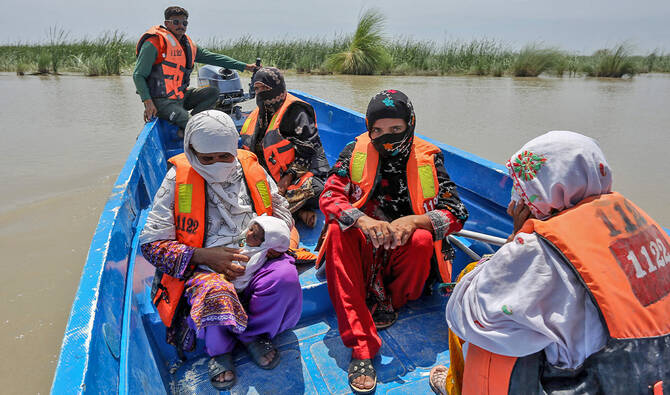
Rescue personnel evacuate villagers by boat from a flooded village following heavy rains in the Taunsa district of Punjab province on July 16, 2025. (AFP)
Short Url
Updated 17 July 2025
Follow

Pakistan’s Punjab reports 63 deaths in 24 hours as monsoon toll rises to 103

  • Heavy rains continue to lash the most populous province, injuring nearly 400 and damaging homes
  • Authorities have declared a rain emergency in Rawalpindi after 230 millimeters of rain in 15 hours

ISLAMABAD: Pakistan’s most populous province of Punjab said on Thursday 63 people were killed and 290 injured in the last 24 hours due to heavy monsoon rains, as downpours continued across parts of the country including the federal capital Islamabad and neighboring Rawalpindi, which has declared a rain emergency.

The Provincial Disaster Management Authority (PDMA) of Punjab said in a statement the deaths were reported from multiple districts, including 15 in Lahore, nine in Faisalabad, nine in Okara, five in Sahiwal and three in Pakpattan.

Many of the casualties occurred in roof and building collapses, particularly in older or poorly constructed homes.

“So far, 103 people have died and 393 have been injured due to monsoon rains this year,” the PDMA said. “In the last 24 hours alone, 63 people have died and 290 have been injured due to monsoon-related incidents.”


A man carrying belongings wades through a flooded village following heavy rains in the Taunsa district of Punjab province on July 16, 2025. (AFP)

The statement added that 128 homes had been damaged and six livestock animals killed.

Authorities have urged residents to vacate unsafe structures, avoid flood-prone areas and keep children away from exposed electric infrastructure.

Medical care is being provided to the injured, with the provincial administration of Punjab saying families of those killed would receive financial compensation under its relief policy.

In Rawalpindi, city authorities declared a rain emergency after more than 230 millimeters of rain fell over the past 15 hours, according to Water and Sanitation Agency (WASA) officials.

“The water level in Nullah Leh is rising rapidly,” the managing director of the agency, Muhammad Saleem Ashraf, said in a statement, noting water flows of 20 feet at Katarian and 19 feet at Gawalmandi.

Heavy machinery and emergency teams have been deployed in low-lying areas, and residents have been advised to avoid unnecessary movement.

In Islamabad, intermittent rainfall has continued for several hours.

Sanitation teams have been carrying out drainage operations in waterlogged areas.

Pakistan, which contributes less than one percent to global greenhouse gas emissions, is among the countries most vulnerable to the impacts of climate change. Rising temperatures, erratic weather patterns and shifting monsoon cycles have made extreme weather events more frequent and severe.

In 2022, record-breaking monsoon rains and glacial melt triggered catastrophic floods that killed more than 1,700 people, displaced millions, and submerged large parts of the country.

Recovery efforts are still ongoing, as climate-linked disasters continue to strain Pakistan’s infrastructure and economy.


Pakistanis at remote border describe scramble to leave Iran

Updated 6 sec ago
Follow

Pakistanis at remote border describe scramble to leave Iran

  • Returning Pakistani nationals recount missile fire in Tehran, transport gridlock as people rush to exit Iran
  • PM Sharif condemns targeting of Iranian leader as embassies urge citizens to leave amid escalating strikes

TAFTANT, Pakistan: Pakistani nationals hauled suitcases across the border from neighboring Iran, describing missiles being launched and travel chaos as they scrambled to leave the country after the US and Israel launched strikes over the weekend.

AFP journalists saw a steady trickle of people passing through large metal gates at the remote border crossing between Iran’s Mirjaveh and Taftan in Pakistan’s western Balochistan province.

Powerful explosions have rocked Iran’s capital Tehran since Saturday, with embassies from countries around the world telling their citizens to leave.

“All our Pakistani brothers who were in Tehran and other cities had started to leave and were arriving at the terminal, which caused a lot of crowd pressure,” 38-year-old trader Ameer Muhammad told AFP on Monday.

“Due to the crowds, there were major transport problems.”

The isolated Taftan border lies around 500 kilometers (310 miles) from Balochistan’s capital and largest city, Quetta.

AFP journalists saw the Iranian flag flying at half-mast as soldiers stood guard.

Most people wheeled bulky luggage over the frontier’s foot crossing, while freight lorries formed a long line.

Irshad Ahmed, a 49-year-old pilgrim, told AFP he was staying at a hostel in Tehran when he saw missiles being fired nearby.

“There was an army base near the hostel, and we saw many missiles being fired,” he said.

“After that, we went to the Pakistani embassy so that they could evacuate us from there. They brought us here safely.”

Pakistan’s Prime Minister Shehbaz Sharif has said the killing of Ayatollah Ali Khamenei was a “violation” of international law.

“It is an age old convention that the Heads of State/Government should not be targeted,” Sharif wrote on X.

The “people of Pakistan join the people of Iran in their hour of grief and sorrow and extend the most sincere condolences on the martyrdom” of Khamenei, he added.

A teacher at Tehran’s Pakistani embassy, who gave his name as Saqib, told AFP: “Before we left, the situation was normal. The situation was not that bad.”

The 38-year-old said the strikes on Tehran on Saturday “pushed us to leave the city.”

“The situation became bad on Saturday night, when attacks caused precious lives to be lost,” he said.
