

Pakistan sees $16 million in online animal sales during Eid — central bank 

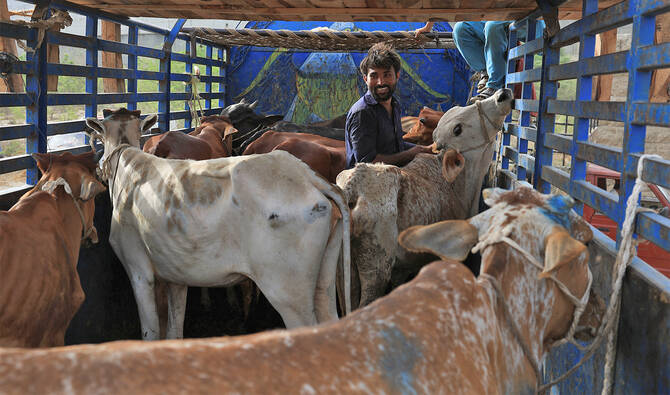
Shafiq, 27, unloads sacrificial bulls for sale from a truck, at a cattle market, ahead of Eid al-Adha celebrations, in Karachi, Pakistan on May 30, 2025. (REUTERS/File)
Short Url
Updated 17 July 2025
Follow

Pakistan sees $16 million in online animal sales during Eid — central bank 

  • Over 64,000 cashless transactions recorded in major cattle markets as part of drive to formalize economy
  • State Bank hails campaign to promote digital payments during Eid-ul-Azha, backed by 24 commercial banks

KARACHI: Pakistanis spent more than 4.7 billion rupees (approximately $16.3 million) on sacrificial animals through digital transactions during Eid-ul-Azha this year, the State Bank of Pakistan (SBP) said on Tuesday, highlighting a growing shift toward cashless commerce in one of the country’s most traditional and informal markets.

The digital sales were part of the central bank’s “Go Cashless in Cattle Markets Campaign 2025,” launched to promote financial inclusion and reduce cash handling during the three-day religious festival that began on June 7. The annual holiday, also known as Eid Al-Adha, marks the Islamic ritual of animal sacrifice, during which millions of Pakistanis buy goats, cows, and camels, often in large, informal marketplaces.

The SBP said the campaign was implemented in collaboration with 24 commercial banks and covered 54 major cattle markets across the country.

“The campaign was successfully implemented in 54 major cattle markets across Pakistan, resulting in 64,553 transactions valued at Rs 4.656 billion,” the central bank said in a statement.

Eid-related animal trade represents a significant part of Pakistan’s informal economy. By introducing digital payment options in livestock markets, the central bank aims to improve financial transparency and support the government’s broader goal of documenting the cash-based economy.

Pakistan is currently under a $7 billion loan program with the International Monetary Fund (IMF), which encourages reforms including digitization of financial services to boost tax collection and economic stability.

“Digital payment systems play a vital role in modern economies by offering transparency, reducing fraud risks, and providing secure, convenient, and inclusive access to financial services,” the SBP said.

It added that such initiatives were crucial for building trust and driving adoption of digital platforms, especially among underserved groups like livestock traders.

The central bank said feedback from buyers and sellers in the cattle markets was positive, with participants appreciating the reduced reliance on physical cash.

“This campaign was highly appreciated by the buyers and sellers in the cattle markets, as it reduced their reliance on cash,” the bank noted.

Najeeb Ahmed Warsi, head of online trading at Foundation Securities Ltd, called the initiative a meaningful step toward modernizing Pakistan’s financial landscape.

“This campaign is more than just numbers, it’s a clear step forward in Pakistan’s journey toward a digitally-driven, cashless economy,” he said. “By digitizing traditional markets, we’re building trust, increasing financial inclusion, and setting the stage for a safer, smarter financial ecosystem.”

Warsi noted that the partnership between 24 commercial banks and the central bank allowed the initiative to scale effectively across the country.

“This groundbreaking initiative earned widespread praise from both buyers and sellers, who welcomed the shift from cash to digital payments, and transparency during one of the busiest market seasons,” he added.

The SBP said it would continue fostering collaborations across the financial sector to further Pakistan’s transition to a digitally inclusive economy.


Pakistan, Iran leaders highlight mutual support after both engaged in short wars this year

Updated 5 sec ago
Follow

Pakistan, Iran leaders highlight mutual support after both engaged in short wars this year

  • Prime Minister Sharif met Iranian President Pezeshkian in Ashgabat on the sidelines of an international forum
  • Pakistani PM also had an informal interaction with President Putin, discussed regional issue with President Erdogan

ISLAMABAD: Prime Minister Shehbaz Sharif and Iranian President Masoud Pezeshkian on Friday praised the support their countries offered one another during episodes of external aggression this year, according to the state media, as they met on the sidelines of an international peace forum in Turkmenistan.

Pakistan fought a four-day war with India in May, when New Delhi fired missiles at its cities and Islamabad responded with retaliatory strikes. Nearly a month after the conflict, Iran waged its own war with Israel after Tel Aviv carried out attacks inside Iranian territory, prompting Tehran to launch a series of missile and drone barrages in response.

The meeting in Turkmenistan came as Pakistan and Iran seek to steady ties after a period of strained security relations, while also attempting to expand economic cooperation and strengthen border management. The two leaders reviewed regional developments, including Pakistan’s concerns over militant attacks it says originate from Afghanistan, and ongoing diplomatic efforts related to Gaza.

“Both leaders appreciated the strong support that their countries had provided to each other when they had faced external aggression earlier this year,” the state-owned Associated Press of Pakistan (APP) said.

Sharif highlighted the outcome of the 22nd Pakistan–Iran Joint Economic Commission held this year and urged closer coordination to increase bilateral trade, operationalize border markets, reinforce border security and revive transport links, including the Islamabad-Tehran-Istanbul rail network.

Pezeshkian, according to the report, said Iran wished to further strengthen ties and thanked Sharif for a “useful and timely exchange of views.”

Sharif also pressed for “meaningful action” from the Afghan Taliban administration to address Pakistan’s security concerns, APP added.

Separately, the Pakistani prime minister met other global leaders attending the forum marking the International Year of Peace and Trust 2025 and Turkmenistan’s Neutrality Day.

He held informal interactions with Russian President Vladimir Putin and discussed regional issues with Turkish President Tayyip Erdogan, Tajik President Emomali Rahmon and Kyrgyz President Sadyr Zhaparov.