

Starvation among kids in Gaza reaches record levels, humanitarian chiefs tell UN Security Council

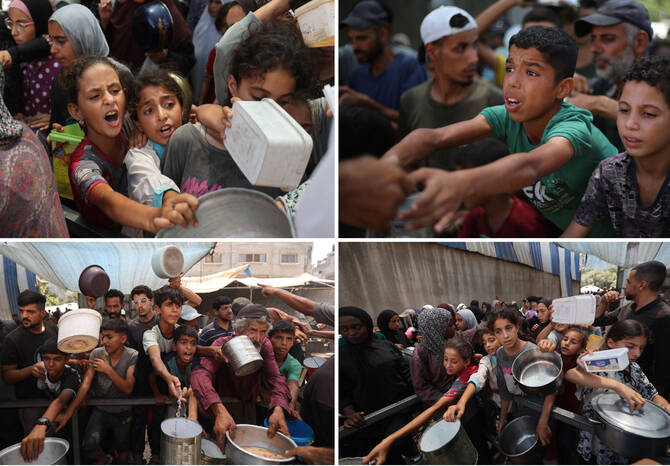
Palestinian children queue for a portion of hot food distributed by a charity kitchen at the Nuseirat refugee camp in the central Gaza Strip on July 15, 2025. (AFP photos)
Short Url
Updated 17 July 2025
Follow

Starvation among kids in Gaza reaches record levels, humanitarian chiefs tell UN Security Council

  • More than 5,800 children diagnosed with acute malnutrition last month, triple the number compared with February
  • UNICEF chief Catherine Russell says children are being killed and maimed as they queue for food and medicine

NEW YORK: Children in Gaza are suffering from the worst starvation rates since the war between Israel and Hamas began in October 2023, aid officials told the UN Security Council on Wednesday, in a devastating assessment of the conditions young Palestinians in the territory face as they try to survive.

“Starvation rates among children hit their highest levels in June, with over 5,800 girls and boys diagnosed as acutely malnourished,” said the UN’s humanitarian chief, Tom Fletcher.

Israel imposed an 11-week blockade on humanitarian aid earlier this year, and has only allowed a trickle of relief supplies to enter the territory since the end of May. The effects on the health of children have been catastrophic, according to the details presented to members of the Security Council. Levels of acute malnutrition have nearly tripled since February, just before the total blockade on aid was imposed.

“Children in Gaza are enduring catastrophic living conditions, including severe food insecurity and malnutrition,” UNICEF’s executive director, Catherine Russell, told the council.

“These severely malnourished children need consistent, supervised treatment, along with safe water and medical care, to survive.”


Yet youngsters in the territory are being killed and maimed as they queue for lifesaving food and medicine, she added. Last week, nine children were among 15 Palestinians killed by an Israeli strike in Deir Al-Balah while they waited in line for nutritional supplies from UNICEF.


“Among the survivors was Donia, a mother seeking a lifeline for her family after months of desperation and hunger,” Russell said.

“Donia’s 1-year-old son, Mohammed, was killed in the attack after speaking his first words just hours earlier. When we spoke with Donia, she was lying critically injured in a hospital bed, clutching Mohammed’s tiny shoe.”

Russell painted a bleak picture of desperation for the 1 million Palestinian children in the territory, where more than 58,000 people have been killed during the 21 months of war.

Among the dead are 17,000 children — an average of 28 each day, the equivalent of “a whole classroom of children killed every day for nearly two years,” Russell said.

Youngsters also struggle to find clean water supplies, she added, and are therefore forced to drink contaminated water, increasing the risk of disease outbreaks; waterborne diseases now represent 44 per cent of all healthcare consultations.

“Thousands of children urgently need emergency medical support,” Russell said, and many of those suffering from traumatic injuries or severe preexisting medical conditions are at risk of death because medical care is unavailable.

She repeated calls from other UN officials for Israel to allow the delivery of humanitarian aid to Gaza “at sufficient speed and scale to meet the urgent needs of children and families.”

A new aid-distribution system, introduced and run by Israel and the US, has sidelined traditional UN delivery mechanisms and restricted the flow of humanitarian supplies to a fraction of what was previously available.

Since the new system, run by the newly formed Gaza Humanitarian Foundation, began operating, hundreds of people, including children, have been shot dead as they gathered to collect aid.

Russell urged the Security Council to push for a return to UN aid-delivery systems so that essentials such as medicine, vaccines, water, food, and nutrition for babies can reach those in need.

Fletcher, the humanitarian chief, told the council that the shattered healthcare system in Gaza meant that in some hospitals, five babies share a single incubator and pregnant women give birth without any medical care.


UN humanitarian chief Tom Fletcher speaks to delegates about the situation in Gaza during a United Nations Security Council meeting at UN headquarters in New York City on July 16, 2025. (REUTERS)

He said the International Court of Justice has demanded that Israel “take immediate and effective measures to enable the provision of urgently needed basic services and humanitarian assistance,” and added: “Intentionally using the starvation of civilians as a method of warfare would, of course, be a war crime.”

During the meeting, Israel faced strong criticism from permanent Security Council members France and the UK.

The British ambassador to the UN, Barbara Woodward, described the shooting of Palestinians as they attempted to reach food-distribution sites as “abhorrent.”

She called for an immediate ceasefire in Gaza and said the UK “strongly opposes” the expansion of Israeli military operations.

French envoy Jerome Bonnafont said Israel must end its blockade of humanitarian aid, and denounced the Gaza Humanitarian Foundation system as “unacceptable and incompatible” with the requirements of international law.

He said an international conference due to take place on July 28 and 29 at the UN headquarters in New York, co-chaired by France and Saudi Arabia, would offer a “pathway toward the future” and identify tangible ways in which a two-state solution might be reached to end the wider conflict between Israelis and Palestinians.

Dorothy Shea, the ambassador to the UN from Israel’s main international ally, the US, said the blame for the situation in Gaza lay with Hamas, which continues to hold hostages taken during the attacks against Israel on Oct. 7, 2023, that ignited the conflict in Gaza.


US raid allegedly killed Syrian undercover agent instead of Daesh group official

Updated 2 sec ago
Follow

US raid allegedly killed Syrian undercover agent instead of Daesh group official

  • Neither US nor Syrian government officials have commented on the death, an indication that neither side wants the incident to derail improving ties
  • Weeks after the raid, interim President Ahmad Al-Sharaa visited Washington and announced Syria would join the global coalition against Daesh
DUMAYR, Syria: A raid by US forces and a local Syrian group aiming to capture an Daesh (IS) group official instead killed a man who had been working undercover gathering intelligence on the extremists, family members and Syrian officials have told The Associated Press.
The killing in October underscores the complex political and security landscape as the United States begins working with interim Syrian President Ahmad Al-Sharaa in the fight against remnants of IS.
According to relatives, Khaled Al-Masoud had been spying on IS for years on behalf of the insurgents led by Al-Sharaa and then for Al-Sharaa’s interim government, established after the fall of former President Bashar Assad a year ago. Al-Sharaa’s insurgents were mainly Islamists, some connected to Al-Qaeda, but enemies of IS who often clashed with it over the past decade.
Neither US nor Syrian government officials have commented on Al-Masoud’s death, an indication that neither side wants the incident to derail improving ties. Weeks after the Oct. 19 raid, Al-Sharaa visited Washington and announced Syria would join the global coalition against IS.
Still, Al-Masoud’s death could be “quite a setback” for efforts to combat IS, said Wassim Nasr, a senior research fellow with the Soufan Center, a New York-based think tank focused on security issues.
Al-Masoud had been infiltrating IS in the southern deserts of Syria known as the Badiya, one of the places where remnants of the extremist group have remained active, Nasr said.
The raid targeting him was a result of “the lack of coordination between the coalition and Damascus,” Nasr said.
In the latest sign of the increasing cooperation, the US Central Command said Sunday that American troops and forces from Syria’s Interior Ministry had located and destroyed 15 IS weapons caches in the south.
Confusion around the raid
The raid occurred in Dumayr, a town east of Damascus on the edge of the desert. At around 3 a.m., residents woke to the sound of heavy vehicles and planes.
Residents said US troops conducted the raid alongside the Syrian Free Army, a US-trained opposition faction that had fought against Assad. The SFA now officially reports to the Syrian Defense Ministry.
Al-Masoud’s cousin, Abdel Kareem Masoud, said he opened his door and saw Humvees with US flags on them.
“There was someone on top of one of them who spoke broken Arabic, who pointed a machine gun at us and a green laser light and told us to go back inside,” he said.
Khaled Al-Masoud’s mother, Sabah Al-Sheikh Al-Kilani, said the forces then surrounded her son’s house next door, where he was with his wife and five daughters, and banged on the door.
Al-Masoud told them that he was with General Security, a force under Syria’s Interior Ministry, but they broke down the door and shot him, Al-Kilani said.
They took him away, wounded, Al-Kilani said. Later, government security officials told the family he had been released but was in the hospital. The family was then called to pick up his body. It was unclear when he had died.
“How did he die? We don’t know,” his mother said. “I want the people who took him from his children to be held accountable.”
Faulty intelligence
Al-Masoud’s family believes he was targeted based on faulty intelligence provided by members of the Syrian Free Army.
Representatives of the SFA did not respond to requests for comment.
Al-Masoud had worked with Al-Sharaa’s insurgent group, Hayat Tahrir Al-Sham, in its northwestern enclave of Idlib before Assad’s fall, his cousin said. Then he returned to Dumayr and worked with the security services of Al-Sharaa’s government.
Two Syrian security officials and one political official, who spoke on condition of anonymity because they were not authorized to comment publicly, confirmed that Al-Masoud had been working with Syria’s interim government in a security role. Two of the officials said he had worked on combating IS.
Initial media reports on the raid said it had captured an IS official. But US Central Command, which typically issues statements when a US operation kills or captures a member of the extremist group in Syria, made no announcement.
A US defense official, when asked for more information about the raid and its target and whether it had been coordinated with Syria’s government, said, “We are aware of these reports but do not have any information to provide.” The official spoke on condition of anonymity in accordance with regulations.
Representatives of Syria’s defense and interior ministries, and of US envoy to Syria Tom Barrack, declined to comment.
Increased coordination could prevent mistakes
At its peak in 2015, IS controlled a swath of territory across Iraq and Syria half the size of the United Kingdom. It was notorious for its brutality against religious minorities as well as Muslims not adhering to the group’s extreme interpretation of Islam.
After years of fighting, the US-led coalition broke the group’s last hold on territory in late 2019. Since then, US troops in Syria have been working to ensure IS does not regain a foothold. The US estimates IS still has about 2,500 members in Syria and Iraq. US Central Command last month said the number of IS attacks there had fallen to 375 for the year so far, compared to 1,038 last year.
Fewer than 1,000 US troops are believed to be operating in Syria, carrying out airstrikes and conducting raids against IS cells. They work mainly alongside the Kurdish-led Syrian Democratic Forces in the northeast and the Syrian Free Army in the south.
Now the US has another partner: the security forces of the new Syrian government.
Airwars, a London-based conflict monitor, has reported 52 incidents in which civilians were harmed or killed in coalition operations in Syria since 2020.
The group classified Al-Masoud as a civilian.
Airwars director Emily Tripp said the group has seen “multiple instances of what the US call ‘mistakes,’” including a 2023 case in which the US military announced it had killed an Al-Qaeda leader in a drone strike. The target later turned out to be a civilian farmer.
It was unclear if the Oct. 19 raid went wrong due to faulty intelligence or if someone deliberately fed the coalition false information. Nasr said that in the past, feuding groups have sometimes used the coalition to settle scores.
“That’s the whole point of having a hotline with Damascus, in order to see who’s who on the ground,” he said.