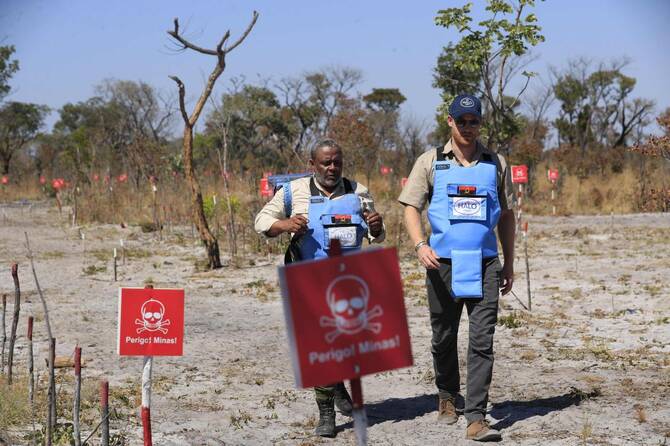
CAPE TOWN: Prince Harry followed in his late mother’s footsteps on Wednesday by wearing a flak jacket and walking down a path in an active land mine field in Angola to raise awareness for a charity’s work clearing explosives from old war zones.
The Duke of Sussex is in the southern African country with the Halo Trust organization, the same group Princess Diana worked with when she went to Angola in January 1997, seven months before she was killed in a car crash in Paris.
Diana’s advocacy and the images of her walking through a minefield helped mobilize support for a land mine ban treaty that was ratified later that year.
Harry walked through a land mine field near a village in Cuito Cuanavale in southern Angola, according to Halo Trust. It’s not the first time he has retraced his mother’s steps after traveling to Angola for a similar awareness campaign in 2019.
The land mines across Angola were left behind from its 27-year civil war from 1975 to 2002. The Halo Trust says at least 60,000 people have been killed or injured by land mines since 2008. It says it has located and destroyed over 120,000 land mines and 100,000 other explosive devices in Angola since it started work in the country in 1994, but 1,000 minefields still need to be cleared.

Prince Harry retraces Diana’s footsteps by walking through a land mine field in Angola for charity
https://arab.news/45mkd
Prince Harry retraces Diana’s footsteps by walking through a land mine field in Angola for charity
- Prince Harry walked through a land mine field near a village in Cuito Cuanavale in southern Angola
- It’s not the first time he has retraced the steps of his mother Princess Diana
‘Justice for the dead’: Protests mark Greece’s worst train disaster
- Tragedy claimed 57 lives in 2023 and rattled the govt of Prime Minister Kyriakos Mitsotakis
- We are here because, three years after the Tempe disaster, we still don’t know exactly what happened, justice has not yet been served and those responsible are still walking free
ATHENS: Tens of thousands of people across Greece demonstrated Saturday in solidarity with victims of the country’s worst train tragedy, which claimed 57 lives in 2023 and rattled the government of Prime Minister Kyriakos Mitsotakis.
More than a hundred gatherings are being held in Greece and abroad to demand justice for the victims, most of whom were young students returning from a three-day carnival weekend.
“We are here because, three years after the Tempe disaster, we still don’t know exactly what happened, justice has not yet been served and those responsible are still walking free,” Lydia Pagkali, a 28-year-old woman protesting in Athens, said.
SPEEDREAD
Nearly 40 people will go on trial on March 23, including railway executives and the station master on duty that night. They risk prison sentences of up to 20 years.
“Even today we don’t feel safe taking the train or the metro,” she added.
The crash on Feb. 28, 2023 took place when a passenger locomotive carrying some 350 people from Athens to Thessaloniki hit a freight train in the dead of the night.
The two trains had run on the same track for more than 10 minutes without triggering any alarm, laying bare the parlous state of the Greek railway network’s security fail-safes — despite EU grants for their modernization.
“We are protesting against a government, a state that has proven it does not take us into account,” 21-year-old student Yiannis Angelidis said in Thessaloniki.
“We demand that everyone responsible be punished, no matter how high up they are,” he said.
The head of an association of relatives of the victims, Pavlos Aslanidis, said the families demanded “justice for the dead.”
“We will allow nothing to be forgotten,” Aslanidis told a crowd of at least 20,000 people in Athens’s Syntagma Square, accusing the government and justice officials of attempting to “bury” the truth and “insulting” the victims’ families by repeatedly turning down requests to exhume the dead for tests. “Murderers,” the crowd shouted back.
Many relatives believe their loved ones were not killed by the collision, but by an ensuing fire that could have been averted if the passenger train had better insulation.
With a long-awaited trial into the disaster looming in March, unanswered questions remain about the accident and the ensuing investigation, which victims’ relatives argue was deficient and left state officials largely untouched.
“Responsibility for the tragedy must be assigned in a strict yet impartial manner in the trial that is beginning,” Prime Minister Kyriakos Mitsotakis said in a statement on Saturday.
In the hours after the tragedy, he had been strongly criticized after stating that “everything indicates” that the collision was “due, unfortunately, mainly to a tragic human error.”
More than 300,000 people rallied to mark last year’s anniversary, one of the biggest demonstrations the country has seen since the decade-long financial crisis which began in late 2009.
This year will see demonstrations in more than 70 towns and cities across Greece.
Unions have kicked off a series of strikes, and there will be no trains or ferry services on Saturday, while stores in the capital Athens have been urged to close.
European Chief Prosecutor Laura Kovesi last year noted that the accident could have been avoided if an EU-funded railway signaling project had been completed on time.
The victims’ families have also protested that valuable clues were lost when the crash site was bulldozed soon after the accident, sparking allegations that the government was literally trying to bury the evidence.
Despite the disaster, Mitsotakis comfortably won reelection just months later, and went on to defeat two votes of no-confidence on the issue.
But anger continues to simmer, increasing support for smaller opposition parties, including one headed by a leading lawyer for the accident victims. The mother of another victim, Maria Karystianou, has announced plans for a new party.
“We don’t just want to remain a protest movement. We really want to see some things change in the country,” Karystianou said in an interview this week.
Nearly 40 people will go on trial on March 23, including railway executives and the station master on duty that night. They risk prison sentences of up to 20 years.
Two former ministers, including the ex-transport minister, were also referred to justice by parliament, but face only misdemeanor charges at present.


