

Astronomers capture the birth of planets around a baby sun outside our solar system

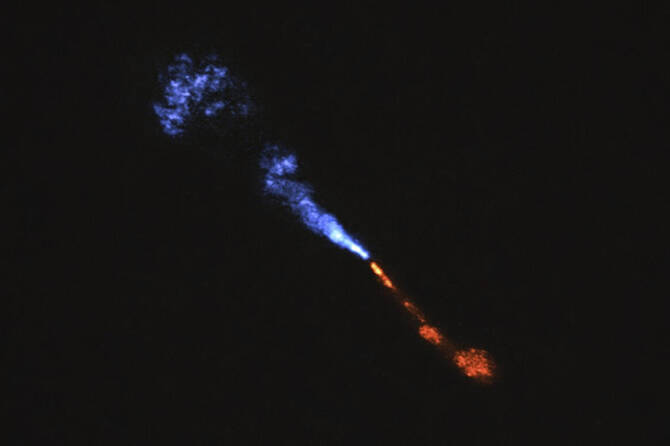
This image provided by the European Southern Observatory on July 15, 2025, shows jets of silicon monoxide blowing away from the baby star HOPS-315. (AP)
Short Url
Updated 16 July 2025
Follow

Astronomers capture the birth of planets around a baby sun outside our solar system

  • It’s an unprecedented snapshot of “time zero,” scientists reported Wednesday
  • In a stunning picture taken by the ESO’s Alma telescope network, the emerging planetary system resembles a lightning bug glowing against the black void

FLORIDA: Astronomers have discovered the earliest seeds of rocky planets forming in the gas around a baby sun-like star, providing a precious peek into the dawn of our own solar system.

It’s an unprecedented snapshot of “time zero,” scientists reported Wednesday, when new worlds begin to gel.

“We’ve captured a direct glimpse of the hot region where rocky planets like Earth are born around young protostars,” said Leiden Observatory’s Melissa McClure from the Netherlands, who led the international research team. “For the first time, we can conclusively say that the first steps of planet formation are happening right now.”

The observations offer a unique glimpse into the inner workings of an emerging planetary system, said the University of Chicago’s Fred Ciesla, who was not involved in the study appearing in the journal Nature.

“This is one of the things we’ve been waiting for. Astronomers have been thinking about how planetary systems form for a long period of time,” Ciesla said. “There’s a rich opportunity here.”

NASA’s Webb Space Telescope and the European Southern Observatory in Chile teamed up to unveil these early nuggets of planetary formation around the young star known as HOPS-315. It’s a yellow dwarf in the making like the sun, yet much younger at 100,000 to 200,000 years old and some 1,370 light-years away. A single light-year is 6 trillion miles.

In a cosmic first, McClure and her team stared deep into the gas disk around the baby star and detected solid specks condensing — signs of early planet formation. A gap in the outer part of the disk gave allowed them to gaze inside, thanks to the way the star tilts toward Earth.

They detected silicon monoxide gas as well as crystalline silicate minerals, the ingredients for what’s believed to be the first solid materials to form in our solar system more than 4.5 billion years ago. The action is unfolding in a location comparable to the asteroid belt between Mars and Jupiter containing the leftover building blocks of our solar system’s planets.

The condensing of hot minerals was never detected before around other young stars, “so we didn’t know if it was a universal feature of planet formation or a weird feature of our solar system,” McClure said in an email. “Our study shows that it could be a common process during the earliest stage of planet formation.”

While other research has looked at younger gas disks and, more commonly, mature disks with potential planet wannabes, there’s been no specific evidence for the start of planet formation until now, McClure said.

In a stunning picture taken by the ESO’s Alma telescope network, the emerging planetary system resembles a lightning bug glowing against the black void.

It’s impossible to know how many planets might form around HOPS-315. With a gas disk as massive as the sun’s might have been, it could also wind up with eight planets a million or more years from now, according to McClure.

Purdue University’s Merel van ‘t Hoff, a co-author, is eager to find more budding planetary systems. By casting a wider net, astronomers can look for similarities and determine which processes might be crucial to forming Earth-like worlds.

“Are there Earth-like planets out there or are we like so special that we might not expect it to occur very often?“


Viral phenomenon in Argentina has young people identifying themselves as animals

Updated 27 February 2026
Follow

Viral phenomenon in Argentina has young people identifying themselves as animals

  • As the movement gains traction, psychologists are stepping in to analyze the phenomenon and its place in public discourse

BUENOS AIRES: On a recent Sunday, a Buenos Aires plaza transformed into a makeshift wilderness for an unusual group of teenagers.
Sofía, wearing a lifelike beagle mask, ran across the grass on all fours. Nearby, 15-year-old Aguara leapt through the air, clearing an obstacle course while imitating the precise movements of a Belgian breed dog. Others dressed as cats and foxes perched in the branches of trees, keeping their distance from curious onlookers.
It was the latest gathering of “therians,” individuals who say they identify mentally, spiritually or psychologically with non-human animals. The trend has taken over Argentine social media over the past few months, gaining traction on platforms like TikTok, where the hashtag #therian has surpassed 2 million posts, with Argentina leading all other Latin American countries in engagement. The surge has drawn the attention of influencers and media outlets alike, sparking reactions that range from laughter and bewilderment to outright anger.
And as the movement gains traction, psychologists are stepping in to analyze the phenomenon and its place in public discourse.
Aguara, who claims to identify as a Belgian Malinois and counts her age as the equivalent of two years and two months in dog years, says she’s a lot like any other teenager.
“I wake up like a normal person and live my life like a normal person,” she said. “I simply have moments when I like being a dog.”
As the leader of what she calls her “pack,” Aguara — the name she identifies with — boasts more than 125,000 followers on TikTok and coordinates regular meetups around the Argentine capital.
Aru, a 16-year-old who wore a seal mask to the park meetup, said she considers herself part of the “otherpaw” branch of therians: individuals who wear masks and tails or move on all fours just for fun. “It’s not necessarily about identifying as an animal,” she said.
She reckons the therian trend took off in Argentina because of the country’s “fairly free” environment. For other young Argentines, the movement has provided a vital community where they can feel truly accepted.
Should parents be worried?
Débora Pedace, a psychologist and director of the Integral Therapeutic Center in Buenos Aires, acknowledged that the phenomenon generates a complex mix of confusion, laughter and even anger.
“From a psychological standpoint, this is a symbolic identification with an animal,” Pedace said. “It becomes pathological or alarming only when it turns into a deeply rooted belief and the person fully assumes the role of an animal, potentially leading to self-harm or hurting others.”