

Iraq PM reopens Mosul airport years after Daesh devastation

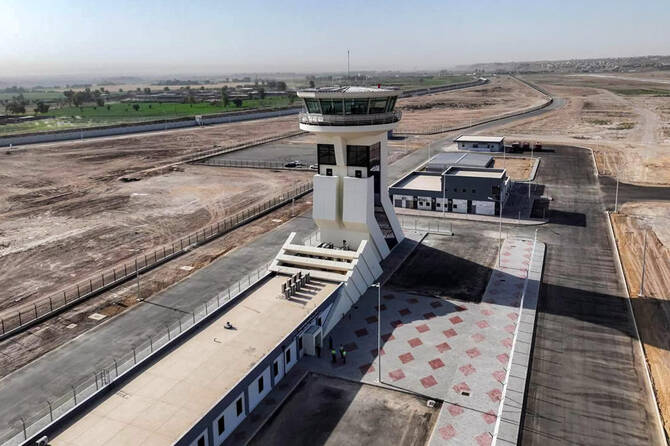
This handout picture released by Iraq’s Prime Minister’s Media Office shows the traffic control tower of Mosul International Airport in northern Iraq during its re-opening on July 16, 2025. (AFP)
Short Url
Updated 16 July 2025
Follow

Iraq PM reopens Mosul airport years after Daesh devastation

  • The airport will serve as an additional link between Mosul and other Iraqi cities and regional destinations
  • The airport has not been operational since the militants seized Mosul

MOSUL, Iraq: Iraqi Prime Minister Mohammed Shia Al-Sudani inaugurated Wednesday the city of Mosul’s newly restored airport, years after it was destroyed in the battle to dislodge the Daesh group.

Sudani’s flight landed at the airport, which is expected to become fully operational for domestic and international flights in two months.

“The airport will serve as an additional link between Mosul and other Iraqi cities and regional destinations,” the media office of the PM said in a statement.

In June 2014, the Daesh group seized Mosul, declaring its “caliphate” from the city after capturing large swathes of Iraq and neighboring Syria.

After years of fierce battles, Iraqi forces backed by a US-led international coalition dislodged the group from the city in July 2017, before declaring its defeat across the country at the end of that year.

The airport, which was heavily damaged in the battle, has not been operational since the militants seized Mosul.

In August 2022, then-prime minister Mustafa Al-Kadhimi laid the foundation stone for the airport’s reconstruction.

Airport director Amar Al-Bayati told AFP that the “airport is now ready for domestic and international flights,” but no date has been announced for their resumption.

He added that the airport previously offered international flights, mostly to Turkiye and Jordan.

The airport now includes a main terminal, a VIP lounge and an advanced radar surveillance system, Sudani’s office said.

It’s expected to handle 630,000 passengers annually.


Koshary, a spicy Egyptian staple, wins UNESCO recognition

Updated 6 sec ago
Follow

Koshary, a spicy Egyptian staple, wins UNESCO recognition

CAIRO: Koshary – a spicy dish of lentils, rice and pasta available at countless Egyptian food stalls – won recognition as a cultural treasure from the UN’s cultural agency on Wednesday, as Cairo makes a broad push to promote its cultural and historical identity abroad.
Egypt’s nomination of koshary for UNESCO’s “Intangible Cultural Heritage” list comes a little over a month after its opening of a sprawling new antiquities museum – another move officials hope will highlight the country’s rich history and lure more tourists.
One popular legend claims koshary originated in northern India and was brought to Egypt by soldiers during the British occupation. But the dish’s origins can in fact be traced through a farther-flung, millennia-old lineage of migration, trade and conquest, food researcher and archaeobotanist Hala Barakat said.

EGYPTIAN DISH, WITH GLOBAL INFLUENCES
Lentils arrived from the Fertile Crescent more than 5,800 years ago, and rice was introduced from East Asia. Tomatoes and chilli peppers were brought from the Americas centuries later, while pasta noodles were a more modern addition.
“These components came together over thousands of years,” Barakat said. “Its name may be Indian, but the Egyptian dish has its own form – and even that varies from Alexandria to Aswan.”
“Koshary in its current form is the koshary Egyptians made their own,” she added.
Egypt’s nomination makes note of this diversity, highlighting the fact that yellow lentils are used on the coast, compared with black lentils in Cairo and Upper Egypt. Some households add boiled eggs, while in Sinai a similar dish called ma’dous is common.
Each of these variations is united by “the special flavour provided by condiments such as vinegar, garlic, and hot sauce, which are added according to preference,” the nomination says.

COUSCOUS, CEVICHE ALSO ON LIST
Making the intangible heritage list is mostly symbolic, and does not bring any direct financial benefit. Other dishes such as couscous – common across the Maghreb region – and the South American dish ceviche are on the list. Italian cuisine was also set to be inscribed this year.
Koshary’s popularity surged in the 20th century as restaurants and brightly decorated street carts proliferated near schools and stations. The absence of animal products has also made it a staple among fasting Coptic Christians and younger Egyptians who are going vegetarian.
Today, the dish is one of Egypt’s most recognizable features, according to Ahmed Shaker, the public relations officer at Abou Tarek Koshary, a popular Cairo restaurant that dates back to 1963.
“Any foreigner or visitor who comes to Egypt visits the Pyramids, visits the museum, and comes to Abou Tarek to eat koshary,” Shaker said.
The dish joins Egypt’s 10 previous “inscriptions,” which include tahteeb, an ancient martial art using sticks, and the Sirat Bani Hilal, an epic oral poem.
UNESCO’s new director-general, Khaled El-Enany, previously served as Egypt’s minister of tourism and antiquities, and has vowed to use his tenure to safeguard cultural traditions.
