BUSRA AL-HARIR: Syria ‘s defense minister announced a ceasefire shortly after government forces entered a key city in southern Sweida province on Tuesday, a day after sectarian clashes killed dozens there. Neighboring Israel again launched strikes on Syrian military forces, saying it was protecting the Druze minority.
The latest escalation under Syria’s new leaders began with tit-for-tat kidnappings and attacks between local Sunni Bedouin tribes and Druze armed factions in the southern province, a center of the Druze community.
Syrian government forces, sent to restore order on Monday, also clashed with Druze armed groups.
A ceasefire announcement
On Tuesday, Syrian Defense Minister Murhaf Abu Qasra said an agreement was struck with the city’s “notables and dignitaries” and that government forces would “respond only to the sources of fire and deal with any targeting by outlaw groups.”
However, scattered clashes continued after his announcement — as did allegations that security forces had committed violations against civilians.
Syria’s Interior Ministry said Monday that more than 30 people had been killed, but has not updated the figures since. The Syrian Observatory for Human Rights, a UK-based war monitor, said Tuesday that 166 people had been killed since Sunday, including five women and two children.
Among them were 21 people killed in “field executions” by government forces, including 12 men in a rest house in the city of Sweida, it said. It did not say how many of the dead were civilians and also cited reports of members of the security forces looting and setting homes on fire.
Syrian interim President Ahmad Al-Sharaa said in a statement that he had tasked authorities with “taking immediate legal action against anyone proven to have committed a transgression or abuse, regardless of their rank or position.”
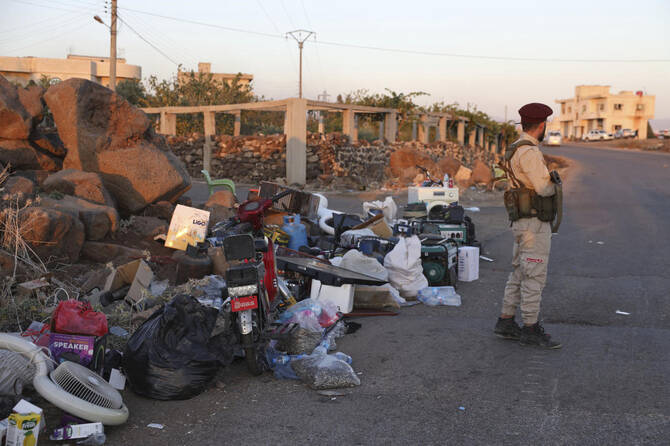
Associated Press journalists in Sweida province saw forces at a government checkpoint searching cars and confiscating suspected stolen goods from both civilians and soldiers.
Israel’s involvement draws pushback
Israeli airstrikes targeted government forces’ convoys heading into the provincial capital of Sweida and in other areas of southern Syria.
Israeli Prime Minister Benjamin Netanyahu and Defense Minister Israel Katz said the strikes sought to “prevent the Syrian regime from harming” the Druze religious minority “and to ensure disarmament in the area adjacent to our borders with Syria.” In Israel, the Druze are seen as a loyal minority and often serve in the armed forces.
Meanwhile, Israeli Cabinet member and Minister of Diaspora Affairs Amichai Chikli called on X for Al-Sharaa to be “eliminated without delay.”
A soldier’s story
Manhal Yasser Al-Gor, of the Interior Ministry forces, was being treated for shrapnel wounds at a local hospital after an Israeli strike hit his convoy.
‘We were entering Sweida to secure the civilians and prevent looting. I was on an armored personnel carrier when the Israeli drone hit us,” he said, adding that there were “many casualties.”
The Syrian Foreign Ministry said Israeli strikes had killed “several innocent civilians” as well as soldiers, and called them “a reprehensible example of ongoing aggression and external interference” in Syria’s internal matters.
It said the Syrian state is committed to protecting the Druze, “who form an integral part of the national identity and united Syrian social fabric.”
Suspicion over Syria’s new government
Israel has taken an aggressive stance toward Syria’s new leaders since Al-Sharaa’s Sunni Islamist insurgents ousted former President Bashar Assad in December, saying it doesn’t want militants near its borders. Israeli forces have seized a UN-patrolled buffer zone on Syrian territory along the border with the Golan Heights and launched hundreds of airstrikes on military sites in Syria.
Earlier Tuesday, religious leaders of the Druze community in Syria called for armed factions that have been clashing with government forces to surrender their weapons and cooperate with authorities. One of the main Druze spiritual leaders later released a video statement retracting the call.
Sheikh Hikmat Al-Hijri, who has been opposed to the government in Damascus, said in the video that the initial Druze leaders’ statement had been issued after an agreement with the authorities in Damascus but that “they broke the promise and continued the indiscriminate shelling of unarmed civilians.”
“We are being subjected to a total war of annihilation,” he claimed, without offering evidence.
Some videos on social media showed armed fighters with Druze captives, beating them and, in some cases, forcibly shaving men’s moustaches.
Sectarian and revenge attacks
The Druze religious sect began as a 10th-century offshoot of Ismailism, a branch of Shiite Islam. More than half the roughly 1 million Druze worldwide live in Syria. Most of the other Druze live in Lebanon and Israel, including in the Golan Heights, which Israel captured from Syria in the 1967 Mideast War and annexed in 1981.
Since Assad’s fall, clashes have broken out several times between forces loyal to the new Syrian government and Druze fighters.
The latest fighting has raised fears of more sectarian violence. In March, an ambush on government forces by Assad loyalists in another part of Syria triggered days of sectarian and revenge attacks. Hundreds of civilians were killed, most of them members of Assad’s minority Alawite sect. A commission was formed to investigate the attacks but no findings have been made public.
The videos and reports of soldiers’ violations spurred outrage and protests by Druze communities in neighboring Lebanon, northern Israel and in the Israel-annexed Golan Heights, where the Israeli military said dozens of protesters had crossed the border into Syrian territory.
The violence drew international concern. The US envoy to Syria, Tom Barrack, called the violence “worrisome on all sides” in a post on.
“We are attempting to come to a peaceful, inclusive outcome for Druze, Bedouin tribes, the Syrian government and Israeli forces,” he said.

Syria announces ceasefire after sectarian clashes, but more fighting and abuse alleged
Short Url
https://arab.news/zb9a5
Syria announces ceasefire after sectarian clashes, but more fighting and abuse alleged
- Tuesday’s announcement follows deadly sectarian clashes between Druze factions and Sunni Bedouin tribes that killed over 30 people
- That’s according to Syria’s Interior Ministry. However, fighting and allegations of civilian abuses by security forces continue
Sudan named most neglected crisis of 2025 in aid agency poll
LONDON: The humanitarian catastrophe engulfing Sudan, unleashing horrific violence on children and uprooting nearly a quarter of the population, is the world’s most neglected crisis of 2025, according to a poll of aid agencies.
Some 30 million Sudanese people – roughly equivalent to Australia’s population — need assistance, but experts warn that warehouses are nearly empty, aid operations face collapse and two cities have tipped into famine.
“The Sudan crisis should be front page news every single day,” said Save the Children humanitarian director Abdurahman Sharif.
“Children are living a nightmare in plain sight, yet the world continues to shamefully look away.”
Sudan was named by a third of respondents in a Thomson Reuters Foundation crisis poll of 22 leading aid organizations.
Democratic Republic of Congo (DRC), widely considered the deadliest conflict since World War Two, ranked second.
Although Sudan has received some media attention, Sharif said the true scale of the catastrophe remained “largely out of sight and out of mind.”
The United Nations has called Sudan the world’s biggest humanitarian crisis, but a $4.16 billion appeal is barely a third funded.
The poll’s respondents highlighted a number of overlooked emergencies, including Myanmar, Afghanistan, Somalia, Africa’s Sahel region and Mozambique.
Many agencies said they were reluctant to single out just one crisis in a year when the United States and other Western donors slashed aid despite soaring humanitarian needs.
“It feels as though the world is turning its back on humanity,” said Oxfam’s humanitarian director Marta Valdes Garcia.
’INDICTMENT OF HUMANITY’
The conflict between the Sudanese army and the paramilitary Rapid Support Forces, which erupted out of a power struggle in April 2023, has created the world’s largest displacement crisis with 12 million people fleeing their homes.
Aid groups cited appalling human rights violations, including child cruelty, rape and conscription.
“What is being done to Sudan’s children is unconscionable, occurring on a massive scale and with apparent impunity,” said World Vision’s humanitarian operations director Moussa Sangara.
Hospitals and schools have been destroyed or occupied, and 21 million people face acute hunger.
The UN World Food Programme (WFP) has warned that without additional funds it will have to cut rations for communities in famine or at risk.
Aid organizations say violence, blockades and bureaucratic obstacles are making it hard to reach civilians in conflict zones.
“What we are witnessing in Sudan is nothing short of an indictment of humanity,” said the UN refugee agency’s regional director Mamadou Dian Balde.
“If the world does not urgently step up — diplomatically, financially, and morally — an already catastrophic situation will deteriorate further with millions of Sudanese and their neighbors paying the price.”
’BREAKING POINT’
South Sudan and Chad, both hosting large numbers of Sudanese refugees, were also flagged in the survey.
Charlotte Slente, head of the Danish Refugee Council, said Chad – a country already dealing with deep poverty and hunger exacerbated by the climate crisis — was being pushed “to breaking point.”
“Chad’s solidarity with the refugees is a lesson for the world’s wealthiest nations. That generosity is being met by global moral failure,” Slente said.
In South Sudan, Oxfam said donors were pulling out, forcing aid agencies to cut crucial support for millions of people.
’HELLSCAPE FOR WOMEN’
Several organizations sounded the alarm over escalating conflict in DRC.
Around 7 million people are displaced and 27 million face hunger in the vast resource-rich country, where rape has been used as a weapon of war through decades of conflict.
“This is the biggest humanitarian emergency that the world isn’t talking about,” said Christian Aid’s chief executive Patrick Watt.
On a recent visit, he said villagers told him how armed groups had stolen livestock, torched homes, recruited boys to fight and subjected women and girls to terrifying sexual violence.
Rwandan-backed M23 rebels seized a swathe of eastern Congo this year in their bid to topple the government in Kinshasa. Fighting has continued despite a US-led peace deal signed this month by DRC and Rwanda.
DRC’s conflict has intensified amid soaring global demand for minerals needed for clean energy technologies, smartphones and more.
Watt said people now face economic disaster due to Kinshasa’s blockade on M23-controlled areas and aid cuts that have hollowed out the humanitarian response.
ActionAid said the violence had “created a hellscape” for women, while the Norwegian Refugee Council (NRC) called Congo “a case study of global neglect.”
“This neglect is not an accident: it is a choice,” said NRC Secretary General Jan Egeland.
UN aid chief Tom Fletcher named Myanmar as the most neglected crisis, describing it as “a billion-dollar emergency running on fumes.”
A $1.1 billion appeal for the southeast Asian country is only 17 percent funded despite mass displacement, rising hunger and rampant violence.
Although donors raced to help after Myanmar’s massive earthquake in March, Fletcher said the world had turned away from the “grinding crisis” underneath.
“Myanmar is becoming invisible,” he said.
Some 30 million Sudanese people – roughly equivalent to Australia’s population — need assistance, but experts warn that warehouses are nearly empty, aid operations face collapse and two cities have tipped into famine.
“The Sudan crisis should be front page news every single day,” said Save the Children humanitarian director Abdurahman Sharif.
“Children are living a nightmare in plain sight, yet the world continues to shamefully look away.”
Sudan was named by a third of respondents in a Thomson Reuters Foundation crisis poll of 22 leading aid organizations.
Democratic Republic of Congo (DRC), widely considered the deadliest conflict since World War Two, ranked second.
Although Sudan has received some media attention, Sharif said the true scale of the catastrophe remained “largely out of sight and out of mind.”
The United Nations has called Sudan the world’s biggest humanitarian crisis, but a $4.16 billion appeal is barely a third funded.
The poll’s respondents highlighted a number of overlooked emergencies, including Myanmar, Afghanistan, Somalia, Africa’s Sahel region and Mozambique.
Many agencies said they were reluctant to single out just one crisis in a year when the United States and other Western donors slashed aid despite soaring humanitarian needs.
“It feels as though the world is turning its back on humanity,” said Oxfam’s humanitarian director Marta Valdes Garcia.
’INDICTMENT OF HUMANITY’
The conflict between the Sudanese army and the paramilitary Rapid Support Forces, which erupted out of a power struggle in April 2023, has created the world’s largest displacement crisis with 12 million people fleeing their homes.
Aid groups cited appalling human rights violations, including child cruelty, rape and conscription.
“What is being done to Sudan’s children is unconscionable, occurring on a massive scale and with apparent impunity,” said World Vision’s humanitarian operations director Moussa Sangara.
Hospitals and schools have been destroyed or occupied, and 21 million people face acute hunger.
The UN World Food Programme (WFP) has warned that without additional funds it will have to cut rations for communities in famine or at risk.
Aid organizations say violence, blockades and bureaucratic obstacles are making it hard to reach civilians in conflict zones.
“What we are witnessing in Sudan is nothing short of an indictment of humanity,” said the UN refugee agency’s regional director Mamadou Dian Balde.
“If the world does not urgently step up — diplomatically, financially, and morally — an already catastrophic situation will deteriorate further with millions of Sudanese and their neighbors paying the price.”
’BREAKING POINT’
South Sudan and Chad, both hosting large numbers of Sudanese refugees, were also flagged in the survey.
Charlotte Slente, head of the Danish Refugee Council, said Chad – a country already dealing with deep poverty and hunger exacerbated by the climate crisis — was being pushed “to breaking point.”
“Chad’s solidarity with the refugees is a lesson for the world’s wealthiest nations. That generosity is being met by global moral failure,” Slente said.
In South Sudan, Oxfam said donors were pulling out, forcing aid agencies to cut crucial support for millions of people.
’HELLSCAPE FOR WOMEN’
Several organizations sounded the alarm over escalating conflict in DRC.
Around 7 million people are displaced and 27 million face hunger in the vast resource-rich country, where rape has been used as a weapon of war through decades of conflict.
“This is the biggest humanitarian emergency that the world isn’t talking about,” said Christian Aid’s chief executive Patrick Watt.
On a recent visit, he said villagers told him how armed groups had stolen livestock, torched homes, recruited boys to fight and subjected women and girls to terrifying sexual violence.
Rwandan-backed M23 rebels seized a swathe of eastern Congo this year in their bid to topple the government in Kinshasa. Fighting has continued despite a US-led peace deal signed this month by DRC and Rwanda.
DRC’s conflict has intensified amid soaring global demand for minerals needed for clean energy technologies, smartphones and more.
Watt said people now face economic disaster due to Kinshasa’s blockade on M23-controlled areas and aid cuts that have hollowed out the humanitarian response.
ActionAid said the violence had “created a hellscape” for women, while the Norwegian Refugee Council (NRC) called Congo “a case study of global neglect.”
“This neglect is not an accident: it is a choice,” said NRC Secretary General Jan Egeland.
UN aid chief Tom Fletcher named Myanmar as the most neglected crisis, describing it as “a billion-dollar emergency running on fumes.”
A $1.1 billion appeal for the southeast Asian country is only 17 percent funded despite mass displacement, rising hunger and rampant violence.
Although donors raced to help after Myanmar’s massive earthquake in March, Fletcher said the world had turned away from the “grinding crisis” underneath.
“Myanmar is becoming invisible,” he said.
© 2025 SAUDI RESEARCH & PUBLISHING COMPANY, All Rights Reserved And subject to Terms of Use Agreement.


