

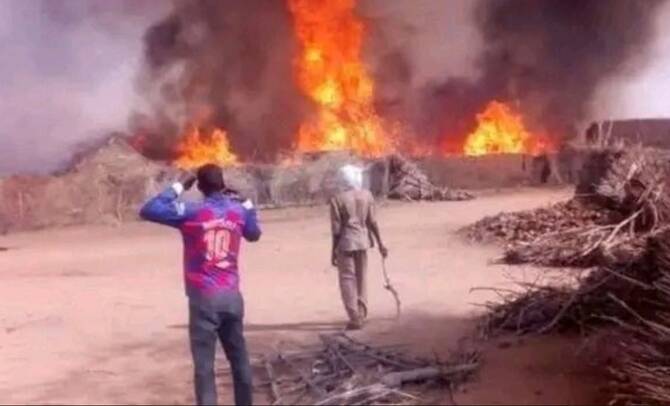
Survivors bury dead after RSF attack devastates Sudan village

The Saturday attack by the Rapid Support Forces (RSF) -- the paramilitary force at war with the regular army since April 2023 -- was part of a series of raids in recent days on villages in North Kordofan, some 250 kilometres (155 miles) southwest of the capital Khartoum. (X/@MohanadElbalal)
Short Url
Updated 15 July 2025
Follow

Survivors bury dead after RSF attack devastates Sudan village

  • The Emergency Lawyers reported on Monday that nearly 300 people were killed in North Kordofan villages
  • The area is home to several armed tribes that have refused to pledge allegiance to the RSF

PORT SUDAN: It took a full day for the villagers of Shaq Al-Nom, in Sudan’s North Kordofan state, to bury their dead after an attack by paramilitary fighters that left the village in ruins, a survivor told AFP on Tuesday.

The Saturday attack by the Rapid Support Forces (RSF) — the paramilitary force at war with the regular army since April 2023 — was part of a series of raids in recent days on villages in North Kordofan, some 250 kilometers (155 miles) southwest of the capital Khartoum.

“On Sunday, we collected the bodies from the village streets and inside the houses, and we buried 200 bodies,” Saleh Abdel Rahim, 34, told AFP.

The Emergency Lawyers, a group that documents atrocities by both sides in the war, reported on Monday that nearly 300 people were killed in North Kordofan villages between Saturday and Sunday.

Tolls are nearly impossible to independently verify in Sudan, with many medical facilities forced out of service and limited media access.

“It was indescribable,” Abdel Rahim said, using a pseudonym for fear of retaliation because he had fled to an area close to RSF positions.

“Under artillery shelling, houses burned with their families inside,” he told AFP via satellite Internet connection to circumvent a communications blackout.

Since it began, the war has killed tens of thousands and created the world’s largest hunger and displacement crises, with 14 million Sudanese currently displaced inside the country and across borders.

The Emergency Lawyers reported on Monday that paramilitaries had killed women and children, abducted civilians and looted livestock in the villages surrounding the RSF-controlled city of Bara.

In Shaq Al-Nom, “RSF vehicles arrived in the village, in an attempt to storm it” on Saturday under a hail of machine gun fire and drone strikes, according to Abdel Rahim.

“We had no choice but to resist in defense,” he said, adding that “all of the villagers of the Bara countryside have fled.”

The area is home to several armed tribes that have refused to pledge allegiance to the RSF.

North Kordofan, key to the RSF’s fuel smuggling route via Libya, has been an important battleground between the army and the paramilitaries for months.

The RSF has tried to encircle the North Kordofan state capital of El-Obeid — the only road link between Khartoum and the vast western region of Darfur, which the RSF has all but conquered.

It has been unable, however, to seize the North Darfur state capital of El-Fasher despite an ongoing siege for more than a year.

Sudanese analyst Kholood Khair told AFP that “they want to consolidate that road that links El-Fasher to El-Obeid and other parts of Kordofan, so effectively they’re in a race against time to consolidate in the west before the rains come.”

Sudan’s rainy season, which peaks in August, renders much of the country’s roads inaccessible, making it impossible for either side to capture territory until the floods start clearing in September.


Lebanon’s south could become US-backed economic zone, according to local paper Nidaa Al-Watan

Updated 16 December 2025
Follow

Lebanon’s south could become US-backed economic zone, according to local paper Nidaa Al-Watan

  • Lebanese daily quotes sources as saying the US plan casts southern Lebanon as a key gateway for broader economic transformation
  • White House fails to respond to Arab News’ request for comment

LONDON: Lebanese daily Nidaa Al-Watan has reported that the office of Jared Kushner, son-in-law and senior adviser to US President Donald Trump, has prepared detailed maps for a so‑called “Trump Economic Zone” in southern Lebanon. 

According to columnist Tarek Abou Zeinab, the Kushner plan has been formally submitted to the White House for consideration. 

Citing unnamed sources, the column said that the idea is no longer just a “whispered” concept among political circles but has entered what it described as “concrete border‑related discussions aimed at fast‑tracking the plan onto the US administration’s Middle East implementation agenda.” 

Arab News asked the US Embassy in Beirut and the US State Department for comment, but was directed to the White House for any official response. The White House was subsequently contacted but has not responded. 

Lebanon has been mired in prolonged political paralysis. Large parts of the south remain under Hezbollah’s influence, while Israel illegally occupies at least five outposts along the border that are within Lebanese sovereign land. 

According to Nidaa Al‑Watan’s sources, the US concept frames southern Lebanon as a key gateway for a wider economic transformation, tying large‑scale investment and infrastructure projects to security arrangements on the ground. 

The reported plan would seek to attract international capital, establish factories and logistics hubs, upgrade infrastructure, and build a port connected to global shipping routes. 

Its aim, according to the column, would be to open new export channels through a free‑zone model and lure major energy companies by linking southern Lebanon to wider schemes such as the India–Middle East–Europe Economic Corridor. 

Supporters of the plan argue it could trigger large Arab and international investments, raise living standards and create long‑term jobs, thereby lowering the risk of renewed conflict. 

However, Lebanese political and media sources quoted by the daily have warned that the proposal follows a new “hegemonic” approach and carries major political implications that cannot be ignored. 

The critics say the reported US vision goes beyond development to include the establishment of Jewish settlements in parts of southern Lebanon, justified on religious and security grounds to protect northern Israel. 

One source expressed concern that such moves would create a geographic and symbolic link between Israel and southern Lebanon, deepening fears over sovereignty and the region’s future political trajectory. 

The paper said Kushner is focussed on areas stretching from Mount Hermon to Shebaa and Naqoura in the far south at a time when Israel has been pressing for a buffer zone along the border, citing security concerns since the end of major clashes with Hezbollah in November 2024. 

The proposed zone would cover more than 27 southern towns, raising questions over Lebanese sovereignty. 

In parallel, the Lebanese army has been tasked with bringing all weapons under state control and asserting government authority in areas long dominated by Hezbollah, as part of a broader disarmament and security plan. 

Despite a ceasefire, Israel has continued to carry out attacks inside Lebanese territory and maintains control over parts of the south, saying the measures are necessary for security. 

Lebanese and Israeli delegations held talks in Naqoura earlier in December to shore up the ceasefire and discuss reconstruction in the south.