

Pakistan court orders probe into online blasphemy spike

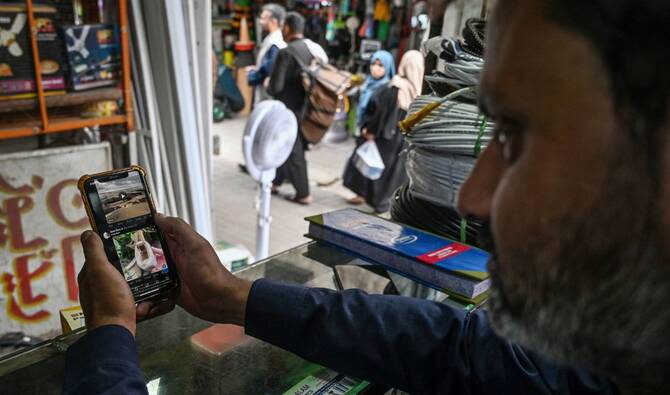
A man uses the social media platform X, formerly known as Twitter, on his phone at a market in Islamabad on April 17, 2024. (AFP/ file)
Short Url
Updated 15 July 2025
Follow

Pakistan court orders probe into online blasphemy spike

  • There has been a spike in cases of mostly young men being arrested for committing blasphemy in WhatsApp groups since 2022
  • Rights groups, police say many are brought to trial by private law firms, who use volunteers to scour Internet for offenders

ISLAMABAD: A Pakistan court ordered a government probe on Tuesday into allegations that young people are being entrapped in online blasphemy cases, following appeals from hundreds of families.

There has been a spike in cases of mostly young men being arrested for committing blasphemy in WhatsApp groups since 2022.

Rights groups and police have said that many are brought to trial by private law firms, who use volunteers to scour the Internet for offenders.

“The government will constitute a commission within a 30-day timeframe,” said Justice Sardar Ejaz Ishaq Khan at Islamabad High Court, adding that the commission is required to submit its findings within four months.

Blasphemy is an incendiary charge in Muslim-majority Pakistan punishable by death, and even unsubstantiated accusations can incite public outrage, lead to lynchings and to families being shunned by society.

A report published by the government-run National Commission for Human Rights in October last year said there were 767 people, mostly young men, in jail awaiting trial over blasphemy allegations.

“This is a huge ray of hope and it’s the first time that the families have felt heard,” said lawyer Imaan Mazari, who represents the families of arrested men and women, of the court order.

“Youngsters have been falsely roped into cases of such a sensitive nature that the stigma will last forever even if they are acquitted,” she added.

A 2024 report by Punjab police into the sudden spike in cases, that was leaked to the media, found that “a suspicious gang was trapping youth in blasphemy cases” and may be motivated by financial gain.

The Legal Commission on Blasphemy Pakistan (LCBP) is the most active of lawyers groups prosecuting young men in Pakistan.

Sheraz Ahmad Farooqi, one of the group’s leaders, told AFP in October that “God has chosen them for this noble cause.”

In recent years, several youngsters have been convicted and handed death sentences, although no execution has ever been carried out for blasphemy in Pakistan.

“We will fully support the probe commission and are confident that our voices will finally be listened to, our concerns will be heard, and the truth will come out,” the relative of one of the accused, who asked not to be named because of the backlash, told AFP.


Pakistan, UK sign £35 million Green Compact to strengthen climate resilience

Updated 21 December 2025
Follow

Pakistan, UK sign £35 million Green Compact to strengthen climate resilience

  • Pakistan ranks among nations most vulnerable to climate change and has seen erratic changes in its weather patterns
  • UK will help Pakistan mobilize climate finance, strengthen regulatory frameworks and develop bankable climate projects

ISLAMABAD: Pakistan and the United Kingdom (UK) have formalized a comprehensive climate partnership with the launch of a Green Compact that aims to enhance climate resilience, accelerate clean energy transition and scale up nature-based solutions, including mangrove conservation, Pakistani state media reported on Sunday.

The agreement, signed in Islamabad by Federal Minister for Climate Change and Environmental Coordination Dr. Musadik Malik and UK Minister for International Development Jennifer Chapman, unlocks £35 million in targeted support for green development and long-term climate action, according to Radio Pakistan broadcaster.

Pakistan ranks among nations most vulnerable to climate change and has seen erratic changes in its weather patterns that have led to frequent heatwaves, untimely rains, storms, cyclones, floods and droughts in recent years. In 2022, monsoon floods killed over 1,700 people, displaced another 33 million and caused over $30 billion losses, while another 1,037 people were killed in floods this year.

Mohammad Saleem Shaikh, a spokesperson for Pakistan’s Ministry of Climate Change, described the compact as a “decisive move toward action-oriented climate cooperation,” noting that its implementation over the next decade will be critical for Pakistan which regularly faces floods, heatwaves and water stress.

“The Compact is structured around five core pillars: climate finance and investment, clean energy transition, nature-based solutions, innovation and youth empowerment, and adaptation and resilience,” the report read.

“Under the agreement, the UK will work with Pakistan to mobilize public and private climate finance, strengthen regulatory frameworks for green investment, and develop bankable climate projects.”

Clean energy forms a central component of Pakistan’s transition, with Islamabad planning to expand solar and wind generation to reduce fossil fuel dependence, improve energy security and stabilize power costs, according to Shaikh.

“Renewable energy is now economically competitive, making the transition both environmentally and financially viable,” he was quoted as saying.

“Nature-based solutions, particularly large-scale mangrove restoration, will protect coastal communities from storm surges and erosion while enhancing biodiversity and carbon sequestration.”

Under the Compact, technical support, mentoring and access to investors will be provided to climate-smart startups and young innovators, reflecting Pakistan’s recognition of youth-led initiatives as central to future climate solutions.

On the occasion, Chapman, on her first official visit to Pakistan, underscored the urgency of climate action, highlighting the UK’s support for renewable energy, mangrove and ecosystem restoration, early-warning systems, climate budgeting and international investment flows into Pakistan.

Shaikh described the Green Compact as “a strategic turning point” in Pakistan–UK relations on climate change, saying its effective implementation is essential for Pakistan to meet its national climate targets.