

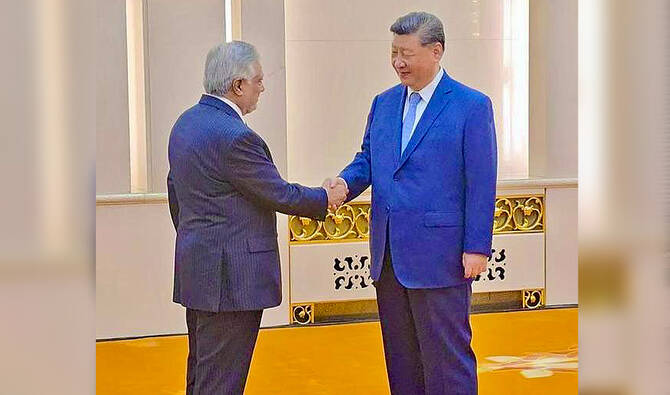

ISLAMABAD: Pakistan’s Deputy Prime Minister Ishaq Dar on Tuesday highlighted his country’s commitment to strengthening ties with China and reaffirmed a shared vision for regional peace and development during an interaction with Chinese President Xi Jinping at the joint call of the Shanghai Cooperation Organization (SCO) Foreign Ministers in Beijing.
The interaction took place on the sidelines of the SCO Council of Foreign Ministers (CFM) meeting, a key diplomatic gathering aimed at preparing the groundwork for the upcoming SCO Leaders’ Summit later this year. The CFM convened to review progress on multilateral cooperation and set the agenda for endorsement by heads of state.
“Delighted to meet earlier today with President Xi Jinping at the Great Hall of the People in Beijing,” Dar said in a post on social media platform X. “Conveyed the warm greetings of the leadership, government and people of Pakistan. As iron-clad brothers and All-Weather Strategic Cooperative Partners, we remain committed to deepening Pak-China enduring friendship and advancing shared regional goals.”
Islamabad and Beijing are long-time allies and have been jointly working on multibillion-dollar infrastructure, energy and connectivity initiatives under the China-Pakistan Economic Corridor (CPEC), a flagship project of China’s Belt and Road Initiative. The corridor provides China direct access to the Arabian Sea through Pakistan’s Gwadar port, while enabling Pakistan to modernize its infrastructure and strengthen regional trade links.
The foreign office of Pakistan said in a statement released earlier today that President Xi emphasized the importance of regional cooperation under the SCO framework, an organization spanning the Eurasian landmass and representing a significant portion of the global population.
BILATERAL MEETINGS
On the sidelines of the conference, the Pakistani deputy prime minister also met Russian Foreign Minister Sergei Lavrov.
The two officials expressed satisfaction over the positive trajectory of bilateral ties and agreed to further enhance cooperation in trade, energy, agriculture and defense, according to an official statement.
It added Dar also invited Lavrov to visit Pakistan.
Their meeting came at a time when Pakistan and Russia are seeking to deepen their partnership through plans to build a new steel mill in southern Sindh and launch a pilot cargo train project in August.
The deputy PM also met with Iranian Foreign Minister Seyyed Abbas Araghchi, with the two leaders reviewing bilateral cooperation and discussing the evolving regional situation following Israel’s war against Iran.
Dar reaffirmed Pakistan’s “unwavering solidarity with the people and Government of Iran,” and emphasized that dialogue and diplomacy remain the only viable path to de-escalation and lasting peace, according to the foreign office.
The SCO conference is also being attended by India’s External Affairs Minister Subrahmanyam Jaishankar, though no meeting is scheduled between Pakistani and Indian officials.
The CFM takes place nearly two months after a tense four-day military standoff between Pakistan and India, during which both sides exchanged missiles, drones and artillery fire before agreeing to a US-brokered ceasefire.


