

Nationwide strike looms as Karachi business leaders, transporters unite against ‘anti-business’ tax law

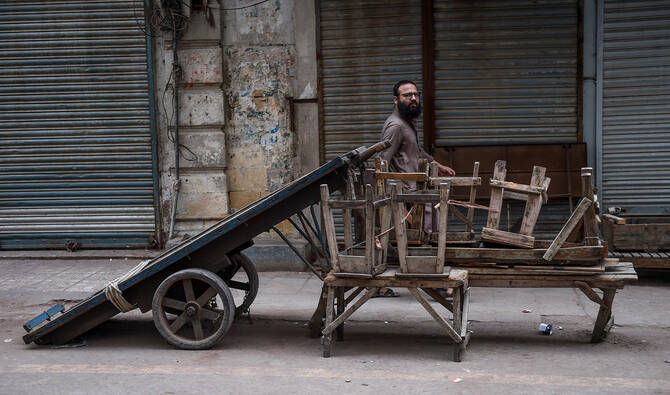
A man walks past a shuttered market during the countrywide traders strike in Karachi, Pakistan, on October 29, 2019. (AFP/File)
Short Url
Updated 15 July 2025
Follow

Nationwide strike looms as Karachi business leaders, transporters unite against ‘anti-business’ tax law

  • Shutdown on July 19 could bring economic activity to a standstill, traders and transporters warn
  • Business community is protesting over key provisions in government’s new Finance Act 2025

KARACHI: Pakistan’s largest business chamber has joined forces with goods transporters from across the country to call for a nationwide strike this week on July 19 in protest against key provisions in the government’s new Finance Act 2025, which they say threaten to paralyze economic activity and stifle trade.

The president of the Karachi Chamber of Commerce & Industry (KCCI), Muhammad Jawed Bilwani, announced the planned shutdown at a press conference on Monday, flanked by senior chamber officials and leaders of multiple transport alliances.

The strike, they warned, will halt the movement of goods and bring business operations to a grinding halt if the federal government fails to suspend what they describe as “anti-business” measures.

“Unless the government puts all these measures in abeyance, the nationwide strike scheduled for July 19 will take place with full force, bringing economic activity across the country to a grinding halt,” Bilwani said, according to the official statement.

The business community says more than 50 trade associations nationwide have pledged formal support for the strike, signaling what could be one of the biggest shutdowns in Pakistan in recent years if the deadlock persists.

The chamber has listed five key demands, including withdrawal of new sections that grant the Federal Board of Revenue (FBR) powers to arrest traders, penalties on cash transactions above Rs200,000, mandatory digital invoicing, a new e-bilty requirement for goods transporters, and the restoration of the Final Tax Regime for exporters.

Bilwani said transporters’ associations had pledged “unwavering solidarity” with the business community and committed to a complete wheel-jam strike that will stop the movement of trucks nationwide on July 19.

“No vehicle will move… in absolute unity with the business community,” he said.

This is not the first time Pakistan’s business community has threatened mass shutdowns in response to tax measures. But the show of unity between traders and goods transporters has raised fears of significant supply chain disruptions.

Bilwani said while the Ministry of Finance has made informal contact with the chamber, there has been no official commitment to roll back the controversial measures. He insisted that “only upon suspension of these provisions” would the business community agree to any further talks with lawmakers.

Chairman of the Businessmen Group (BMG) Zubair Motiwala, also speaking at the event, warned that the strike was a last resort:

“While the business community does not favor frequent strikes, the prevailing conditions have left no other option,” he said, according to the KCCI statement.

Transport leaders, including representatives of the Pakistan Goods Transport Alliance and other associations, declared their “full and unconditional support” for the strike and pledged to remain aligned with KCCI’s demands “regardless of the consequences.”


Islamabad offers skilled manpower to help Iraq in reconstruction, development efforts

Updated 21 December 2025
Follow

Islamabad offers skilled manpower to help Iraq in reconstruction, development efforts

  • The development comes during Pakistan President Asif Ali Zardari’s four-day visit to Iraq to strengthen bilateral cooperation
  • Zardari says current levels of bilateral trade do not reflect true potential of Pakistan-Iraq ties, highlights opportunities

ISLAMABAD: Pakistan has offered to provide skilled manpower to support Iraq’s reconstruction and development efforts, the Pakistani government said on Sunday, signaling Islamabad’s willingness to deepen cooperation with Baghdad in sectors including infrastructure, technical services and human resource development.

The development comes during Pakistan President Asif Ali Zardari’s four-day visit to Iraq to strengthen cooperation in trade, investment, religious tourism, energy and other sectors.

Zardari held a one-on-one meeting with his Iraqi counterpart, Dr. Abdul Latif Jamal Rashid, at Baghdad Palace, which was followed by delegation-level talks to review the state of bilateral relations.

“President Zardari reiterated Pakistan’s willingness to support Iraq’s reconstruction and development efforts through the provision of skilled and semi-skilled manpower under the existing Memorandum of Understanding on manpower transmission,” Pakistan’s Press Information Department (PID) said in a statement.

“He also highlighted Pakistan’s capacity in medical services, financial expertise and digital governance, and expressed readiness to share technical experience, including in secure data management, to support institutional capacity-building in Iraq.”

Iraq has been working to rebuild its economy and infrastructure after decades of conflict, including the 2003 US-led invasion and years of instability caused by sectarian violence and the fight against Daesh group. Although security conditions have improved in recent years, large parts of the country still face damaged roads, power plants, hospitals and housing, requiring large-scale reconstruction and public service delivery.

During Sunday’s meeting, Zardari noted that the current levels of bilateral trade do not reflect the true potential of Pakistan-Iraq economic, cultural and security relations, highlighting opportunities in agriculture, defense production, information technology, construction, pharmaceuticals and other sectors. He underscored the importance of business-to-business engagement and the establishment of direct banking channels to facilitate trade and commercial activity, according to the PID.

Zardari also requested improved facilitation for Pakistani pilgrims visiting Iraq and expressed hope for early finalization and implementation of a proposed Memorandum of Understanding on Zaireen (pilgrims) Management, aimed at ensuring orderly travel. He expressed his firm resolve to work with the Iraqi government to stop illegal entry and overstay of those Pakistanis who violate Iraqi law.

“Both Presidents expressed their resolve to fight extremism, terrorism and narco trade and enhance bilateral cooperation,” the PID said. “The two leaders reaffirmed their commitment to further deepening bilateral cooperation across political, economic and social domains.”

Pakistan and Iraq established diplomatic relations in 1947 and have traditionally maintained cordial ties, though commercial links remain modest. The volume of trade between both countries stood at $268 million in 2023.

Pakistan’s major exports to Iraq include machinery and mechanical appliances, pharmaceutical products, fish, cereals, essential oils and resinoids. Islamabad’s imports from Iraq include mineral fuels, mineral, organic chemicals, edible fruit and nuts.