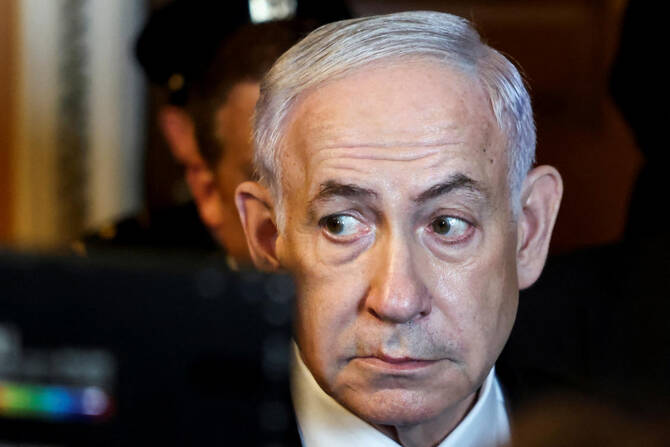
Netanyahu under mounting political pressure after party quits

United Torah Judaism’s departure has a window of 48 hours before becoming official, meaning Prime Minister Benjamin Netanyahu can still find ways to satisfy the party and bring it back into the coalition. (Reuters)
Short Url
Updated 15 July 2025
Follow

Netanyahu under mounting political pressure after party quits

  • UTJ lawmakers said walkout would come into effect after 48 hours, giving Netanyahu two days to try and resolve crisis which has dogged his coalition for months

JERUSALEM: A religious party has quit Israel’s ruling coalition in a dispute over military service, leaving Prime Minister Benjamin Netanyahu with a razor-thin majority in parliament but still enough political support to secure a potential Gaza ceasefire.
Six members of United Torah Judaism (UTJ) handed in resignation letters overnight from posts in parliamentary committees and government ministries, in protest against lawmakers’ failure to guarantee future exemption from military conscription for ultra-Orthodox religious students.
Shas, a second ultra-Orthodox party closely allied with UTJ, may follow and leave the government with no parliament majority.
The UTJ lawmakers said their walkout would come into effect after 48 hours, giving Netanyahu two days to try and resolve the crisis which has dogged his coalition for months.
Even if that fails, parliament goes on summer break at the end of July, which would give the prime minister a further three months to seek a solution before any loss of his majority could threaten his position.
Netanyahu is also facing pressure from far-right parties in his coalition over ceasefire talks underway in Qatar.
The indirect negotiations between Israel and Palestinian militant group Hamas aim to halt fighting in Gaza for 60 days to allow half of remaining hostages held by Hamas to be released and aid to flow into the battered enclave.
It would also open a further phase of talks on ending the war entirely.
National Security Minister Itamar Ben-Gvir and Finance Minister Bezalel Smotrich want Israel to press on with the war, but Netanyahu would still be likely to have enough cabinet votes to secure a ceasefire without them.
“As soon as the right deal is on the table, the prime minister will be able to pass it through,” a close aide to Netanyahu, Topaz Luk, told Army Radio on Tuesday.

Military exemptions 
Israelis have become increasingly weary of the 21-month war in Gaza, which began with a surprise attack by Hamas on October 7, 2023 that led to Israel’s single deadliest day with 1,200 killed and 251 taken hostage by the Palestinian militants.
Israel’s subsequent offensive against Hamas has since killed more than 58,000 Palestinians, according to health officials, displaced almost the entire population of Gaza, led to a humanitarian crisis and left much of the enclave in ruins.
It has also exacted Israel’s highest military death toll in decades, with around 450 soldiers killed so far in Gaza combat. This has added fuel to an already explosive debate over a new conscription bill at the center of Netanyahu’s political crisis.
Ultra-Orthodox seminary students have long been exempt from mandatory military service. Many Israelis are angered by what they see as an unfair burden carried by the mainstream who serve.
Ultra-Orthodox Jewish leaders say full-time devotion to holy scriptures study is sacrosanct and fear their young men will steer away from religious life if they are drafted into the military.
Last year the Supreme Court ordered an end to the exemption. Parliament has been trying to work out a new conscription bill, which has so far failed to meet UTJ demands.


First AI-aided transaction in Dubai promises to change way consumers shop

Updated 15 min 3 sec ago
Follow

First AI-aided transaction in Dubai promises to change way consumers shop

  • Artificial intelligence agent purchases movie tickets for a customer after asking a few questions

DUBAI: CEO of Mastercard Michael Miebach announced on Tuesday that the company, in conjunction with UAE retailer Majid Al-Futtaim, had successfully completed the first transaction by an AI agent in Dubai.

An AI agent purchased movie tickets for a customer after asking a few questions during the transaction.

Speaking at the Dubai Future Forum alongside UAE Minister of State for Artificial Intelligence Omar Al-Olama, Miebach said that in the future “AI agents” would guide most transactions.

Al-Olama hailed the transaction, saying it was part of a future that would streamline the way people consumed online and in person.

“I saw that transaction, I found it extremely seamless,” Olama told the crowd at the Museum of the Future. “It’s very, very convenient, and it’s like having the best personal assistant that will do everything for you, select the movie, get your best seats, find the best timing, the closest location to you, and make a payment without many instructions. And that’s why it stood out.”

While retail chatbots that help customers have been around for some time, Mastercard’s new agentic solution differs in that it is able to make the transaction directly, working like a real-life assistant with access to your finances.

Asked by Al-Olama whether this risked agentic AI going on shopping sprees without consent, likening it to giving away card details to your child, Miebach said that the risk could be mitigated through the right mix of controls and regulation.

“If you think about it from a perspective of powering a digital economy in a country like the UAE, a lot of things need to have (happened) in the background to make it safe, to make it secure, to make it intuitive,” Miebach told the forum.

“When AI starts to make decisions on your behalf for shopping, that can be very scary. So, we (have) got to put in the controls, and all of that is what Mastercard’s Agent Pay has done.”

Miebach said that he envisioned a future where agents would start to understand your preferences for groceries, movies and retail items and make purchases seamlessly when asked, which would substantially streamline the experience of customers.

But he believed that before the technology could really take off, companies and governments would have to gain the trust of individuals and communities.

“What happens if something goes wrong in the world of an AI-generated transaction? And so, what do you do as a consumer? You say, I never intended to do this transaction, and you lose trust,” Miebach said.

“So we have to build in the safeguards. We have to build in the controls. And that is what our business does for a living. That’s what regulators look at. I think it’s really important.”