

Bangladesh struggles to contain the fallout of an uprising that toppled its leader last year

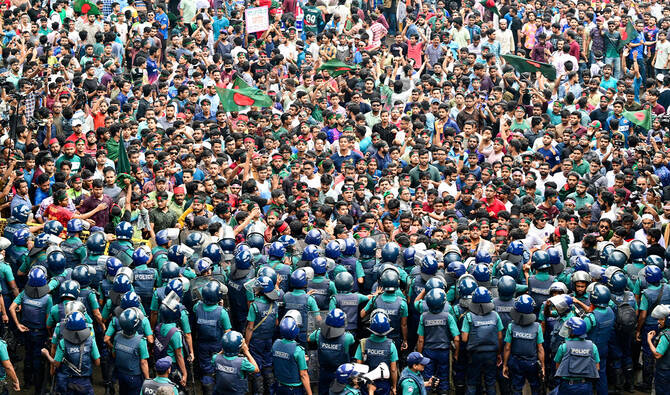
Students scuffle with police during a protest to demand merit-based system for civil service jobs in Dhaka, Bangladesh, on July 11, 2024. (AFP/File)
Short Url
Updated 15 July 2025
Follow

Bangladesh struggles to contain the fallout of an uprising that toppled its leader last year

  • One year after Hasina’s ouster, interim government faces growing unrest, delayed reforms, political fragmentation
  • Rights concerns remain a major issue, conservative religious factions gain ground and Yunus resists calls for early elections

DHAKA: Bangladesh was on the cusp of charting a new beginning last year after its former Prime Minister Sheikh Hasina was removed from power in a student-led uprising, ending her 15-year rule and forcing her to flee to India.

As the head of a new interim government, Nobel Peace Prize laureate Muhammad Yunus promised to hold a credible election to return to democracy, initiate electoral and constitutional reforms and restore peace on the streets after hundreds were killed in weeks of violence that began on July 15, 2024.

A year later, the Yunus-led administration has struggled to contain the fallout of the uprising. Bangladesh finds itself mired in a growing political uncertainty, religious polarization and a challenging law-and-order situation.

Here’s what to know about Bangladesh a year after the protests that toppled Hasina.

Chaotic political landscape

Uncertainty about the future of democracy looms large in Bangladesh.

The student protesters who toppled Hasina formed a new political party, promising to break the overwhelming influence of two major dynastic political parties — the Bangladesh Nationalists Party, or BNP, and Hasina’s Awami League.

But the party’s opponents have accused it of being close to the Yunus-led administration and creating chaos for political mileage by using state institutions.

Meanwhile, Bangladesh’s political landscape has further fragmented after the country’s largest Islamist party, the Jamaat-e-Islami, returned to politics more than a decade after it was suppressed by Hasina’s government.

Aligned with the student-led party, it’s trying to fill the vacuum left by the Awami League, which was banned in May. Its leader, Hasina, is facing trial for crimes against humanity. The strength of Jamaat-e-Islami, which opposed Bangladesh’s independence from Pakistan in 1971, is unknown.

Both BNP and the Jamaat-e-Islami party are now at loggerheads over establishing supremacy within the administration and judiciary, and even university campuses.

They are also differing over the timing of a new parliamentary election. Yunus has announced that the polls would be held in April next year, but poor law and order situation and a lack of clear-cut political consensus over it have created confusion. The chief of Bangladesh’s military also wanted an election in December this year — a stance Yunus didn’t like.

“Post-revolution honeymoons often don’t last long, and Bangladesh is no exception,” says Michael Kugelman, a Washington-based South Asia analyst and senior fellow of Asia Pacific Foundation. “The interim government faced massive expectations to restore democracy and prosperity. But this is especially difficult to do as an unelected government without a public mandate.”

Yunus wants reforms before election

Yunus has delayed an election because he wants reforms — from changes to the constitution and elections to the judiciary and police. Discussions with political parties, except Hasina’s Awami League, are ongoing.

Some of the reforms include putting a limit on how many times a person can become the prime minister, introduction of a two-tier parliament, and appointment of a chief justice.

There appears to be little consensus over some basic reforms. While both the BNP and the Jamaat-e-Islami parties have agreed to some of them with conditions, other proposals for basic constitutional reforms have become a sticking point.

The Jamaat-e-Islami also wants to give the interim government more time to complete reforms before heading into polls, while BNP has been calling for an early election. The student-led party mostly follows the pattern of the Jamaat-e-Islami party.

Kugelman says the issue of reforms was meant to unite the country, but has instead become a flashpoint.

“There’s a divide between those that want to see through reforms and give them more time, and those that feel it’s time to wrap things up and focus on elections,” he says.

Human rights and the rise of Islamists

Human rights in Bangladesh have remained a serious concern under Yunus.

Minority groups, especially Hindus, have blamed his administration for failing to protect them adequately. The Bangladesh Hindu Buddhist Christian Unity Council says minority Hindus and others have been targeted in hundreds of attacks over the last year. Hasina’s party has also blamed the interim government for arresting tens of thousands of its supporters.

The Yunus-led administration denies these allegations.

Meenakshi Ganguly, deputy Asia director for Human Rights Watch, says while the interim government has stopped enforced disappearances and extrajudicial executions that had occurred under the Hasina government, “there has been little progress on lasting security sector reforms or to deliver on the pledge to create robust, independent institutions.”

Meanwhile, Islamist factions — some of whom have proposed changes to women’s rights and demanded introduction of Sharia law — are vying for power. Many of them are planning to build alliances with bigger parties like the BNP or the Jamaat-e-Islami.

Such factions have historically struggled to gain significant electoral support despite Bangladesh being a Muslim majority, and their rise is expected to further fragment the country’s political landscape.

Diplomatic pivot and balancing with global powers

During Hasina’s 15-year rule, Bangladesh was India’s closest partner in South Asia. After her ouster, the Yunus-led administration has moved closer to China, which is India’s main rival in the region.

Yunus’ first state visit was to China in March, a trip that saw him secure investments, loans and grants. On the other hand, India is angered by the ousting of its old ally Hasina and hasn’t responded to Dhaka’s requests to extradite her. India stopped issuing visas to Bangladeshis following Hasina’s fall.

Globally, Yunus seems to have strong backing from the West and the United Nations, and it appears Bangladesh will continue its foreign policy, which has long tried to find a balance between multiple foreign powers.

But Kugelman says the country’s biggest challenge may be the “Trump factor.”

In January, the Trump administration suspended USAID funds to Bangladesh, which had sought significant levels of US support during a critical rebuild period post Hasina’s ouster.

“Dhaka must now reframe its relations with an unconventional US administration that will largely view Bangladesh through a commercial lens,” Kugelman says.


India’s wealthy embrace a new luxury symbol: water

Updated 02 February 2026
Follow

India’s wealthy embrace a new luxury symbol: water

  • Tap water in India is not fit for human consumption
  • Wealthy opt for premium water as wellness craze boosts industry

NEW DELHI: At an Indian gourmet food store, Avanti Mehta is organizing a blind tasting of drinks sourced from France, Italy and India. No, ​this isn’t wine, it’s water.
Participants use tiny shot glasses to check the minerality, carbonation and salinity in samples of Evian from the French Alps, Perrier from southern France, San Pellegrino from Italy and India’s Aava from the foothills of the Aravalli mountains.
“They will all taste different ... you should be choosing a water that can give you some sort of nutritional value,” said Mehta, who is 32 and calls herself India’s youngest water sommelier, a term usually associated with premium wine. Her family owns the Aava mineral water brand. Premium water is a $400 million business in the world’s most populous nation and is growing bigger as its wealthy see it as a new status symbol that fits in with a spreading wellness craze.
Premium Indian mineral water costs around $1 for a one-liter bottle, while imported brands are upwards of $3, or 15 times the price of the country’s lowest-priced basic bottled water.
Clean water is a privilege in the country of 1.4 billion people where ‌researchers say 70 percent of ‌the groundwater is contaminated. Tap water remains unfit to drink, and 16 people died in Indore city ‌after ⁠consuming contaminated ​tap water ‌in December.
Many in India see bottled water as a necessity and standard 20 US-cent bottles are available widely at convenience stores, restaurants and hotels. The market is worth nearly $5 billion annually and is set to grow 24 percent a year — among the fastest in the world.

Workers arrange PET (Polyethylene Terephthalate) bottles filled with natural water on a conveyor at Tata's Himalayan natural mineral water bottling plant in Dhaula Kuan, Himachal Pradesh, India. (REUTERS)

Bottled water demand in United States or China is driven by convenience, making it a $30 billion-plus market in each country which will grow just 4-5 percent each year, Euromonitor says.
In India, the premium water segment is leading the surge in demand, accounting for 8 percent of the bottled water market last year compared to just 1 percent in 2021, Euromonitor said.
“Distrust of municipal water in some areas has escalated the demand for bottled water. Now, people understand how mineral water has more health benefits. It’s expensive, but the category will boom,” said Amulya Pandit, a senior consultant at Euromonitor specializing in the drinks ⁠market.
Among its consumers are New Delhi-based real estate developer B.S. Batra, who says his family uses only premium water at home to get more minerals and safeguard health.
“You feel different, more energetic during the day,” ‌said Batra, 49, an avid badminton player.
“I consume mineral water even with whisky at home, and ‍kids use it for their smoothies.”

Natural water is filled into PET (Polyethylene Terephthalate) bottles at a bottling machine at Tata's Himalayan natural mineral water bottling plant in Dhaula Kuan, Himachal Pradesh, India. (REUTERS)


Water lures Bollywood star, wealthy
The popular 20-cent plastic ‍bottled water is mainly made by Pepsi, Coca-Cola and Indian market leader Bisleri. In addition, Indians who can afford it, install purifiers in their homes which ‍clean the water but also remove most minerals.
Imported and local premium waters are luring wealthy consumers and businesses alike.
Bollywood star Bhumi Pednekar and her sister have launched Backbay — selling 750 ml cartons of mineral water for $2.2; Indian conglomerate Tata is expanding its premium water portfolio, and retailers and businesses are reporting higher sales.
Tata Consumer Products, also Starbucks’ partner in India, sells 20-cent bottled water, but premium water is its priority as it sees affluent, health-focused consumers willing to spend on the drink without worrying about the price, CEO Sunil D’Souza said in ​an interview.
“I don’t have to push water uphill...I see a long, long, long runway for the business,” he said.
Tata’s premium “Himalayan” mineral water factory — which a Reuters photographer visited — is located in the foothills of the Himalayan range in Himachal Pradesh state. Workers there largely ⁠keep a hands-free watch on machines filling plastic and glass bottles with water sourced from a natural underground aquifer.

A drone view shows Tata's Himalayan natural mineral water bottling plant in Dhaula Kuan, Himachal Pradesh, India. (REUTERS)


Looking for springs
Most Indians prefer still water, and the sparkling variant remains niche. Tata said it plans to launch a sparkling Himalayan water, and is also scouting for natural springs for expanding its other offerings. At three Foodstories Indian gourmet stores, sales of premium waters tripled in 2025. Customer demand prompted the chain to import “light and creamy” Saratoga Spring Water from New York, which costs 799 rupees ($9) for a 355-milliliter (12-fluid-ounce) bottle, and stocks sold out within days, said co-founder Avni Biyani.
Indian mineral water brand Aava’s sales touched a record 805 million rupees ($9 million) last year, growing 40 percent a year since 2021. Tata said its basic and premium water portfolio will grow 30 percent a year, after growing tenfold to $65 million in six years.
Imported waters, which attract an over 30 percent tax, are pricier than Indian brands. Nestle’s Perrier and San Pellegrino, and Danone’s Evian retail for over 300 rupees, or $3.20, for a 750 ml bottle.
Nestle declined to comment, while Danone said the Indian bottled water market was growing at a “robust” pace but imported waters “tend to be niche and boutique.”
“When you open your tap, you’re not getting an Aava, Evian ... And that is what you’re essentially paying for,” said water sommelier Mehta.
At the water tasting session, some participants said they enjoyed the experience ‌but many found the price hard to swallow.
“To be honest, it is kind of expensive,” said executive Hoshini Vallabhaneni, one of 14 people at the event. “For everyday use — it will burn a hole in the pocket.”