

‘Generational benefits’ from Reko Diq mines will uplift conflict-hit Balochistan — Barrick CEO

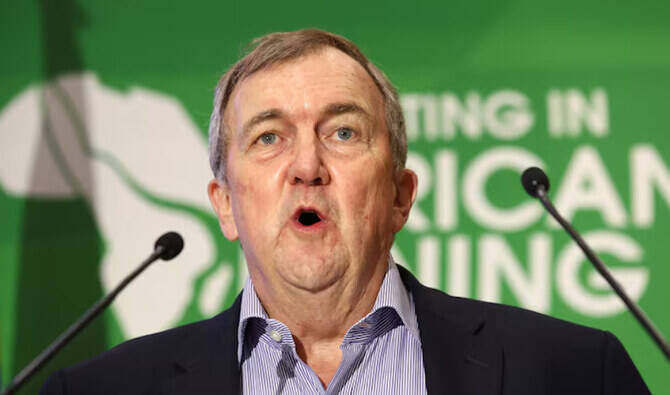
Mark Bristow, CEO of Barrick Gold Co., speaks during the Investing in African Mining Indaba 2023 conference in Cape Town, South Africa on February 8, 2023. (REUTERS/File)
Short Url
Updated 15 July 2025
Follow

‘Generational benefits’ from Reko Diq mines will uplift conflict-hit Balochistan — Barrick CEO

  • Mining giant highlights local hiring, health care and education projects during visit to remote Chagai village
  • Project being developed in backdrop of decades of unrest, economic marginalization in restive Balochiatan

QUETTA: The chief executive of Canadian mining firm Barrick Gold said this week the multibillion-dollar Reko Diq copper and gold project in Pakistan’s Balochistan province will deliver “generational benefits” to the impoverished, conflict-hit region, as he met residents of Humai village near the mine site.

The Reko Diq project, jointly owned by Barrick and the governments of Pakistan and Balochistan, is one of the world’s largest undeveloped copper-gold deposits. Long delayed by legal disputes and concerns over foreign investment, the mine is seen as a potential economic game changer in a province that has long suffered from poverty, underdevelopment, and armed separatist violence.

Balochistan, Pakistan’s largest but least populated province, has for years seen unrest rooted in demands for greater autonomy and a larger share of natural resource revenues. Separatist militants have regularly targeted infrastructure, Chinese investments, and security forces. Against this backdrop, Barrick has emphasized its commitment to inclusive and transparent development.

“Reko Diq is not just a mining project; it is a multi-generational opportunity that promises sustained economic and social development for local communities for decades to come,” Barrick CEO Mark Bristow said in a statement on Monday released after he visited Humai, the closest village to the project site in District Chagai.

Bristow met local elders and development committee members, reaffirming the company’s goal to invest in job creation, skills training, education, and health care for Baloch communities.

“We are creating job opportunities not only through RDMC but also through our large network of partner and supplier companies that are coming onboard to support this major development,” Bristow said. “Currently, 75 percent of our workforce is from Balochistan — the majority from District Chagai — and we aim to continue strengthening this local representation.”

Bristow also highlighted recent investments in health care, including a new Mother and Child Health Center in Humai that offers maternal care services — the first such facility of its kind in the area.

“No meaningful development of this world-class mineral resource can happen without the active involvement and support of the people who live here,” he said.

Humai village chief Liaqat Malik and Par-e-Koh Community Development Committee Chairman Taj Muhammad thanked Bristow and RDMC for their engagement and development work, pledging continued community support for the project, according to the Barrick statement. 

The Reko Diq project is expected to begin production by 2028 and generate thousands of jobs while significantly boosting Pakistan’s export revenues. The Pakistani government has said it will ensure environmental protections and fair distribution of project benefits, though watchdog groups continue to call for greater transparency and community participation in oversight.


Imran Khan not a ‘national security threat,’ ex-PM’s party responds to Pakistan military

Updated 06 December 2025
Follow

Imran Khan not a ‘national security threat,’ ex-PM’s party responds to Pakistan military

  • Pakistan’s military spokesperson on Friday described Khan’s anti-army narrative as a “national security threat”
  • PTI Chairman Gohar Ali Khan says words used by military spokesperson for Khan were “not appropriate”

ISLAMABAD: Former prime minister Imran Khan’s Pakistan Tehreek-e-Insaf (PTI) party on Saturday responded to allegations by Pakistan military spokesperson Lt. Gen. Ahmed Sharif Chaudhry from a day earlier, saying that he was not a “national security threat.”

Chaudhry, who heads the military’s media wing as director general of the Inter-Services Public Relations (ISPR), spoke to journalists on Friday, in which he referred to Khan as a “mentally ill” person several times during the press interaction. Chaudhry described Khan’s anti-army narrative as a “national security threat.”

The military spokesperson was responding to Khan’s social media post this week in which he accused Chief of Defense Forces Field Marshal Asim Munir of being responsible for “the complete collapse of the constitution and rule of law in Pakistan.” 

“The people of Pakistan stand with Imran Khan, they stand with PTI,” the party’s secretary-general, Salman Akram Raja, told reporters during a news conference. 

“Imran Khan is not a national security threat. Imran Khan has kept the people of this country united.”

Raja said there were several narratives in the country, including those that created tensions along ethnic and sectarian lines, but Khan had rejected all of them and stood with one that the people of Pakistan supported. 

PTI Chairman Gohar Ali Khan, flanked by Raja, criticized the military spokesperson as well, saying his press talk on Thursday had “severely disappointed” him. 

“The words that were used [by the military spokesperson] were not appropriate,” Gohar said. “Those words were wrong.”

NATURAL OUTCOME’

Speaking to reporters earlier on Saturday, Pakistan’s Defense Minister Khawaja Asif defended the military spokesperson’s remarks against Khan.

“When this kind of language is used for individuals as well as for institutions, then a reaction is a natural outcome,” he said. 

“The same thing is happening on the Twitter accounts being run in his [Khan’s] name. If the DG ISPR has given any reaction to it, then I believe it was a very measured reaction.”

Khan, who was ousted after a parliamentary vote of confidence in April 2022, blames the country’s powerful military for removing him from power by colluding with his political opponents. Both deny the allegations. 

The former prime minister, who has been in prison since August 2023 on a slew of charges he says are politically motivated, also alleges his party was denied victory by the army and his political rivals in the 2024 general election through rigging. 

The army and the government both deny his allegations.