

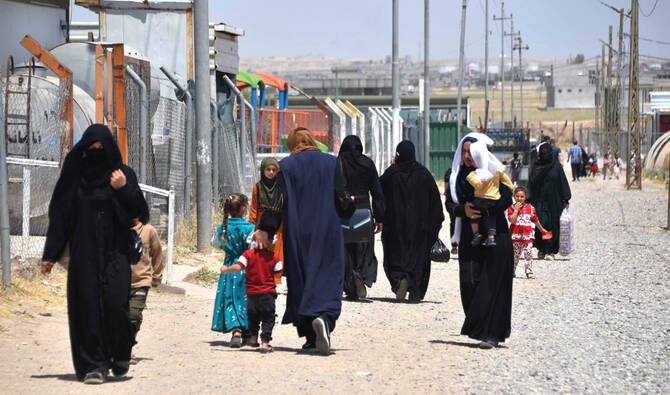

MOSUL: After years in a Syrian detention camp, Ibrahim Darwish was relieved to be allowed to return home to Iraq, but his joy was quickly punctured by the harsh reality that he had to disown his sons accused of being militants.
“All I wanted was to return to Iraq,” the 64-year-old said of his time in the Kurdish-controlled Al-Hol camp, where family members of suspected Daesh fighters are held in prison-like conditions alongside refugees and displaced people.
But back home in Iraq, “I had to disown my sons. My house is gone,” he said. “I am back to square one.”
Thousands of Iraqi returnees from the camp have faced major obstacles reintegrating into their communities, their perceived affiliation with Daesh casting a dark shadow over their prospects.
They described armed groups and local authorities in some areas pressuring returnees to cut ties with relatives suspected of Daesh links as a precondition for going home or obtaining essential documents.
A lawyer for many returnees equated the pledges of disownment to denunciations, “essentially complaints by one family member against another.”
He also warned of a widespread misconception among returnees that they must comply in order to obtain identity cards and other government papers.
But a senior Iraqi official insisted that the authorities supported reintegration, including when it came to the issuance of documents.
Requesting “disownment statements has become illegal, and anyone who asks for it should be reported,” the official said.
Darwish said he was allowed to leave Al-Hol after receiving Iraqi security clearance and support from his tribal leader.
Back in Iraq, he spent the first several months at Al-Jadaa camp, presented by the authorities as a “rehabilitation” center where returnees wait for further permission to return home.
There, “we felt the most welcome,” Darwish said.
But when it was time to go home to Salaheddin province, Darwish said local authorities told him he first had to disown his sons, who are locked away on suspicion of joining Daesh — a charge he denies.
Reluctantly, he complied.
Otherwise, “how was I going to farm my land and make ends meet?” he said.
In the northern city of Mosul, one woman in her thirties said she was afraid to return to her hometown in Salaheddin, where her father was arrested upon his arrival and later passed away in prison.
She is currently squatting with her sister and children in a dilapidated house, living in fear of eviction.
When the family first returned to Iraq, she said, people “looked at us differently, just because we came from Al-Hol.”
Now her concern is obtaining new identity cards, which are essential for accessing healthcare, education and employment, and she fears she will have to disown her husband to do so.
The authorities, she said, “did well” by bringing them back from Al-Hol, where many speak of increased violence, but they must now solve the issue of reintegration.
“We need them to support us so we can stand on our feet,” she added.
Thanassis Cambanis, director of New York-based Century International, said the returnees “face a murky future,” especially since some of those tarred as Daesh families are denied documentation.
“At a minimum, collective punishment of the Daesh families is an injustice and a moral error,” Cambanis warned.
“At a maximum, Iraq’s policy creates a ripe pool of potential recruits for violent sectarian extremists.”
While many countries refuse to repatriate their nationals from Al-Hol, Baghdad has so far brought back around 17,000 people, mostly women and children.
Local and international organizations facilitated reintegration. The Global Community Engagement and Resilience Fund, a Geneva-registered organization that focuses on preventing extremism, supports several centers that have so far assisted around 6,000 returnees.
According to the fund’s Kevin Osborne, the centers provide services such as psychosocial support and vocational training.
But the growing number of returnees requires “expanded support to adequately prepare communities and enable smooth, sustainable reintegration,” Osborne said.
Noran Mahmood, of the GCREF-supported Iraqi Institution for Development, said many returnees fear “society’s refusal” to welcome them, as if having spent time in Al-Hol is a “disgrace.”
Her organization in Mosul provides counselling for the many returnees who suffer from depression, insomnia and anxiety.
Rahaf, 24, is one of the many women receiving help after years of accumulated trauma.
With the organization’s assistance, she achieved her long-held dream of furthering her education, enrolling in middle school.
“I feel successful,” she said. “I want to become a lawyer or a teacher.”


