Blast claimed by Daesh kills four in northwest Pakistan

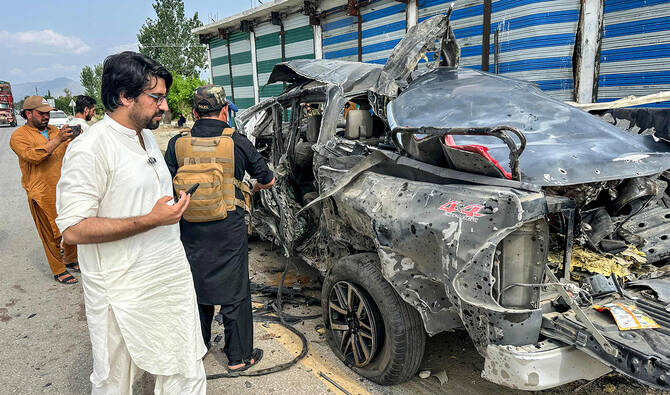
Local residents gather beside the wreckage of a vehicle after a blast in Bajaur, Khyber Pakhtunkhwa province, on July 2, 2025. (AFP)
Short Url
Updated 03 July 2025
Follow

Blast claimed by Daesh kills four in northwest Pakistan

  • Officials were traveling in a car in Khyber Pakhtunkhwa province when attack happened in a market in Bajaur city
  • Around 300 people, mostly security officials, have been killed in attacks in KP and Balochistan provinces since start of year

PESHAWAR: An explosion in northwest Pakistan killed at least four local government officials and police Wednesday, an officer told AFP, in an attack claimed by a branch of the Daesh group.

“One senior government official, along with another government official and two police officers, were killed in the attack. Eleven people were wounded,” said Waqas Rafiq, a senior police official stationed in Bajaur, a city near the border with Afghanistan.

The officials were traveling in a car in Khyber Pakhtunkhwa province when “the attack happened in a market in Bajaur city,” Rafiq added.

Hours later the IS-K group of Daesh claimed to have detonated an explosives-laden moped that targeted the vehicle in which the officials were traveling.

The deadly blast came four days after 16 soldiers were killed in the same province in an attack claimed by the Pakistan Taliban, a group which is very active in the area.

Around 300 people, mostly security officials, have been killed in attacks since the start of the year by armed groups fighting the government in both Khyber Pakhtunkhwa and Balochistan provinces, according to an AFP tally.

Last year was the deadliest in a decade for Pakistan, with a surge in attacks that killed more than 1,600 people, according to Islamabad-based analysis group the Center for Research and Security Studies.

Pakistan has witnessed a sharp rise in violence in its regions bordering Afghanistan since the Taliban returned to power in Kabul in 2021, with Islamabad accusing its western neighbor of allowing its soil to be used for attacks against Pakistan — a claim the Taliban denies.


Pakistan says defense pact with Saudi Arabia elevated brotherly ties to ‘new heights’

Updated 6 sec ago
Follow

Pakistan says defense pact with Saudi Arabia elevated brotherly ties to ‘new heights’

  • Pakistan, Saudi Arabia signed strategic defense pact last year pledging aggression against one will be treated as attack on both
  • Deputy PM Ishaq Dar says enduring bonds with Islamic and Arab nations form vital pillar of Pakistan’s foreign policy 

ISLAMABAD: Deputy Prime Minister Ishaq Dar said on Wednesday that Pakistan’s defense pact with Saudi Arabia elevated its brotherly ties with the Kingdom to “new heights,” stressing that close ties with Arab and Islamic nations form a key pillar of Islamabad’s foreign policy. 

Pakistan and Saudi Arabia signed a Strategic Mutual Defense Agreement on Sept. 17 last year, pledging that aggression against one country would be treated as an attack on both, enhancing joint deterrence and formalizing decades of military and security cooperation.

Both nations agreed in October 2025 to launch an economic cooperation framework to strengthen trade and investment ties. 

“In the Middle East, our landmark Strategic Mutual Defense Agreement with Saudi Arabia has elevated our brotherly ties to new heights,” Dar said while speaking at the Pakistan Governance Forum 2026 event in Islamabad. 

The Pakistani deputy prime minister was speaking on the topic “Navigating International Relations Amidst Changing Geo-Politics.”

Dar noted that Pakistan has reinforced partnerships with other Middle Eastern nations such as the UAE, Qatar, Jordan, Oman, Egypt and Bahrain. He said these partnerships have yielded “concrete agreements” in investment, agriculture, infrastructure, and energy sectors. 

“Our enduring bonds with Islamic and Arab nations form a vital pillar of our foreign policy, and we will continue to expand our partnerships across Asia, Latin America, and Africa,” he said. 

Dar pointed out that the presidents of Kazakhstan, Uzbekistan and Kyrgyzstan have undertaken visits to Pakistan in recent months, reflecting Central Asian nations’ desire to boost cooperation with Islamabad.

On South Asia, the Pakistani deputy PM said Pakistan has successfully transformed its fraternal ties with Bangladesh into “a substantive partnership.”

“Similarly, the trilateral mechanism involving China, Pakistan, and Bangladesh has been launched with a view to expanding and deepening regional cooperation and synergy,” the Pakistani minister said. 

He said Islamabad has strengthened its “all-weather” partnership with China via the second phase of the multi-billion-dollar China-Pakistan Economic Corridor agreement and “unwavering support” from both sides for each other’s core interests. 

Dar said Pakistan had also reinvigorated its partnership with the US, advancing cooperation in trade, technology, investment, and regional stability. 

“This calibrated approach has enhanced our ability to navigate complexity with skill and confidence, ensuring that our national interests are served without compromising our core foreign policy principles,” he said.