

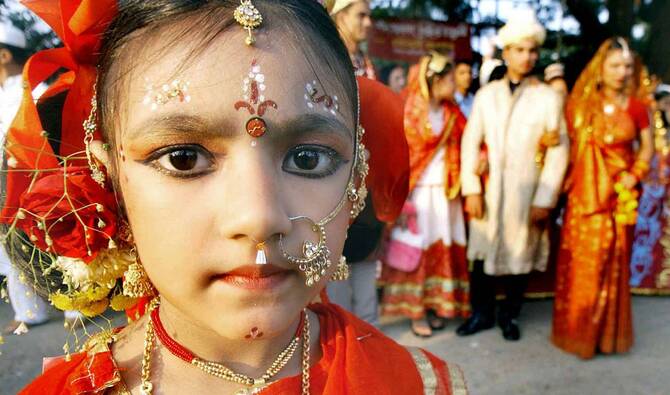

DHAKA: The child marriage rate continues to rise since the COVID-19 pandemic, experts warn, as the latest UN data shows that more than half of Bangladeshi women are married before reaching adulthood — the highest percentage in the whole South Asia.
Bangladesh has long had one of the world’s highest rates of child marriage and, unlike other countries in the region, for the past few years has seen the situation worsening.
According to the annual report of the UN Population Fund released last month, 51 percent of Bangladeshi girls are found to have been married before turning 18 — the legal age for marriage.
The rate was significantly lower, at 29 percent in nearby Afghanistan, 23 percent in India, and 18 percent in Pakistan.
“Among South Asian countries, we are in a poor position when it comes to child marriage rates, even though we perform better on some other gender-related indicators set by the UN,” Rasheda K. Chowdhury, social activist and executive director of the Campaign for Popular Education, told Arab News.
“Before the COVID-19 pandemic, the child marriage rate in the country was around 33 percent. At that time, we were not the worst in South Asia in this regard. However, the pandemic disrupted everything.”
Data from the Bangladesh Bureau of Statistics shows a steady increase in child marriage rates of several percent a year since 2020 — coinciding with coronavirus lockdowns, which exacerbated poverty, disrupted education, and increased household stress.
“Our research found that COVID-19 increased poverty, interrupted education for both boys and girls, and worsened malnutrition. In this context, many guardians from underprivileged communities chose to marry off their daughters in hopes of reducing the financial burden on their families,” Chowdhury said.
“Poverty is the primary driver of early marriages, as many guardians are unable to cope with household expenses. As a result, they often choose to marry off their daughters at a young age.”
Lack of women’s access to education is usually seen as the main reason behind high child marriage rates, but Bangladesh has the highest enrollment of girls in secondary school in the whole region.
“Bangladesh has invested much in infrastructure development rather than human development,” Chowdhury said.
“To prevent early marriages, society must play a crucial role. The government alone cannot act as a watchdog in every household. Local communities need to take initiative and actively work to stop child marriages.”
Azizul Haque, project manager at World Vision Bangladesh, also saw the problem as related to social awareness.
“In the villages and remotest parts of the country, girls are mostly considered a burden for the family, so the parents prefer to marry off the girls as soon as possible ... In many of the remotest areas, there are schools that provide education only up to class eight, so after the completion of their eighth grade in school, many of the girls have nothing to do at home. This situation also triggers the increase in child marriages,” he said.
“There is a huge lack of social awareness. At the national level, we need to strengthen the mass campaign conveying the demerits of early marriages, so that everyone becomes aware of the negative impacts.”


