Trump envoy arrives in Kyiv as US pledges Patriot missiles to Ukraine

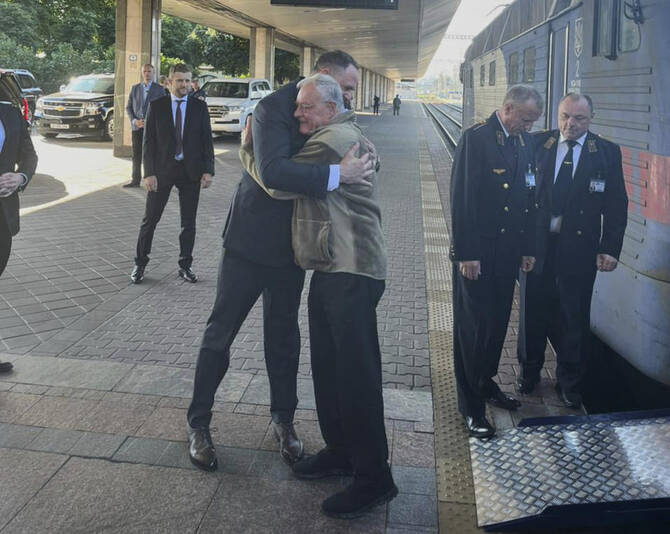
Andriy Yermak, the head of Ukraine’s Presidential Office, left, meets with United States Special Envoy for Ukraine and Russia, Joseph Keith Kellogg, at a train station in Kyiv, Ukraine on July 14, 2025. (Ukrainian Presidential Press Office via AP)
Short Url
Updated 14 July 2025
Follow

Trump envoy arrives in Kyiv as US pledges Patriot missiles to Ukraine

  • Donald Trump last week teased that he would make a ‘major statement’ on Russia on Monday
  • US leader made quickly stopping the Russia-UKraine war one of his diplomatic priorities

KYIV: US President Donald Trump’s special envoy to Ukraine and Russia, retired Lt. Gen. Keith Kellogg, arrived in Kyiv on Monday, a senior Ukrainian official said, as anticipation grew over a possible shift in the Trump administration’s policy on the more than three-year war.

Trump last week teased that he would make a “major statement” on Russia on Monday. Trump made quickly stopping the war one of his diplomatic priorities, and he has increasingly expressed frustration about Russian President Vladimir Putin’s unbudging stance on U.S-led peace efforts.

Putin “talks nice and then he bombs everybody,” Trump said late Sunday, as he confirmed the US is sending Ukraine badly needed US-made Patriot air defense missiles to help it fend off Russia’s intensifying aerial attacks.

Russia has spread terror in Ukrainian cities, including the capital, Kyiv, with hundreds of drones and cruise and ballistic missiles that Ukraine’s air defenses are struggling to counter. June brought the highest monthly civilian casualties of the past three years, with 232 people killed and 1,343 wounded, the UN human rights mission in Ukraine said Thursday. Russia launched 10 times more drones and missiles in June than in the same month last year, it said.

That has happened at the same time as Russia’s bigger army is making a new effort to drive back Ukrainian defenders on parts of the 1,000-kilometer frontline.

A top ally of Trump, Republican Sen. Lindsey Graham of South Carolina, said Sunday that the conflict is nearing an inflection point as Trump shows growing interest in helping Ukraine fight back against Russia’s full-scale invasion. It’s a cause that Trump had previously dismissed as being a waste of US taxpayer money.

“In the coming days, you’ll see weapons flowing at a record level to help Ukraine defend themselves,” Graham said on CBS’ “Face the Nation.” He added: “One of the biggest miscalculations (Russian President Vladimir) Putin has made is to play Trump. And you just watch, in the coming days and weeks, there’s going to be a massive effort to get Putin to the table.”

Also, NATO Secretary-General Mark Rutte was due in Washington on Monday and Tuesday. He planned to hold talks with Trump, Secretary of State Marco Rubio and Defense Secretary Pete Hegseth, as well as members of Congress.

Talks during Kellogg’s visit to Kyiv will cover “defense, strengthening security, weapons, sanctions, protection of our people and enhancing cooperation between Ukraine and the United States,” said the head of Ukraine’s presidential office, Andrii Yermak.

“Russia does not want a cease fire. Peace through strength is President Donald Trump’s principle, and we support this approach,” Yermak said.

Russian troops conducted a combined aerial strike at Shostka, in the northern Sumy region of Ukraine, using glide bombs and drones early Monday morning, killing two people, the regional prosecutor’s office said. Four others were injured, including a 7-year-old, it said.

Overnight from Sunday to Monday, Russia fired four S-300/400 missiles and 136 Shahed and decoy drones at Ukraine, the air force said. It said that 61 drones were intercepted and 47 more were either jammed or lost from radars mid-flight.

The Russian Defense Ministry, meanwhile, said its air defenses downed 11 Ukrainian drones over Russian regions on the border with Ukraine, as well as over the annexed Crimea and the Black Sea.


Suspect in Brown University shooting and MIT professor’s killing was once a physics student

Updated 4 sec ago
Follow

Suspect in Brown University shooting and MIT professor’s killing was once a physics student

PROVIDENCE, R.I.: Thirty years ago, Claudio Neves Valente and Nuno F.G. Loureiro were classmates with bright futures. Both excelled in physics and made their way from their home country of Portugal to the US, settling on the campuses of prestigious East Coast universities.
But Neves Valente’s path took a darker turn than his former peer. Investigators say the 48-year-old fatally shot two students last week at Brown University in Providence, where he was a graduate student in the early 2000s, and later killed Loureiro, who led one of the largest laboratories at the Massachusetts Institute of Technology.
Authorities have offered no motive for the shootings or elaborated on what, if any, history was between the two men.
Neves Valente was found dead Thursday from a self-inflicted gunshot wound at a New Hampshire storage facility, ending a search that started with last Saturday’s shooting in a Brown lecture hall, where nine other people were also wounded. Authorities believe that on Monday, two days after the Brown shooting, Neves Valente shot Loureiro at the professor’s home in the Boston suburbs, about 50 miles (80 kilometers) from Providence. An autopsy found Neves Valente died Tuesday.
In high school, Neves Valente had been a promising physics student, but he was let go from Portugal’s premier engineering school, Instituto Superior Técnico, in 2000 and withdrew from a Brown University graduate program three years later without a degree.
Before his death, he was renting a room in a home in a working class Miami neighborhood, the past two decades of his life a mystery. What he was doing for a job was unclear. One witness to the Brown shooting noted he was wearing the kinds of pants and shoes that are typical of restaurant workers.

Neves Valente and Loureiro were in the same academic program in Portugal
Neves Valente was born in Torres Novas, Portugal, about 75 miles (121 kilometers) north of Lisbon. As a high school student, he competed in a national physics competition in 1994, coming in third place, according to a Portuguese physics magazine. Five of the top finishers got to compete in an international competition the following year in Australia.
From 1995 to 2000, he was in the same physics program in Lisbon with Loureiro, federal prosecutor Leah B. Foley said. Loureiro graduated from Instituto Superior Técnico in 2000, according to his MIT faculty page. A termination notice from the Lisbon university’s then president shows that Neves Valente was let go from a position at Instituto Superior Técnico that same year.

Neves Valente was a graduate student at Brown
Neves Valente came to Brown that fall as a graduate student on a student visa. Brown University President Christina Paxson said he took a leave in 2001 and formally withdrew effective July 31, 2003.
Around that time, he posted on the Brown physics website that he was back home in Portugal and had dropped out of the program permanently, according to a webpage saved by the Internet Archive. Then in Portuguese, he added: “And the moral of the story is: The best liar is the one who manages to deceive himself. These exist everywhere, but at times they proliferate in more unexpected places.”
During his time at Brown, he enrolled only in physics classes. Paxson said it is likely that he would have taken courses and spent time at the building where the shooting occurred because that’s where the vast majority of physics courses take place.
Paxson said Brown found no indication of any public safety interactions or other concerns while Neves Valente was a student.
“As of yet, we have not identified any employee who recalls Neves Valente nor is there any Brown record of recent contact between this individual and Brown,” Paxson said.

Brown classmate says Neves Valente was ‘genuinely impressive’
A former classmate of Neves Valente at Brown, Syracuse University professor Scott Watson, recalled being “essentially his only friend” in the graduate program in physics. Over dinners at a Portuguese restaurant near campus, Neves Valente shared his frustrations.
“He would say the classes were too easy — honestly, for him they were. He already knew most of the material and was genuinely impressive,” Watson said.
When Neves Valente decided to leave, Watson encouraged him to stay but to no avail. He said he never saw or heard from Neves Valente again.

Renting a room outside Miami
In September 2017, Neves Valente obtained legal permanent residence status in the US, Foley said. It was not immediately clear where he was between taking a leave of absence from the school in 2001 and getting the visa in 2017.
His last known address was about 10 miles (16 kilometers) north of Miami. The yellow house with a red roof is in a working-class neighborhood that features large houses.
Some neighbors who talked with The Associated Press on Friday said they had never seen Neves Valente. No police were in sight.
Edward Pol, a race car mechanic who lives across the street from the home, said the owner rents some rooms to people. He said he never talked to Neves Valente but had seen him several times, most recently two or three months ago. He realized the man was the suspect when he saw his pictures on the news Friday morning.
A man who answered the door through an intercom at the home said he was the homeowner but declined to identify himself or make any comment.

Loureiro was excelling
While Neves Valente’s life remained a mystery, his former classmate Loureiro was excelling. Loureiro joined MIT in 2016 and was named last year to lead the school’s Plasma Science and Fusion Center, one of its largest laboratories. The 47-year-old scientist from Viseu, Portugal, had been working to explain the physics behind astronomical phenomena such as solar flares.
Portugal’s top diplomat said Friday that the government was taken aback by revelations that a Portuguese man is the main suspect.
There are still “a lot of unknowns” in regard to motive, Rhode Island Attorney General Peter Neronha said. “We don’t know why now, why Brown, why these students and why this classroom.”