

Syrian, Israeli officials meet in Baku: Diplomatic source in Damascus

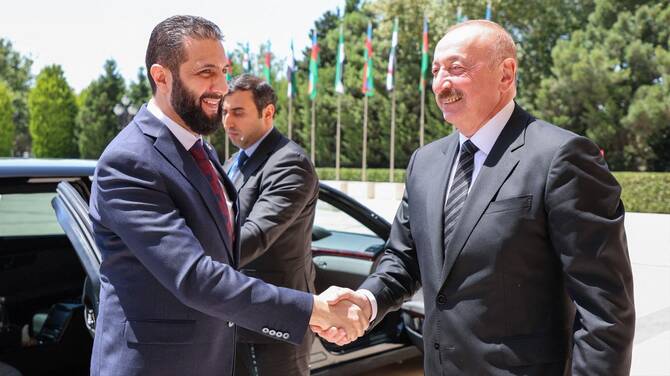
This handout picture released by the Syrian Presidency shows Azerbaijan’s President Ilham Aliyev (R) receiving Syria’s interim President Ahmed Al-Sharaa in Baku on July 12, 2025. (AFP via handout Syrian Presidency)
Short Url
Updated 12 July 2025
Follow

Syrian, Israeli officials meet in Baku: Diplomatic source in Damascus

  • Meeting marked major step for two countries which have been foes for decades

DAMASCUS: A Syrian and an Israeli official met face to face in Baku Saturday on the sidelines of a visit to Azerbaijan by President Ahmed Al-Sharaa, a diplomatic source in Damascus said.

The meeting marked a major step for the two countries which have been foes for decades, and comes after Israel initially cold-shouldered Al-Sharaa’s administration as jihadist because of his past links to Al-Qaeda.

“A meeting took place between a Syrian official and an Israeli official on the sidelines of Al-Sharaa’s visit to Baku,” the source said, requesting anonymity because of the sensitivity of the issue.

Israel is a major arms supplier to Azerbaijan and has a significant diplomatic presence in the Caucasus nation which neighbors its arch foe Iran.

Al-Sharaa himself did not take part in the meeting, which focused on “the recent Israeli military presence in Syria,” the source added.

After the overthrow of longtime ruler Bashar Assad in December, Israel carried out hundreds of air strikes in Syria to prevent key military assets falling into the hands of the Islamist-led interim administration headed by Al-Sharaa.

It also sent troops into the UN-patrolled buffer zone that used to separate the opposing forces in the strategic Golan Heights, from which it has conducted forays deeper into southern Syria.

Al-Sharaa has said repeatedly that Syria does not seek conflict with its neighbors, and has instead asked the international community to put pressure on Israel to halt its attacks.

His government recently confirmed that it had held indirect contacts with Israel seeking a return to the 1974 disengagement agreement which created the buffer zone.

Late last month, Foreign Minister Gideon Saar said Israel was interested in striking a peace and normalization agreement with Syria.

A Syria government source quoted by state media responded that such talk was “premature.”

But during a visit to Lebanon this week, US special envoy to Syria Tom Barrack said: “The dialogue has started between Syria and Israel.”

After meeting Al-Sharaa in Riyadh in May, US President Donald Trump told reporters he had expressed hope that Syria would join other Arab states which normalized their relations with Israel.

“(Al-Sharaa) said yes. But they have a lot of work to do,” Trump said.

During his visit to Baku, Al-Sharaa held talks with his counterpart Ilham Aliyev, the two governments said.

Azerbaijan announced it would begin exporting gas to Syria via Turkiye, a key ally of both governments, a statement from the Azerbaijani presidency said.


Gaza needs unrestricted access to aid, Qatar PM tells Davos

Qatar’s Prime Minister and Minister for Foreign Affairs Sheikh Mohammed bin Abdulrahman bin Jassim Al-Thani speaks during WEF.
Updated 14 sec ago
Follow

Gaza needs unrestricted access to aid, Qatar PM tells Davos

LONDON: Humanitarian aid for Gaza is still being restricted, and Qatar is working with its partners to ensure that changes, the country’s prime minister told Davos on Tuesday.

“The humanitarian situation (in Gaza) may be better than last year, but it still needs a lot of intervention. A lot of humanitarian aid is still not allowed to enter because of restrictions, and we need to have unrestricted access for humanitarian aid for the people,” Sheikh Mohammed bin Abdulrahman told President and CEO of the World Economic Forum Borge Brende.

“We are working together very closely with our colleagues in the United States, Egypt, and Turkiye in order to ensure that there is a mechanism that supports the technocratic government that’s just been established in Gaza, in order to enable them to help the people and deliver a better life for the people,” he said.

The premier’s comments come a week after US Envoy Steve Witkoff announced the start of phase two of President Donald Trump’s plan to end the war in Gaza, with a technocratic Palestinian government established in the territory.

The 15-member Palestinian body will be headed by Ali Shaath, a former deputy minister in the Palestinian Authority, according to a joint statement by mediators Egypt, Qatar and Turkiye.

On Friday, an official from the UN Office for the Coordination of Humanitarian Affairs said that the humanitarian crisis in Gaza is far from over.

“For the Palestinians in Gaza, their lives continue to be defined by displacement, trauma, uncertainty, and deprivation,” Olga Cherevko said.

She said that aid restrictions are preventing Gazans from accessing the help that they desperately need.

“Due to various impediments and restrictions placed on organizations operating in Gaza and specific types of supplies that could enter, we could basically only apply Band-Aids to a wound that can only be closed with proper care,” she said.

Restrictions on both aid agencies and critical supplies must be lifted, early recovery must be funded and enabled, and donor support must continue, Cherevko added.

Speaking about the situation in the Syrian Arab Republic, Sheikh Mohammed said that the country had been through a very difficult 15 years and that such turmoil would always have consequences.

“We know that it’s not easy to come to a country after a civil war and to start rebuilding the institutions, state and systems. It’s a difficult job, and the Syrian government needs help, and they’ve been asking for this help, and we are all trying to help them reach that stage,” he said.

“The beauty of Syria is its diversity, the social fabric of Syria that has been there for centuries, not something new. I believe that everyone in Syria wants to see a stable Syria, wants to ensure that they are treated equally and their rights are protected, and it’s their right.”

The prime minister said the international community should help the Syrian government build a state, institutions and an inclusive system that extends to all Syrians.

“You cannot build a state without building a proper institutional system that includes everybody,” he said.

On Tuesday, the Syrian government announced a new four-day truce after a previous ceasefire between government forces and the Kurdish-led Syrian Democratic Forces broke down.

In a statement carried by state media, the Syrian presidency said that “a joint understanding has been reached between the Syrian government and the Syrian Democratic Forces on a number of issues concerning the future of Hasakah province,” adding that the SDF has “four days for consultations to develop a detailed plan” for the area’s integration, beginning at 8:00 p.m. on Tuesday.

It said that if the agreement is finalized, Syrian forces “will not enter the city centers of Hasakah and Qamishli … and Kurdish villages.”

Turning to the Qatari economy, the prime minister said the country is uniquely positioned when it comes to the supply of energy.

“This revolution that you see in AI and technology will require (energy) to power data centers that they will need. Qatar is at the center of this progress and development,” he said.

He added that the country aims ‌to help domestic ‌companies compete globally and is planning new platforms to support this effort later this year.