Emergency vaccines slash deaths by 60%

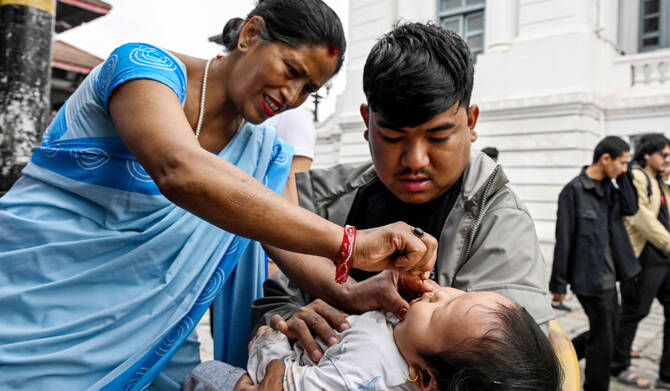
The study estimated that the immunization efforts carried out during the 210 outbreaks generated nearly $32 billion in economic benefits. (AFP)
Short Url
Updated 13 July 2025
Follow

Emergency vaccines slash deaths by 60%

  • ‘For the first time, we are able to comprehensively quantify the benefits of deploying vaccines against outbreaks,’ Gavi chief Sania Nishtar says

GENEVA: Emergency vaccination during outbreaks of diseases like cholera, Ebola and measles have over the past quarter-century reduced deaths from such illnesses by nearly 60 percent, according to a new study.

A similar number of infections are also believed to have been prevented, while billions of euros have been generated in estimated economic benefit.
The Gavi vaccine alliance, which backed the study, said it collaborated with researchers at Burnet Institute in Australia to provide the world’s first look at the historical impact of emergency immunization efforts on public health and global health security.

HIGHLIGHTS

• Vaccination was shown to decrease deaths during yellow fever outbreaks by a full 99 percent, and 76 percent for Ebola.

• At the same time, emergency vaccination significantly reduced the threat of outbreaks expanding.

• The study estimated that the immunization efforts carried out during the 210 outbreaks generated nearly $32 billion.

“For the first time, we are able to comprehensively quantify the benefit, in human and economic terms, of deploying vaccines against outbreaks of some of the deadliest infectious diseases,” Gavi chief Sania Nishtar said in a statement.
“This study demonstrates clearly the power of vaccines as a cost-effective countermeasure to the increasing risk the world faces from outbreaks.”
The study, published this week in the British Medical Journal Global Health, examined 210 outbreaks of five infectious diseases — cholera, Ebola, measles, meningitis and yellow fever — in 49 lower-income countries between 2000 and 2023.
Vaccine roll-outs in these settings had a dramatic impact, with the study showing they reduced both the number of infections and deaths by almost 60 percent across the five diseases.
For some of the diseases the effect was far more dramatic.
Vaccination was shown to decrease deaths during yellow fever outbreaks by a full 99 percent, and 76 percent for Ebola.
At the same time, emergency vaccination significantly reduced the threat of outbreaks expanding.
It also estimated that the immunization efforts carried out during the 210 outbreaks generated nearly $32 billion in economic benefits just from averting deaths and years of life lost to disability.
That amount was however likely to be a significant underestimate of overall savings, it said, pointing out that it did not take into account outbreak response costs or the social and macro-economic impacts of disruptions created by large outbreaks.
The massive Ebola outbreak that hit West Africa in 2014, before the existence of approved vaccines, for instance saw cases pop up worldwide and is estimated to have cost the West African countries alone more than $53 billion.
The study comes after the WHO warned in April that outbreaks of vaccine-preventable diseases such as measles, meningitis, and yellow fever are on the rise globally amid misinformation and cuts to international aid.
Gavi, which helps vaccinate more than half the world’s children against infectious diseases, is itself currently trying to secure a fresh round of funding in the face of the global aid cuts and after Washington last month announced it would stop backing the group.


Muslim World League commits resources to help victims of Indonesia flooding

Updated 4 sec ago
Follow

Muslim World League commits resources to help victims of Indonesia flooding

  • Floods, landslides on Sumatra island killed more than 800 people and injured 4,200 others 
  • Al-Issa is in Jakarta this week for meetings with Indonesian officials, religious leaders

JAKARTA: The Muslim World League is ready to mobilize its resources to support relief efforts in Indonesia, its chief said on Friday during a visit to the Southeast Asian country, which was recently hit by its most devastating floods and landslides in decades.

At least 867 people were killed and more than 4,200 others injured after the disasters inundated three provinces on Indonesia’s Sumatra island in late November. 

More than 121,000 homes were destroyed and more than 1,100 public infrastructure sites were severely affected in about 50 cities and regencies in the region, where emergency support has been limited due to the collapse of roads and bridges. About 1.1 million people were displaced at one point and for days communities were cut off from basic supplies, power and communication. 

“I conveyed my sincere condolences to H.E. for the victims of the recent devastating floods and landslides across various regions of the Republic,” MWL Secretary-general Sheikh Mohammed bin Abdulkarim Al-Issa said on X, following his meeting with President Prabowo Subianto in Jakarta. 

“Furthermore, I confirmed the MWL’s commitment to mobilizing all its resources to provide relief and support to those impacted by this terrible calamity.”

Despite offers from several countries and international organizations, Indonesia is not accepting international humanitarian aid, as the central government has yet to declare the Sumatra floods a national emergency,

Al-Issa arrived in Jakarta on Wednesday at the invitation of the Indonesian government for meetings with officials and religious leaders. 

On Saturday, he is scheduled to attend talks on interreligious harmony alongside Indonesian Religious Affairs Minister Nasaruddin Umar. 

The MWL is an international non-government Islamic organization founded in Saudi Arabia in 1962. Its work is focused on promoting and clarifying the worldwide understanding of Islam, with headquarters in Makkah and offices around the world.

Din Syamsuddin, former chairman of Indonesia’s second-biggest Muslim group, Muhammadiyah, told Arab News that Al-Issa’s visit brought a “positive message” to promote global unity in the Muslim world. 

“We see the visit as an appreciation for Indonesia as the world’s largest Muslim-majority country, where there is unity and harmony amid religious and ethnic diversity,” he said. 

“In the context of the visit of the secretary-general of the Muslim World League, from Indonesia we would like to call on Muslims around the world to unite. (The MWL) has a strategic and central role to play for this purpose.”