

UK police arrest more than 70 protesters for allegedly supporting banned Palestine Action group

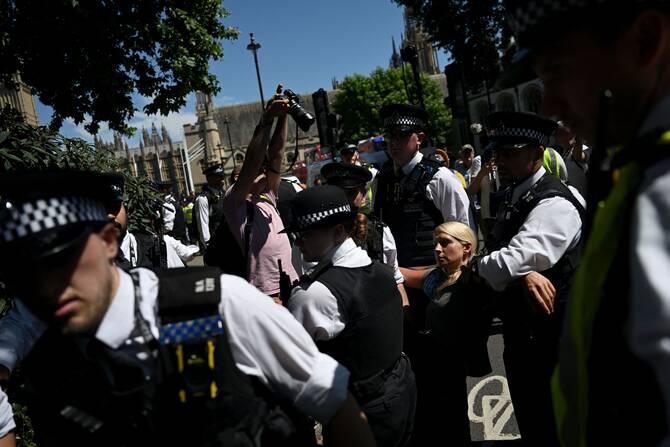
Protester is carried away after being arrested as people gather in support of the pro-palestinian group “Palestine Action,” in Parliament Square, London on July 12, 2025, following the Home Secretary’s decision to proscribe the group under anti-terror laws. Police have warned that expressing support for Palestine Action would be a criminal offense after the ban kicked in last weekend. (AFP)
Short Url
Updated 13 July 2025
Follow

UK police arrest more than 70 protesters for allegedly supporting banned Palestine Action group

  • Protest marked second consecutive weekend of arrests over alleged references to the proscribed organization

LONDON: More than 70 people were arrested Saturday at protests in the UK against the Palestine Action group being proscribed a terrorist organization by the British government following a break-in and vandalism at a Royal Air Force base.

In London, the Metropolitan Police arrested 42 people during a protest in Parliament Square. All but one of the arrests were for showing support for a proscribed organization, which police have said includes chanting, wearing clothing or displaying articles such as flags, signs or logos. Another person was arrested for common assault.

Sixteen more arrests were made in Manchester, according to Greater Manchester Police, while South Wales Police said 13 people were also held in Cardiff.

The protests marked the second consecutive weekend of arrests over alleged references to the proscribed organization. Its outlawing has meant support for the organization is deemed a criminal offense. Police arrested 29 people at a similar protest last weekend.

The demonstration was part of a coordinated campaign by the group Defend Our Juries, which held simultaneous actions in other UK cities including Manchester, Cardiff, and Derry.
 

Defend Our Juries said on X: “Over 300 police officers have been seen to carry away dozens of people from the foot of statues of Nelson Mandela and Gandhi for alleged ‘terrorism offences’. Those arrested are accused of holding signs in support of Palestine Action.”

Officers were seen cordoning off demonstrators, searching their bags, inspecting ID cards, and seizing signs. Some protesters lay atop one another as police moved in to confiscate their placards. The demonstrators’ signs reportedly included messages such as: “I oppose genocide. I support Palestine Action.” 

The protest comes days after the UK government’s controversial decision to ban Palestine Action under the Terrorism Act.

The move followed an incident in which activists allegedly broke into RAF Brize Norton and defaced two military aircraft with spray paint.

The ban was announced by Home Secretary Yvette Cooper in late June and formally approved by MPs last Wednesday.

The House of Lords backed the decision without a vote the following day. It marks the first time a direct action protest group has been proscribed under terrorism legislation in the UK, placing Palestine Action in the same legal category as Hamas, al-Qaeda, and Islamic State.

Under the new law, supporting or promoting the group now carries a prison sentence of up to 14 years.

Palestine Action is known for its campaigns targeting Israeli and Israeli-linked businesses in Britain, particularly defense firm Elbit Systems.


A protester is carried away after being arrested as people gather in support of the pro-Palestinian group "Palestine Action", in Parliament Square, London on July 12, 2025. (AFP)

Its protests have included blocking entrances, damaging property, and spraying buildings with red paint to symbolise blood.

Critics of the ban say the government is conflating protest with terrorism and suppressing legitimate dissent.

In a failed legal challenge to the proscription, a lawyer for Palestine Action argued the government’s move marked “the first time Britain had proscribed a group which undertook this type of direct action.”


Police officers carry a detained demonstrator, during a protest calling for the de-proscription of the Palestine Action group, in Manchester, Britain, on July 12, 2025. (REUTERS)

UN experts, human rights organisations, cultural figures, and hundreds of lawyers have also voiced alarm over the decision, warning it sets a dangerous precedent for criminalizing civil disobedience.

Saturday’s demonstration echoed scenes from the previous weekend, when 29 protesters, including 83-year-old former priest Rev Sue Parfitt, were arrested at a similar gathering in Parliament Square.

In Manchester, police also made arrests at a protest in support of Palestine Action, while peaceful demonstrations took place in Cardiff and Derry.

The controversy surrounding Palestine Action’s ban comes amid heightened tensions over the war in Gaza, where the International Court of Justice in The Hague is hearing a case brought by South Africa accusing Israel of committing genocide against Palestinians. Israel denies all allegations of wrongdoing.

( With Agencies )


US and Ukraine ‘a lot closer’ on peace deal, Trump says after meeting with Zelensky

Updated 58 min 14 sec ago
Follow

US and Ukraine ‘a lot closer’ on peace deal, Trump says after meeting with Zelensky

  • Zelensky sees agreement on security guarantees for Ukraine
  • Hurdles to a comprehensive peace deal remain
  • Trump spoke with Putin ahead of meeting on Sunday

PALM BEACH, Florida: US President Donald Trump said on Sunday that he and Ukrainian President Volodymyr Zelensky were “getting a lot closer, maybe very close” to an agreement to end the war in Ukraine, though both leaders acknowledged that ​some of the thorniest details remain unresolved.
The two leaders spoke at a joint press conference late Sunday afternoon after meeting at Trump’s Mar-a-Lago resort in Florida. Trump said it will be clear “in a few weeks” whether negotiations to end the war will succeed.
Zelensky said an agreement on security guarantees for Ukraine has been reached. Trump was slightly more cautious, saying that they were 95 percent of the way to such an agreement, and that he expected European countries to “take over a big part” of that effort with US backing.
Zelensky has said previously that he hopes to soften a US proposal for Ukrainian forces to withdraw completely from the Donbas region of eastern Ukraine, a Russian demand that would mean ceding some territory held by Ukrainian forces.
Both Trump and Zelensky said on Sunday the future of the Donbas had not been settled. “It’s unresolved, but it’s getting a lot ‌closer. That’s a ‌very tough issue,” Trump said.
Just before Zelensky and his delegation arrived at Trump’s Florida residence, Trump ‌and ⁠Russian ​President Vladimir ‌Putin spoke in a call described as “productive” by the US president and “friendly” by Kremlin foreign policy aide Yuri Ushakov.
Ushakov, in Moscow, said Putin told Trump a 60-day ceasefire proposed by the European Union and Ukraine would prolong the war. The Kremlin aide also said Ukraine needs to make a decision regarding the Donbas “without further delay.” And he said the Russian government had agreed to establish working groups to resolve the conflict that will focus on economic and security concerns.


Meeting follows Russian attacks on Kyiv
Zelensky arrived at Mar-a-Lago early Sunday afternoon, as Russian air raids pile pressure on Kyiv. Russia hit the capital and other parts of Ukraine with hundreds of missiles and drones on Saturday, knocking out power and heat in parts of Kyiv. Zelensky has described the weekend attacks ⁠as Russia’s response to the US-brokered peace efforts, but Trump on Sunday said he believes Putin and Zelensky are serious about peace.
The US president said he will call Putin again after meeting with Zelensky. Zelensky ‌had previously told journalists he plans to discuss the fate of the contested Donbas ‍region with Trump, as well as the future of the Zaporizhzhia nuclear ‍power plant and other topics.

Russia claims more battlefield advances 
Putin said on Saturday Moscow would continue waging its war if Kyiv did not seek ‍a quick peace. Russia has steadily advanced on the battlefield in recent months, claiming control over several more settlements on Sunday.
While Kyiv and Washington have agreed on many issues, the issue of what territory, if any, will be ceded to Russia remains unresolved. While Moscow insists on getting all of the Donbas, Kyiv wants the map frozen at current battle lines.
The US, seeking a compromise, has proposed a free economic zone if Ukraine leaves the area, although it remains unclear ​how that zone would function in practical terms.
US negotiators have also proposed shared control over the Zaporizhzhia nuclear plant. Power line repairs have begun there after another local ceasefire brokered by the International Atomic Energy Agency, the agency said on ⁠Sunday.
Russia controls all of Crimea, which it annexed in 2014, and since its invasion of Ukraine nearly four years ago has taken control of about 12 percent of its territory, including about 90 percent of the Donbas, 75 percent of the Zaporizhzhia and Kherson regions, and slivers of the Kharkiv, Sumy, Mykolaiv and Dnipropetrovsk regions, according to Russian estimates.
Putin said on December 19 that a peace deal should be based on conditions he set out in 2024: Ukraine withdrawing from all of the Donbas, Zaporizhzhia and Kherson regions, and Kyiv officially renouncing its aim to join NATO. Zelensky’s past encounters with Trump have not always gone smoothly, but Sunday’s meeting follows weeks of diplomatic efforts. European allies, while at times cut out of the loop, have stepped up efforts to sketch out the contours of a post-war security guarantee for Kyiv that the United States would support.
On Sunday, ahead of the Mar-a-Lago visit, Zelensky said he held a detailed phone call with British Prime Minister Keir Starmer. Trump and Zelensky will hold a phone call with European leaders at some point during the Florida meeting, Trump said. The 20-point plan was spun off from a Russian-led 28-point plan, which emerged from talks between US special envoy Steve Witkoff, Trump’s son-in-law Jared Kushner ‌and Russian special envoy Kirill Dmitriev, and which became public in November.
Subsequent talks between Ukrainian officials and US negotiators have produced the more Kyiv-friendly 20-point plan.