

UK students could face jail over support for banned Palestine Action

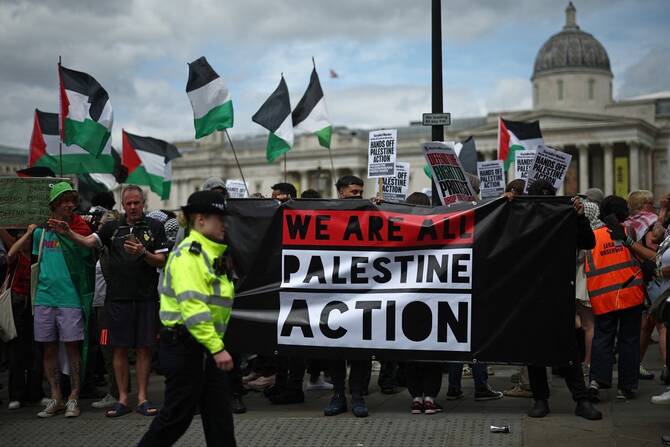
Police officers monitor protesters holding a banner during a protest in support of pro-Palestinian group Palestine Action, in Trafalgar Square. (File/AFP)
Short Url
Updated 10 July 2025
Follow

UK students could face jail over support for banned Palestine Action

  • Ex-govt advisor urges universities to warn students of penalties for supporting illegal organizations
  • Palestine Action proscribed as terrorist group after members broke into Royal Air Force base last month

LONDON: University students in the UK face jail if they support the group Palestine Action, the former government advisor on political violence and disruption has warned.

Lord Walney, who wrote a report in 2024 advising that the organization be proscribed, said vice-chancellors should let students know the penalties that could be incurred by promoting the group’s policies, displaying its symbols or voicing support for it.

Palestine Action was declared a terrorist organization earlier this month after activists filmed themselves breaking into a Royal Air Force base in England. 

On Monday, 29 people were arrested for supporting it at a protest in Westminster, with some holding placards stating: “I oppose genocide, I support Palestine Action.”

Penalties for membership of, or eliciting support for, proscribed groups in the UK include a maximum sentence of 14 years in prison.

Protests in support of the Palestinian cause and against Israel’s war in Gaza have been frequent features across numerous university campuses in the UK since the outbreak of hostilities in October 2023.

In a letter to Vivienne Stern, CEO of Universities UK — a body representing 142 higher education establishments — Walney claimed there was a “clear danger that individuals may be unwittingly lured into expressing support for an entity whose methods are not only criminal, but now formally recognised as terrorism,” and “Universities UK has an important role to play in protecting both freedom of expression and student welfare within the bounds of the law.”

He added: “Palestine Action’s deliberate strategy has long involved drawing students into criminal activity under the guise of legitimate protest, preying on the understandable sympathy for Palestinians felt by large numbers of young people to find recruits.

“With its formal proscription, the legal threshold has shifted: expressions of support, including wearing insignia, arranging meetings, or promoting the group’s activities — whether knowingly or through naivety — now risk serious sanction with students at risk of acquiring a criminal record for a terror offence.

“This risk clearly exists whatever any individual may think of the government’s decision to proscribe Palestine Action.

“My view is that the group’s systematic campaign of sabotage justifies proscription, given the fact that property damage is included in the legal definition of terrorism.”

UUK told The Times that it had “written to our member vice-chancellors to alert them to the fact that Palestine Action has been proscribed as a terrorist organisation under the Terrorism Act 2000, effective from Saturday July 5, and to their obligation to ensure that staff and students are aware of this.”


Tens of thousands attend funeral of killed Bangladesh student leader

Updated 3 sec ago
Follow

Tens of thousands attend funeral of killed Bangladesh student leader

  • Tens of thousands of mourners gathered in the Bangladeshi capital Dhaka on Saturday for the funeral of a student leader, after two days of violent protests over his killing
DHAKA: Tens of thousands of mourners gathered in the Bangladeshi capital Dhaka on Saturday for the funeral of a student leader, after two days of violent protests over his killing.
Huge crowds accompanied the funeral procession of Sharif Osman Hadi, a key figure in last year’s pro-democracy uprising who died in a hospital in Singapore on Thursday after being shot by masked gunmen while leaving a Dhaka mosque.
Police wearing body cameras were deployed in front of the parliament building where the funeral prayers were held.
Hadi’s body, which was brought to the capital on Friday, was buried at the central mosque of Dhaka University.
“We have not come here to say goodbye,” interim leader Muhammad Yunus said in an emotional speech.
“You are in our hearts and you will remain in the heart of all Bangladeshis as long as the country exists.”
Hadi, 32, was an outspoken critic of India and was set to contest the general elections in February.
Iqbal Hossain Saikot, a government employee who traveled from afar to attend the prayers, said Hadi was killed because he staunchly opposed India.
He will continue to live “among the millions of Bangladeshi people who love the land and its sovereign territory,” Saikot, 34, told AFP.
Hadi’s death has triggered widespread unrest, with protesters across the South Asian nation demanding the arrest of those responsible.
Late Thursday, people set fire to several buildings in Dhaka including the offices of leading newspapers Prothom Alo and the Daily Star.
Critics accuse the publications of favoring neighboring India, where Bangladesh’s ousted prime minister Sheikh Hasina has taken refuge since fleeing Dhaka in the wake of the 2024 uprising.
Rights group Amnesty International on Saturday urged Bangladesh’s interim government to carry out “prompt, thorough, independent and impartial” investigations into Hadi’s killing and the violence that followed.
It also expressed alarm over the lynching of Hindu garment worker Dipu Chandra Das following allegations of blasphemy.
Yunus said seven suspects had been arrested in connection with Das’s killing in the central district of Mymensingh on Thursday.